3D-printed hinges 93% lighter unfold satellite panels
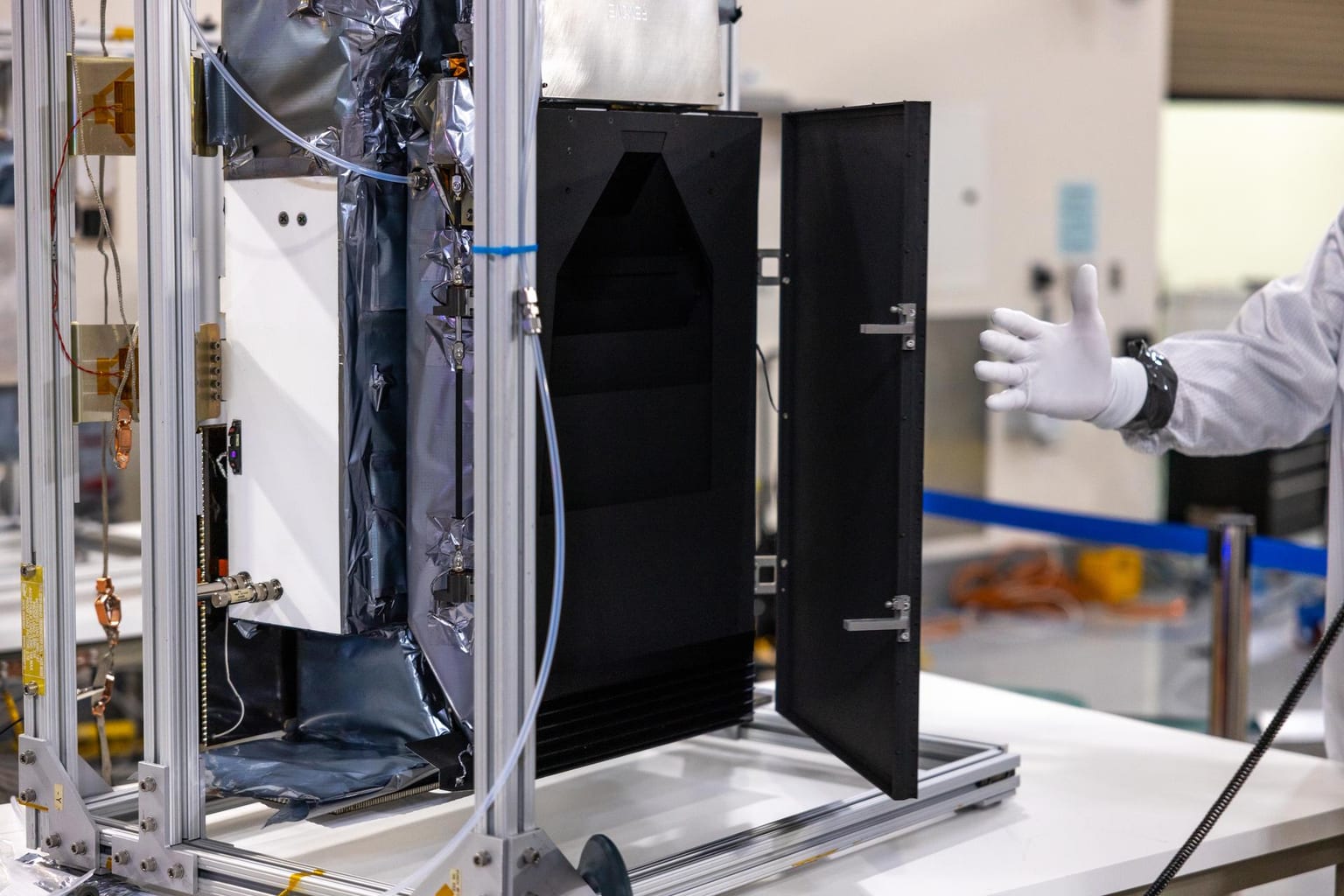
A folded solar panel has to open in orbit, and so far that opening has depended on heavy metal hinges and electromechanical mechanisms. At the Fraunhofer Institute for Applied Polymer Research (IAP) in Germany, researchers have printed a hinge that weighs 1.4 grams and is about 93% lighter than the conventional hinges used in satellite systems, according to the researchers. Heat does the work: a heating element raises the hinge from 73.4°F to 284°F, and the printed polymer returns to the shape it was programmed to take. Under controlled laboratory conditions, the deployment takes about 60 seconds.
The weight is the target. The page of the AM-SPACE project (Additive Manufacturing of Solar Panels for spACE applications), coordinated by German Orbital Systems, describes the electromechanical mechanism that unfolds a satellite as heavy and says it occasionally leads to failures. Its answer is to replace heavy metal hinges with memory plastics that connect the solar elements both mechanically and electrically. The material is a shape-memory polymer, programmed into a temporary shape and returning to its original form when heated. The team turned the polymers into filaments for 3D printing and made two kinds of parts: the hinges, and hold-down and release mechanisms, or HDRMs, which keep components locked during launch and free them in a controlled way once the spacecraft reaches orbit.
Printing is fast. A hinge or an HDRM takes about 15 minutes to print, then 30 more minutes to program its temporary shape. A separate 4D-printing method, which builds the shape-changing response into the part during fabrication, produces HDRMs in about five minutes. Unlike ordinary 3D printing, 4D printing gives a printed object a programmed response to an outside stimulus, here heat. The technology has passed initial laboratory validation, including cleanroom tests, thermal cycling and preliminary vacuum-chamber experiments, and one of the polymers passed outgassing tests run by Spain's National Institute for Aerospace Technology (INTA), which check whether a material releases gas in a vacuum. The components have not yet been tested in orbit, and their long-term reliability under real space conditions remains to be established.
The sources do not all tell the same story. A Fraunhofer IAP page announces a demonstrator for Formnext 2026 showing a hinge developed under the ProFIT Berlin-Brandenburg project, with the polymer adapted to spaceflight requirements; the page is cut off before its comparison with metal hinges. The dates of the project also differ: the AM-SPACE page gives 1 September 2023 to 31 August 2026, while the press report gives October 2023 to September 2026. A separate paper, indexed on ResearchGate, describes a fully 3D-printed 4D hinge built from shape-memory alloys and polymers, which expands by 1000% in under 40 seconds. That is a different design, and its figures cannot be set against the Fraunhofer hinge's 93%.
For a satellite builder, the immediate gain is mass at the hinge. The researchers say it could let satellites launch in a compact configuration and then deploy solar panels or antennas in orbit, and that it may enable other activatable components for small spacecraft. German Orbital Systems has said it is interested in evaluating the components in space. Discussions are under way for a possible follow-up project aimed at an in-orbit demonstration, but no date for a flight has been announced. The next step, if the follow-up project goes ahead, is that demonstration; until it flies, the 1.4-gram hinge remains a laboratory result, and its reliability in space is still to be shown.
Sources — read the originals(Paris time)
Pages consulted while writing
Read next
Comments
Loading the thread…
Sign in to leave a comment. Sign in