A Chinese carmaker's in-house chip takes the stage at TSMC's forum for the first time
November 17, 2026, Beijing. On the stage of TSMC's OIP Ecosystem Forum, the highest-profile annual event in chip design and advanced process technology, stood Xie Yan, Chief Technology Officer of Li Auto. Past speakers have mostly been computing giants such as Google and Meta. This year, sharing the stage were leading global chipmakers including Broadcom, Renesas and SK Hynix. Li Auto was the forum's only invited keynote speaker, and the first mainland Chinese company to take the stage since the event began. Xie was there to talk about the Mach M100, Li Auto's in-house chip.
Driver-assist features, meaning the intelligent driving functions of a vehicle, often seem hesitant at complex intersections, and one reason lies inside the chip. For decades, computers have mostly worked this way: the processor that computes and the memory that stores data each handle their own job, and during computation data has to move back and forth between them. Picture a restaurant kitchen: the chef has to put down the knife after every cut, run to a distant storeroom to fetch ingredients, then run back to keep cutting. AI models now have billions of parameters, and video streams pour in in real time, so the route keeps getting longer. The industry calls this the “memory wall.” The chef spends most of the time on the run, and far less time actually cutting.
Li Auto's approach is to overhaul that kitchen workflow. Instead of having the chef run back and forth, the Mach M100 uses a central-kitchen assembly line. Ingredients, meaning data, are processed as soon as they reach a station, then passed directly along a high-speed conveyor inside the chip to the next station, and can be shared among several stations working together. The design is called a “dynamic dataflow architecture,” and Li Auto says it is the world's first mass-produced AI chip of this type. It also keeps room for programmability: when algorithms are upgraded, the assembly line swaps in a new recipe through software recompilation, without requiring new hardware. Li Auto says its algorithm and chip teams have worked together from day one.
The results show up in utilization. Li Auto says the chip's compute utilization has risen to more than 82%, meaning most of its computing power is actually spent on computation rather than lost to shuffling data. On one large AI model, it processes user input 2.7 times faster than Nvidia's DGX Spark. Earlier this year, the Mach M100's architecture paper was also accepted to the industry track of ISCA 2026, a leading computer architecture conference.
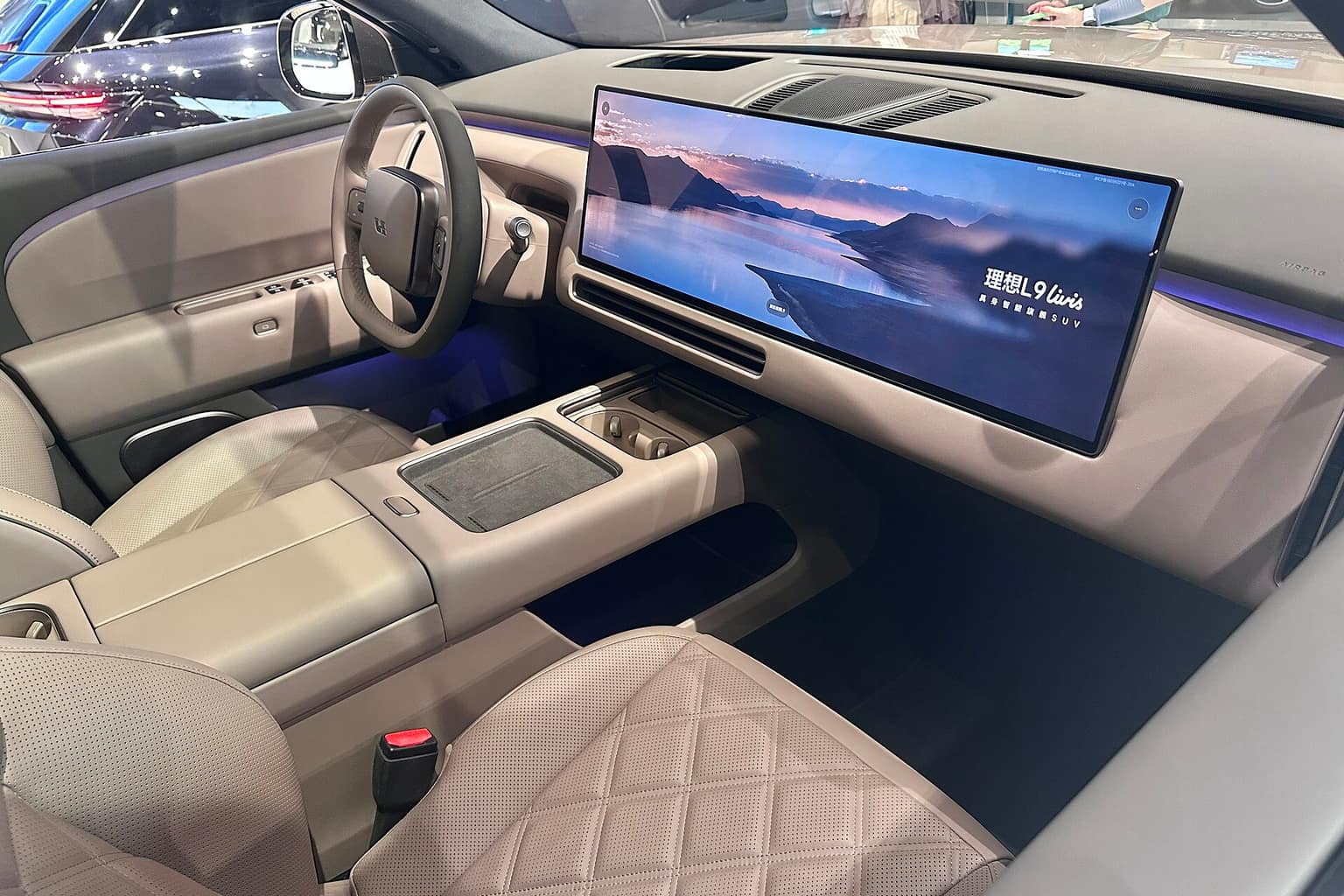
For drivers, the time the chip saves ultimately shows up on the road. Li Auto says this leaves room for deeper anticipation in driver-assist. A software update pushed on November 6 brought new 3D vision capabilities to the vehicle, extending its forward sensing range to 300 meters. The chip has been in mass production since May 2026, in models including the all-new Li L9, and is already running in customers' cars.
The chip is also starting to leave the car. The humanoid robotics industry faces a similar problem: batteries cannot sustain traditional power-hungry chips, yet robots must run large AI models locally in real time. Li Auto's CEO said the Mach M100 will gradually be offered to outside customers, and robotics companies have already expressed interest. Li Auto has not disclosed pricing or given a specific timeline for external supply.
These figures all come from Li Auto's disclosures. Next, the company plans to take the chip gradually from its own cars to robots and more customers.
Sources — read the originals(Paris time)
Pages consulted while writing
Read next
Comments
Loading the thread…
Sign in to leave a comment. Sign in