A drone folds its arms to fit through gaps 52% narrower than it
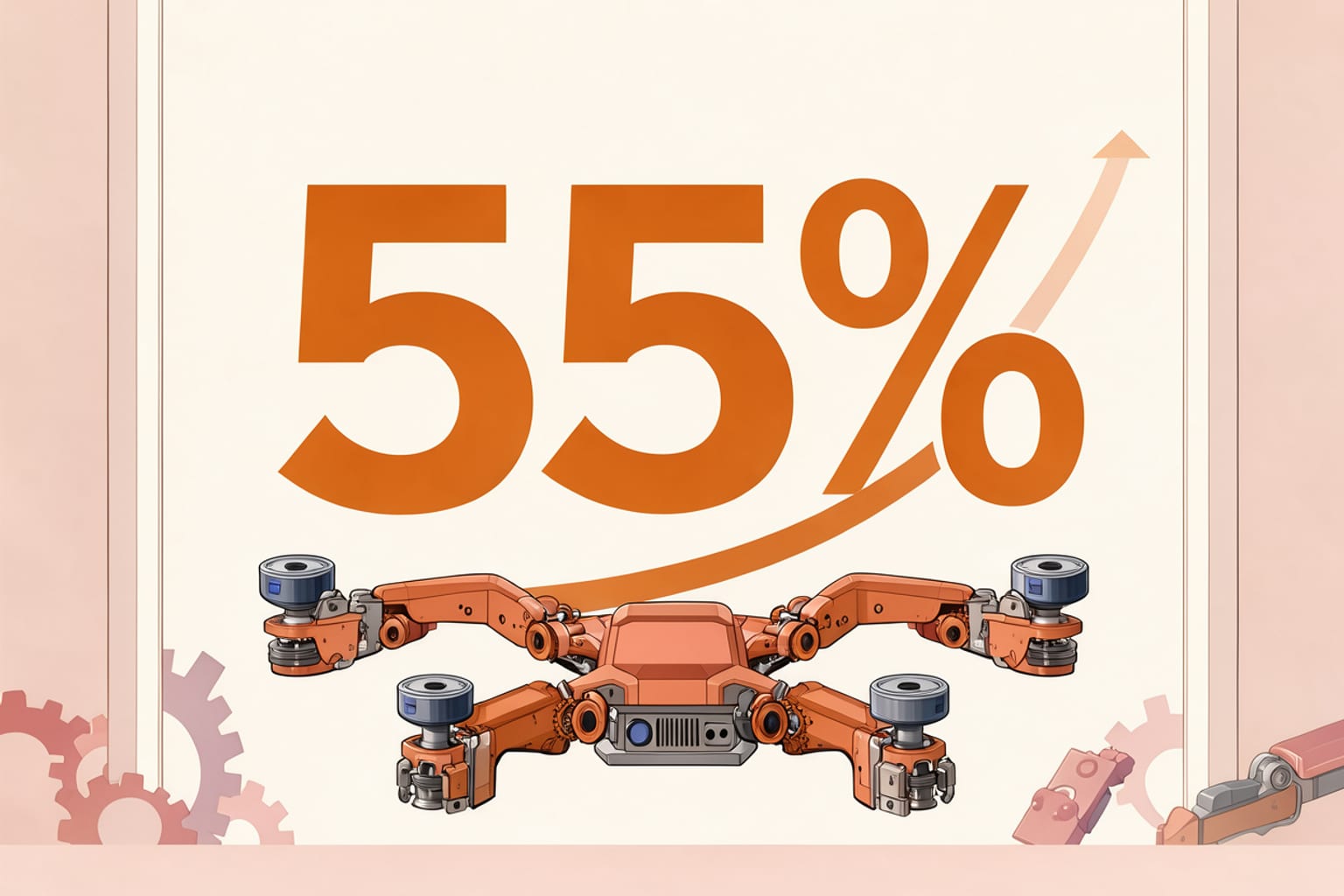
Spread out, the drone measures 31.3 cm across. Then it reaches a 15 cm gap, and its two side arms fold back against the body. Once folded, it measures 14.1 cm, a 55% reduction, and it flies through at about 2 m/s.
Drones are now common in places people find hard to reach, and those places are often full of small, awkwardly shaped openings. Shape-changing drones existed before, but past designs had reached at most a 29% reduction in width. Their mechanisms usually relied on extra motors or special thrust maneuvers, which added complexity or restricted movement in other ways.
The trick here sits in the joints. Each side arm is held by a spring-loaded joint, built from 3D-printed parts, that is stiff enough to take normal flight forces. When the edge of an opening presses on the arm, the joint gives and the arm folds. Once the drone is through, the arm springs back. The authors call these elastic rolling cam joints. Their cam shape can be tuned so the arm stays rigid in normal flight and bends easily after contact, a little like a folding ruler that stays straight until something pushes on it.
The team, a group of researchers in Europe, did not design the drone by hand. They set up an automated search that simulated candidate designs: contact with edges, folding, passage through an opening, and recovery on exit. Each round, the best-performing candidate guided the next one. The search tuned 22 parameters of the frame and of the arms' spring response at the same time, optimizing for success in the traversal itself.
The built prototype went through four flight tests. It crossed a 15 cm gap, and a 40 cm tube with a 22.5 cm diameter, which kept its arms folded for the whole passage. Real openings are rarely approached head-on, so the team also tested angled approaches. The drone got through without issue at every angle up to 20°, across 20 trials each. At 30°, one arm dislocated in one of 20 attempts, and at 35°, mechanical problems became more frequent. The authors say the design holds up to 30°, which is close to an ideal limit of 45.2°. Below that, the failures came from the prototype's 3D printing and manufacturing limits rather than from the body design or the control system. In ordinary flight, compared with an otherwise identical rigid drone, the flexible joints added just 2 mm to position-tracking error and less than 1% to electrical power use.
Not every crossing was smooth. The gap and tube passages produced tilts of roughly 90° and altitude losses of around 0.6 m, but the drone recovered without crashing. The simulation also underestimated real rotational disturbances, partly because the built drone was heavier than modeled and its motors responded differently.
The gain is for anyone who needs a drone to go where a rigid one cannot, without the extra motors and weight that folding used to require. The study gives no timeline and no commercial plans, and the results come from a single prototype tested in the authors' own flights. The authors see room to improve. A more accurate simulation, they write, could enable designs with even better real-world performance.
Sources — read the originals(Paris time)
Pages consulted while writing
Read next
Comments
Loading the thread…
Sign in to leave a comment. Sign in