A screen that holds its picture for months without power
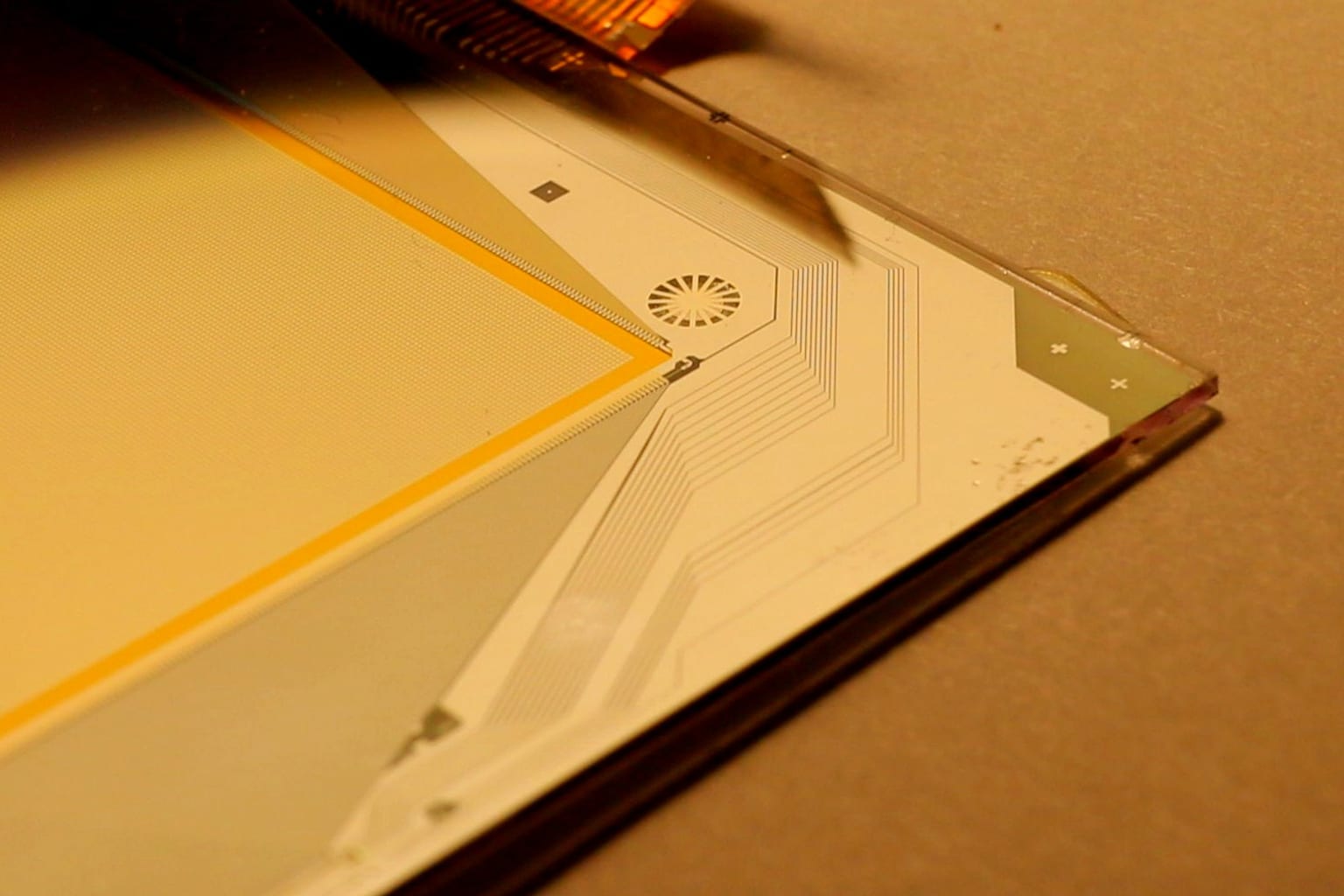
Draw a koala on a screen, cut the power, and it stays there. A team at the ARC Centre of Excellence for Transformative Meta-Optical Systems (TMOS) says it has built a reflective display that holds an image for three months under ambient conditions with no power at all. Its lead researcher, Dr Phuong Yen Le, says the koala still looks the same a year later. The researchers, from the Royal Melbourne Institute of Technology (RMIT) and the Australian National University (ANU), say they are the first to report a reflective display based on antimony selenide that can hold an image for months without being powered. The work was published in Advanced Photonics Research.
Most screens pay a price to keep a picture. A phone, a laptop or a television needs a constant power draw to maintain what it shows, and a conventional display refreshes dozens of times a second whether or not the content changes. Reflective displays are emerging as a more sustainable alternative, one that could offer near-zero power consumption while still holding an image. E Ink's electronic paper is one example: its image stays on the screen even when all power sources are removed.
The new display rests on a family of materials called phase-change materials (PCMs). Most materials keep the structure they were made with. PCMs can be rearranged at the level of their atoms, from amorphous (irregular arrangements of atoms) to crystalline (highly ordered arrangements), and back again, by heat, light or electricity. Light travels through each phase at a different speed and is absorbed to a different degree. A review in Nature notes that the optical properties of these materials change drastically between the two states, and that short optical or electrical pulses can switch them. Antimony selenide stands out, Dr Le says, because once it changes phase it stays locked in that state without continuous power. The same kind of switching has already been used to write photonic circuits with nanosecond laser pulses, a process one study compares to rewritable compact discs.
Color comes from the material's own optics. By combining the two phases with different thicknesses of antimony selenide, the researchers produced colors from deep blues to greys and oranges. The team's release describes the platform as offering a wide color gamut. Dr Le, however, says the current structure gives only a limited range of colors, and the next task is to find which changes to the device would make more colors accessible.
Erasing and drawing rely on heat and laser light. To erase, the whole layer is heated uniformly to about 200°C. At that temperature the atoms can move and settle into the most stable positions, which tend to be crystals, and the screen resets to a blank. To draw, co-author Dr Shvedov fires short laser pulses at the blank surface, "like drawing with a laser instead of a pencil." Each pulse adds just enough energy to set atoms moving, but the spot cools so quickly that they freeze in an irregular arrangement before they can settle back into order. Those frozen spots are the colored regions.
The team drew and erased a map of Australia, the TMOS logo and a koala. After erasing, no residual image could be seen, even under a 5× microscope. The koala image was then left for three months under ambient conditions without any noticeable change. The one-year figure comes from Dr Le's own observation of the sample, which Dr Le still keeps.
The display is not yet a product. It is written with a laser, and Dr Le's own words, "Right now, it uses a laser," point to the next obstacle. An arXiv preprint describes what its authors call the first electrically driven micro-scale display built from phase-change metasurfaces, a different device from the Australian one.
If the approach holds up beyond the laboratory, the gain would be a screen that draws power only when its picture changes. Dr Le speaks of avenues still to explore before reaching truly commercial, energy-efficient displays.
What comes next, according to Dr Le, is to identify the changes to the device's structure that widen the range of colors, and then to move from laser writing to fully electronic control.
Sources — read the originals(Paris time)
Pages consulted while writing
Read next
Comments
Loading the thread…
Sign in to leave a comment. Sign in