A single AI model simulates sand, sloshing oil and folding proteins
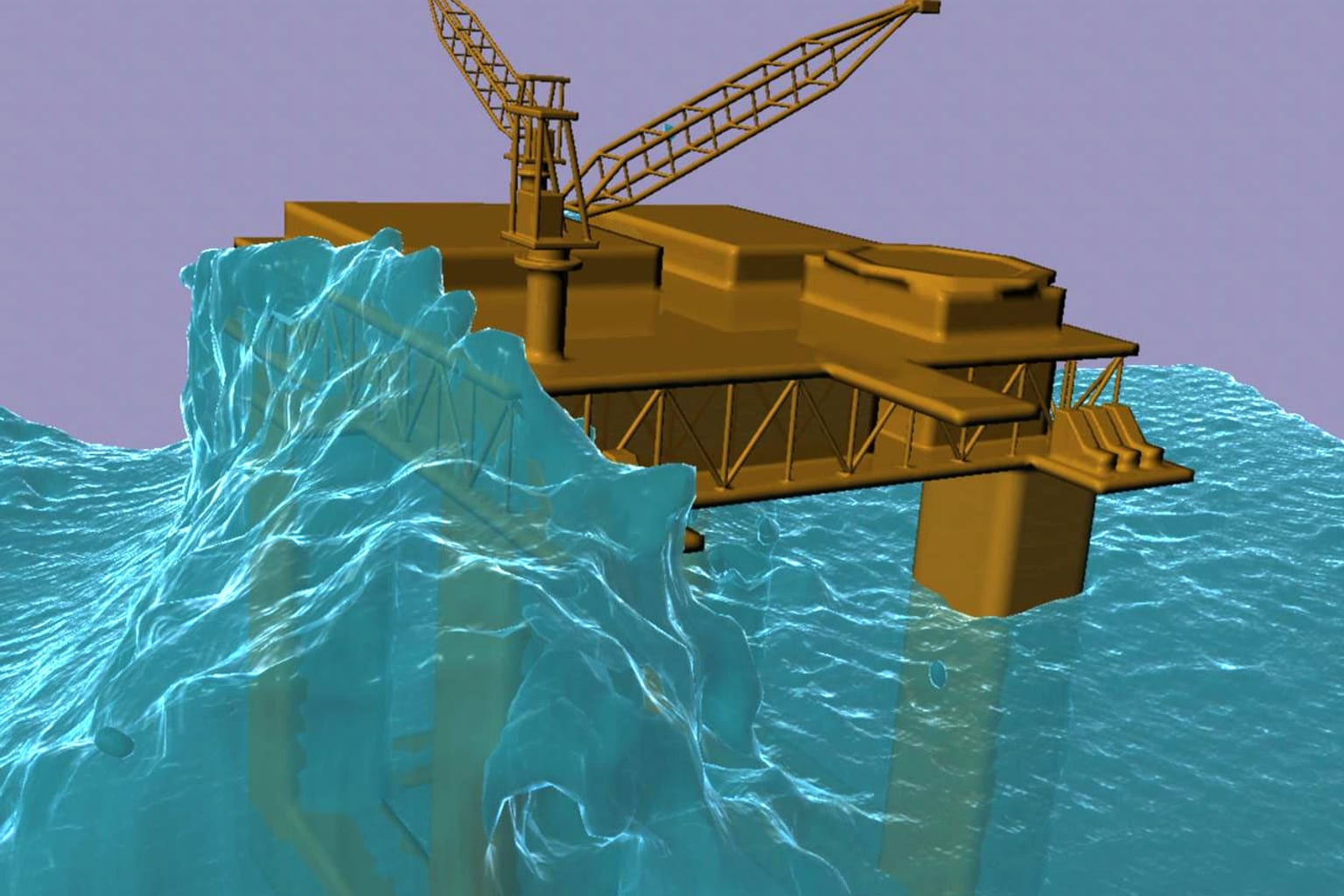
A scientist who wants to know how oil sloshing in a storage tank will strain an elastic valve has, until now, needed one simulator for the liquid and another for the solid. A team from MIT, the University of British Columbia (UBC) and several other institutions has built a single model that covers both, along with sand, soil and protein molecules. The system, called WorldParticle, is one deep-learning architecture for many kinds of physical phenomena.
WorldParticle breaks each object into thousands or millions of three-dimensional particles and tracks how they move. A neural network takes their positions and properties as inputs and predicts them for the next frame, in one-second increments. Peter Yichen Chen, now an assistant professor at UBC, compares the design to ChatGPT: a similar architecture, except that it predicts how particles move one step at a time instead of the next word. Before each step, the system sets aside external forces, such as the impulse of an ocean wave hitting a seawall, then folds them back in to correct its prediction.
The old approach required an engineer to convert each governing equation into a formula a solver could handle, and to repeat that work for every material and process. The researchers trained a network to learn the dynamics instead, which lets it handle materials, forces and environments it never saw during training. Scale was the hard part: a complex object can become too computationally intensive for the model once it is split into millions of particles. A merging technique combines and compresses particles while keeping fine-grained detail. “We needed to do a lot of detailed engineering,” says Minghao Guo, an MIT postdoc.
The team demonstrated the system on six different physical phenomena, including deformable objects, granular materials and proteins, and reports higher accuracy than existing methods. The size of that gain is not stated.
For engineers, the immediate benefit would be a single tool in place of a set of specialised simulators, and a faster way to study questions such as how sloshing oil affects a valve or where sand moves under a soft robot. The researchers also hope the approach will help scientists explore new materials and physical processes that current methods cannot model effectively. They give no date for either. Chen calls the work “a first step” toward a foundation model that “works out of the box for any scenario you want to simulate.”
Sources — read the originals(Paris time)
Read next
Comments
Loading the thread…
Sign in to leave a comment. Sign in