A young star vaporizes rock to reveal its titanium
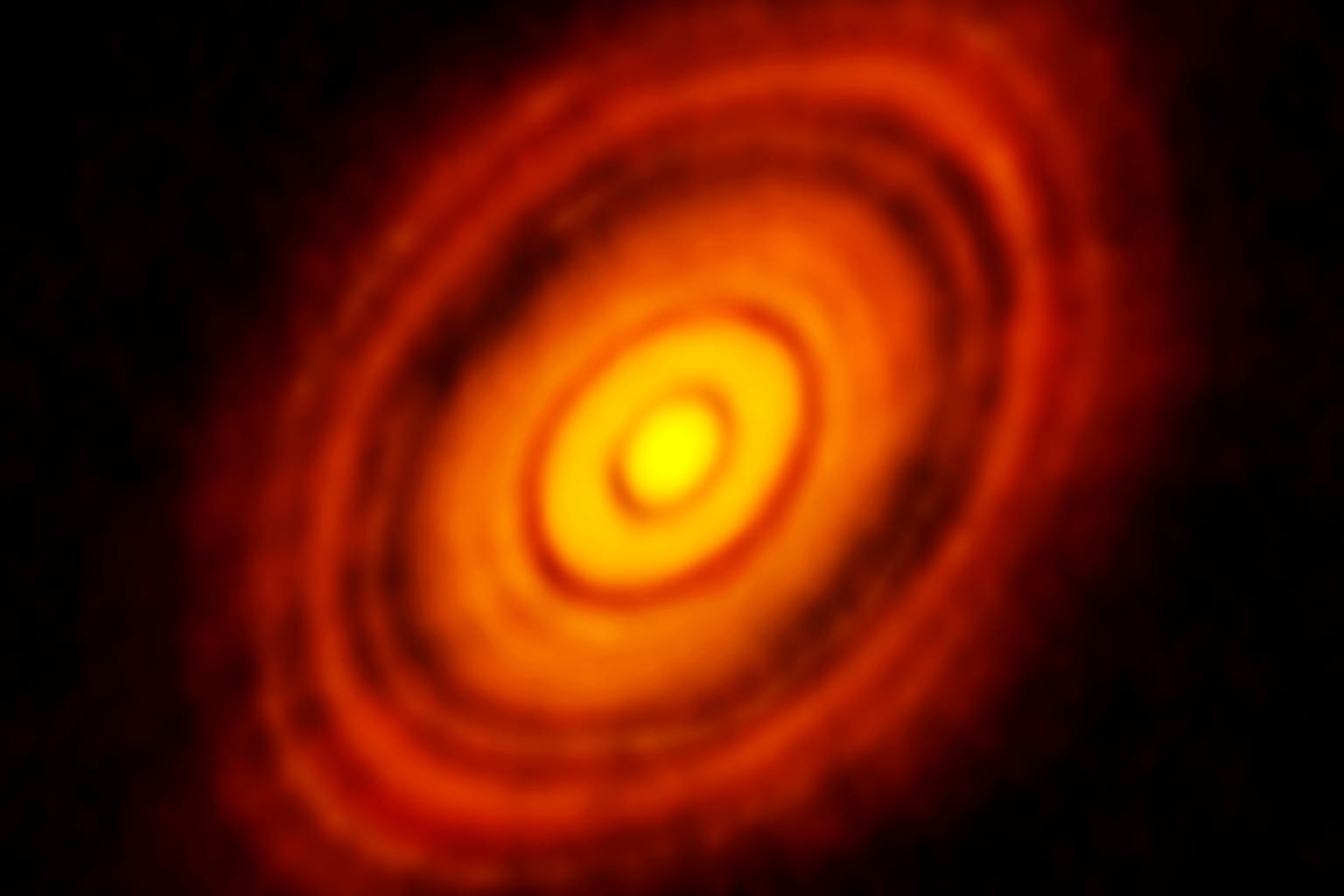
On Earth, reading the makeup of a rock takes a laboratory. A sample is blasted with heat until it turns to vapor, and a spectrograph, which splits the light from that vapor, shows which molecules it holds. The catch is that anything found in space has to be carried home first. “We basically have been unable to study solids like this in the interstellar medium,” says Adam Ginsburg, an astronomer at the University of Florida. This time, nature supplied the heat. A team including Ginsburg and researchers led by Ziwei Zhang and Nami Sakai at the RIKEN Pioneering Research Institute reports in The Astrophysical Journal Letters that it has detected titanium oxide gas around Orion Source I, a massive young star in a dusty cloud behind the Orion Nebula. It is the first detection of this gas in a star-forming region. Ginsburg, who identified the system and helped develop the analysis, calls it “just what we would do in the lab,” except that “nature is doing that for us.”
The gas matters because it lets astronomers read solid matter that is otherwise out of reach. The work belongs to astromineralogy, the study of the minerals that make up cosmic dust and other solid matter in space. Until now that field had been applied only to our own solar system, where researchers can collect rocks and bring them into a lab. With this result, it reaches beyond it.
Titanium is one of the most refractory elements, meaning it usually stays locked inside solid dust grains in interstellar space, where it is hard to detect as gas. Around Orion Source I, the intense heat close to the young star frees it from those mineral-bearing grains and sends it into a rotating disk of material around the star. Ginsburg and other researchers had already found salt compounds coming from that same disk. Salt in a gaseous state is rare but possible; titanium oxide had previously appeared in gas only naturally, on the surface of stars.
The gas was picked up by the Atacama Large Millimeter/submillimeter Array, or ALMA, a set of radio dish antennas in the Atacama Desert, 5,000 meters above sea level. Molecules that rotate give off signals at specific frequencies, and ALMA recorded several of titanium oxide's. The emission is compact, lying within about 50 astronomical units of the star. An astronomical unit is the average distance between the Earth and the Sun.
For researchers, the immediate gain is a measurement. The paper reports how much titanium oxide is present, with error margins, and Ginsburg says the team can now measure how much of the element is there. “The exciting thing is we're seeing the titanium oxide,” he says. “We can start comparing our measurements to how our own solar system formed.” In our solar system, he adds, researchers can compare ratios between rock types because they can grab those rocks and bring them into a lab. Here, that comparison has to be made from a distance.
For now, the result rests on a single system, Orion Source I, and on one published study. What opens next is the comparison itself: setting the chemistry of a star still forming beside the record preserved in our own solar system.
Sources — read the originals(Paris time)
Pages consulted while writing
Read next
Comments
Loading the thread…
Sign in to leave a comment. Sign in