Apple: Simulation-Trained Robot Scores 91% in Unseen Homes
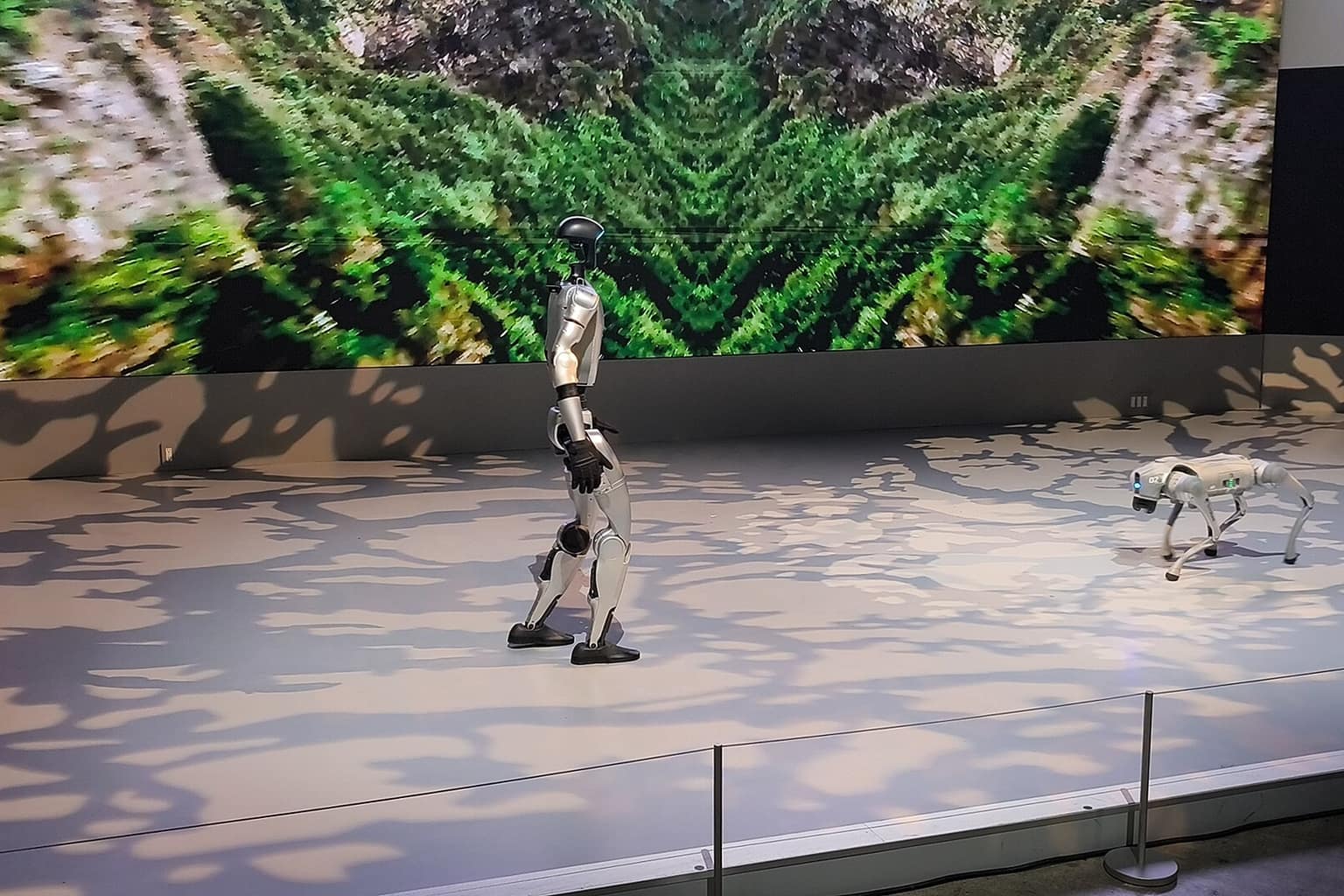
Apple's new CEO is reportedly unhappy with the pace of the company's AI work, and Bloomberg reports that he has asked the head of software to speed things up. Meanwhile, Apple's research team has published a humanoid robot study called HALO. A Mac mini M4 Pro is strapped to the back of a Unitree G1, and the software running on it is Alibaba's Qwen model. The robot can walk autonomously into unfamiliar homes, find a chair and sit down, crawl under a table, and push a box out of the way. Across 360 tests in six real environments it had never seen and had not been scanned in advance, the average success rate reached 91%.
For humanoid robots, the main difficulty has always been data. Teaching a robot a single action requires a “vision-language-action” sample: an instruction, a first-person view, and a record of how the whole body's joints move. Large language models can learn from the vast amount of text on the internet, but the real world has no comparable ready-made corpus. Each sample has to be produced through human teleoperation or motion-capture suits, and one hour of data consumes at least one hour of human labor. This is what the field calls the “data bottleneck.” HALO sidesteps it. The researchers used a procedural generator to create about 1,000 virtual homes, with living rooms, offices and bedrooms furnished at randomly varying densities. A motion-generation model produced multiple trajectories for walking over, turning and sitting down, and an automatic checker filtered out bad samples with sliding feet or clipping through objects. The final output was 163,000 paired samples, nearly 300 hours of data, with scale limited only by computing power.
The compute costs are also concrete. Sitting alone, using 50,000 samples, took 250 H100 GPUs nine hours to run. Across all 1,178 rooms, about 300 GPUs ran for 26 hours. Room diversity turned out to be the key factor. Keeping the amount of motion data fixed and adding only training scenes, the success rate for sitting in a chair in 100 unseen simulated rooms rose from 43% (training on one room) to 81% (100 rooms), and reached 84% when the number of scenes grew to 1,000. The robot's “brain” has three layers. The Mac mini on its back looks at the scene every two seconds and breaks down instructions such as “push the box to that side of the table” into subtasks. The motion generator updates about three times per second and plans the whole-body movements for the next five seconds. The low-level motion tracker sends commands to the joints at 50Hz and runs on the Jetson chip built into the G1. In the simulated sitting test, removing depth input reduced the success rate from 84% to 74%.
The real-world results matched the simulation. Six task types, namely sitting down, walking to a specified object, sidestepping through a half-open door, crawling under a table and pushing a box, all had the same average success rate of 91% across six real homes. When skills were chained into combined tasks, such as “crawl through the table, walk to the box, push the box,” the success rate dropped to about 70%. Failures were mostly caused by the robot ending one action facing the wrong way, which left the next target out of view. The paper proposes adding a recovery behavior that spins in place to search for the target, which could ease the problem. The work also continues Apple's research direction of the past two years. In November 2024, ARMOR fitted 40 low-cost ToF radar sensors to the arms of a Fourier GR1. In January 2025, ELEGNT explored how robots can express themselves through movement. In May 2025, EgoDex and PH2D used Vision Pro to collect 829 hours of first-person dexterous manipulation data.
HALO is still a long way from entering millions of households. It cannot tidy a messy bedroom or take a drink out of the fridge, and for every new skill, researchers still have to design action prompts and keyframes by hand. But it demonstrates a path that is easier to scale. In the past, accumulating 300 hours of robot experience required people to supervise practice and record it. Now, several hundred GPUs can generate the same amount of data in a little over a day. For this industry, the competition may shift from whose mechanical body is more agile to who can help robots accumulate experience faster and more cheaply.
Sources — read the originals(Paris time)
Read next
Comments
Loading the thread…
Sign in to leave a comment. Sign in