China's Qingzhou prototype flew 1,020 kg of experiments in orbit
Inside an onboard cultivation chamber, a moss native to the deserts of northwestern China came back to life in orbit, fed with only a small amount of water. The moss, Syntrichia caninervis, withstands severe cold, dehydration and radiation. It was one of the experiments carried by the Qingzhou prototype, a cargo craft that flew its maiden mission with 1,020 kg of scientific research payloads.
The Qingzhou, whose name means "light vessel", was developed by the Innovation Academy for Microsatellites of the Chinese Academy of Sciences. It began its maiden flight in March and is expected to remain in sun-synchronous orbit for up to three years. Its 27 cubic meters of internal volume were used for cargo rather than docking: it made no attempt to approach the station. Other experiments included a working microgravity space fridge and a tethered adhesive anchor, nicknamed a "spider-grip", which could in the future capture non-cooperative targets and, in the longer term, help remove orbital debris.
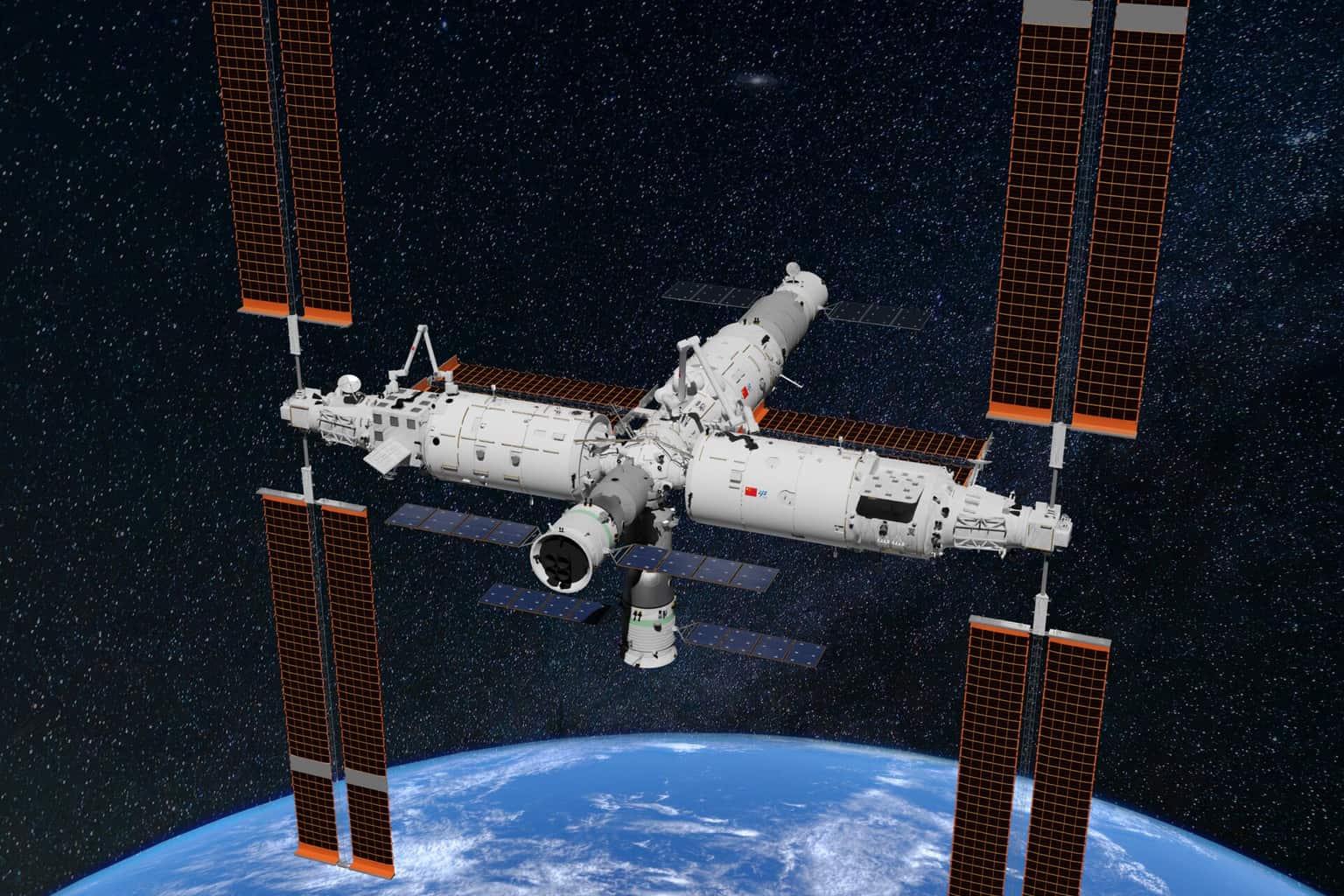
For Tiangong, the gain is frequency. The operational Tianzhou craft flies roughly once every nine months, and the two new designs selected by the China Manned Space Agency are meant to add low-cost flights between those missions. A second Qingzhou is being built for launch no earlier than January 2027, aboard the triple-core Lijian-2 rocket, with up to 1,800 kg of supplies, then a downmass of up to 2,900 kg some weeks later. The Qingzhou is not designed to be recovered and will burn up on re-entry. The reusable Haolong, by contrast, is designed to survive re-entry and land on a runway, and could fly repeated missions carrying around 2,000 kg in upmass and downmass. Its engineer Tang Wangyuan cited ten flights as an example of how the design spreads development and manufacturing costs.
The schedule for Haolong remains open. The company has given no recent update and no official lifespan, and no first flight date. An orbital launch tender, expected to be for this vehicle, is capped at 100 million yuan (about $14.9m), below typical expected launch costs, which could mean bidders are willing to accept a loss to win future contracts. Landspace was earlier named as Haolong's carrier with its ZhuQue-3 rocket.
On the rocket side, the Chang Zheng 12A reached orbit on its maiden flight at the end of 2025 from Jiuquan, but its first stage crashed about five kilometers from the target: one of its three engines did not restart for the landing burn. A second attempt is expected no earlier than November 3. A success would be China's third booster recovery on an orbital launch, each by a different rocket type. So far, only Landspace's ZhuQue-3 has landed a first stage on land, while a Chang Zheng 10B first stage was recovered at sea.
Sources — read the originals(Paris time)
Read next
Comments
Loading the thread…
Sign in to leave a comment. Sign in