Dead bacteria still make DNA in the lab, and it can be steered
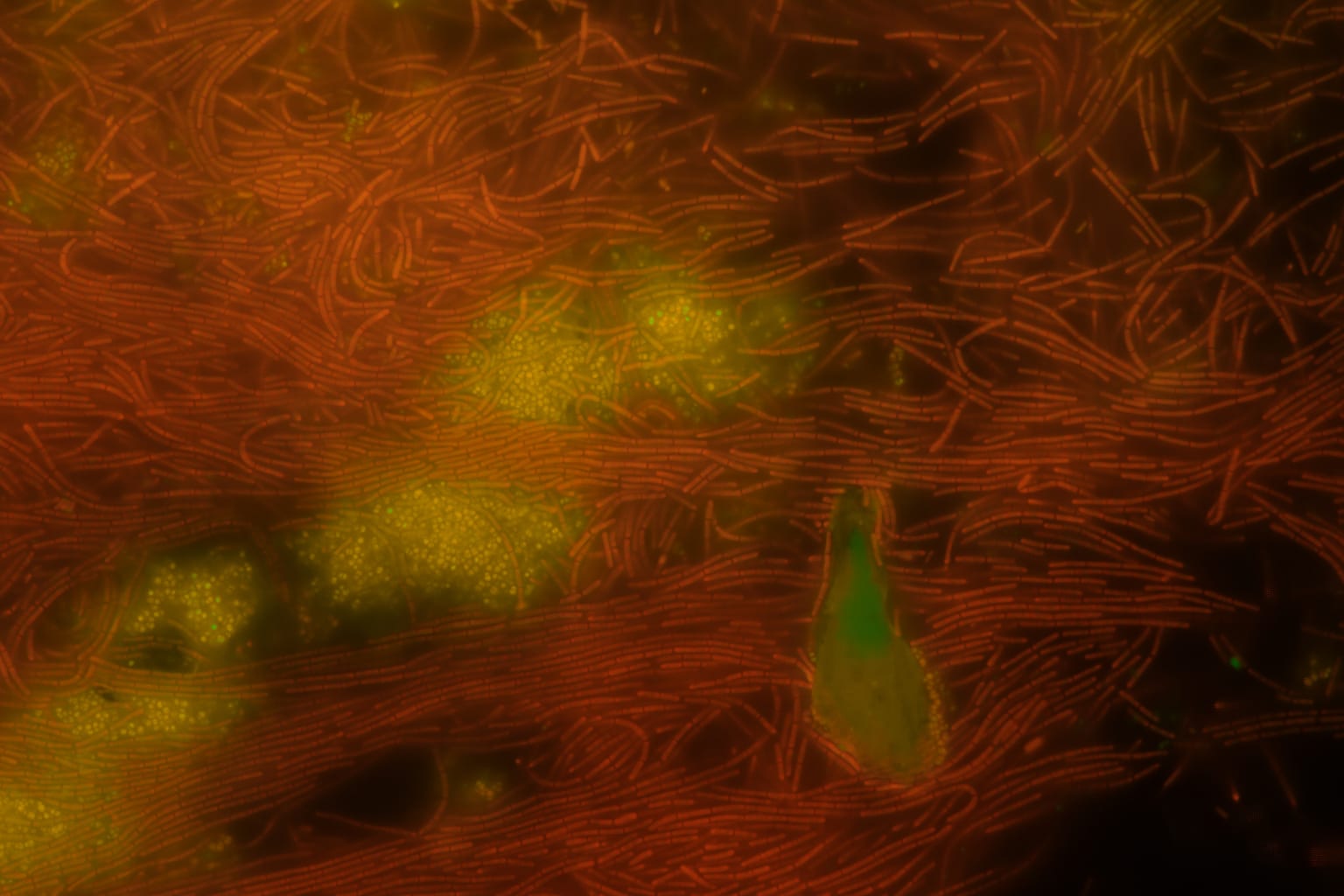
Under a microscope at Aarhus University, a biofilm of the bacterium Shewanella oneidensis shows red, flower-like structures that did not exist before the experiment. Their builders are dead. Bacteria in a biofilm live in sticky communities, held together by a substance that contains DNA, the same kind of material that forms the plaque we brush off our teeth. The assumption has been that when a bacterium dies, its work stops. The team led by assistant professor Gabriel Antonio Minero, of the Department of Biology, found that the work can continue.
The trigger is a virus. Many bacteria carry bacteriophages, viruses that infect only bacteria, and some lie dormant in the bacterium's genetic material. When the researchers starved Shewanella oneidensis and Bacillus subtilis of nutrients, some of these viruses woke up, multiplied and burst the cells open. The cells died, but their contents were released into the biofilm: the building blocks of DNA and specialized enzymes. Those enzymes kept making DNA outside the dead bacteria. Minero calls the phages "nano-architects": they kill some bacteria, yet they also supply part of the machinery that keeps the biofilm growing.
To check that the DNA was really new and not leftover debris from the burst cells, the team added a small, artificially made DNA ring to the cultures. The enzymes copied it over and over, producing long strands with a distinctive structure that fluorescent dyes can reveal. In one species the DNA combined with other substances into flower-like shapes, in the other into long strands. With a strain lacking the relevant viruses, none of this DNA was produced.
The researchers also learned to change the blueprint, and so to choose which DNA the machinery makes. Among other things, they obtained G-quadruplexes, DNA structures that fold into particular shapes, bind other molecules and can act somewhat like enzymes, speeding up certain chemical reactions. Minero describes it as equipping the zombies with armour or a weapon, giving the biofilm new properties. "What matters most to me is that we can hijack the process," he says.
What this changes is the control. A material whose chemistry is partly built after its cells have died could, in principle, be designed by choosing the template, and the researchers say the discovery could eventually contribute to new biological materials. The limits are clear: the work covers two bacterial species, under laboratory conditions, and the source gives no timeline, no field test and no application yet.
Sources — read the originals(Paris time)
Read next
Comments
Loading the thread…
Sign in to leave a comment. Sign in