Flying robot lighter than a paperclip senses and steers itself
A robot lighter than a paperclip follows a complex path through the air and lands on a sunflower, exactly where it was aimed. Until now, microrobots of this kind could only do that inside the lab, because they could not carry the electronics to find their own way and stayed tied to the lab's motion-capture system. This time the robot located itself outside that system, using sensors it carries.
The point is the field. Kevin Chen, who leads the Soft and Micro Robotics Laboratory at MIT, sees these machines weaving through almond trees or blueberry bushes to pollinate blossoms in regions where natural pollinators have been wiped out by habitat loss. They could also hover near plants without damaging them, watching crop health and spotting pests before they spread. Chen says that for jobs like pollination or industrial surveillance, a larger robot simply cannot fit.
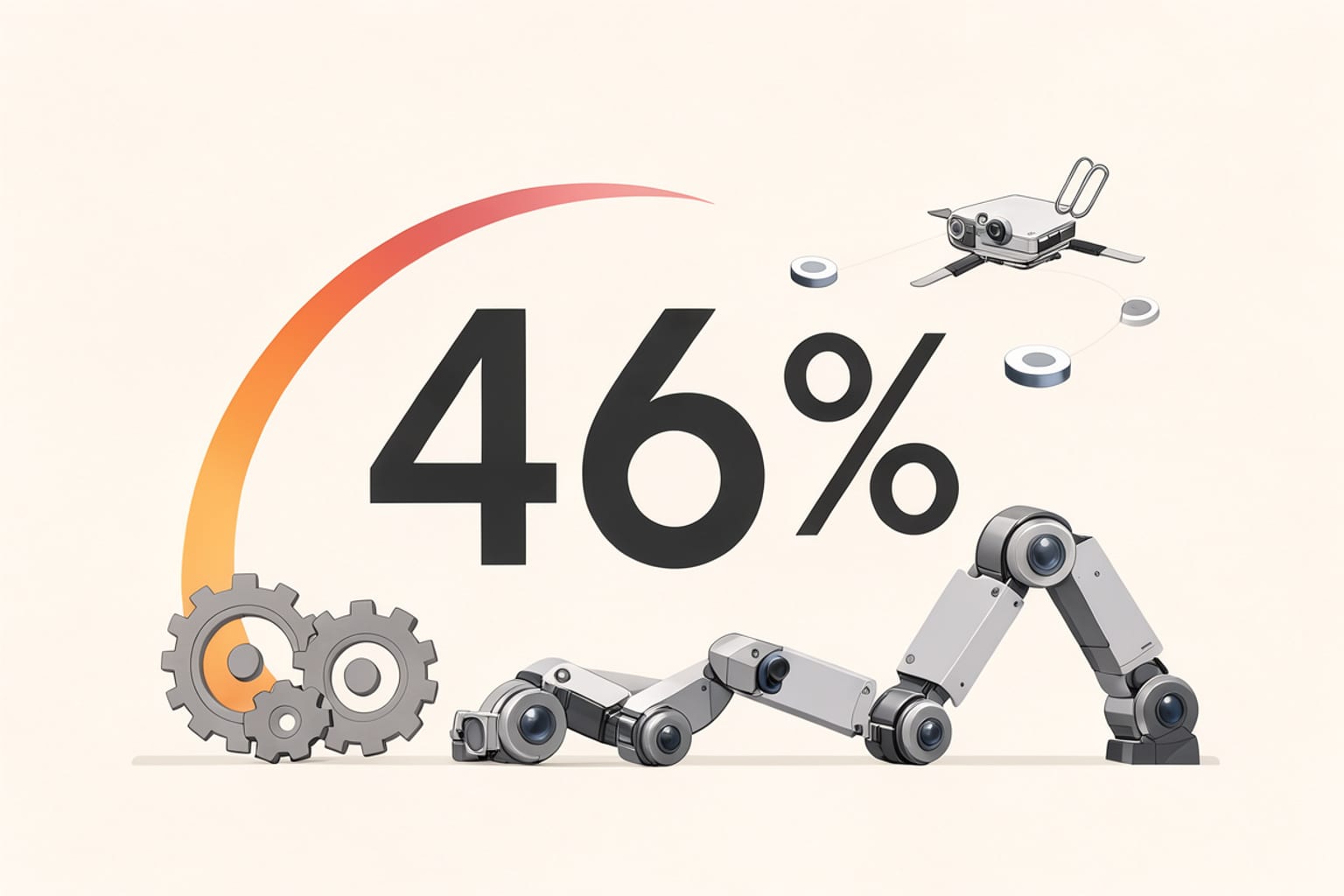
The robot has four wings, each driven by soft actuators, or artificial muscles, that flap fast enough to make it agile. It is roughly the size of a microcassette. The hard part was weight. Scaling up those muscles normally weakens them: their output power drops, and so does the lift. The team tuned the radius and length of the actuators so that they grew by 50% while the robot's net lift rose by 46%. The result is a lift-to-weight ratio of 1.9, enough to carry an electronics package that weighs only 244 milligrams.
That package holds a motion sensor to estimate the body's tilt, an optical flow sensor to measure lateral speed and position, a time-of-flight sensor to measure height, and the microcontroller that runs the software. Without an external reference, though, the robot does not know its absolute position and drifts off course. The team wrote a sensing algorithm that calculates orientation, angular velocity and position very quickly, by simplifying the calculations. A counterintuitive choice paid off: estimating position continuously at a faster rate gave better performance than a more accurate but slower estimate. 'Our robot can now fly with positional accuracy that is comparable to flying with offboard cameras,' says Yi-Hsuan (Nemo) Hsiao, one of the co-lead authors and an MIT graduate student.
In flight tests, the robot hovered at different heights and followed point-to-point trajectories, maneuvering quickly and precisely. The limit is clear: the robot is still connected to an off-board power source, so it cannot yet fly untethered. The study appears in Science Robotics.
For growers in regions where wild pollinators have disappeared, the promise is a machine that can work between plants without touching them. That promise is still a future one. The team presents this demonstration as a step toward precision agriculture, and Chen calls it a thread of technology that, if it keeps succeeding, could be very promising.
Sources — read the originals(Paris time)
Read next
Comments
Loading the thread…
Sign in to leave a comment. Sign in