In a lab flask, atomic hydrogen made at just 30°C
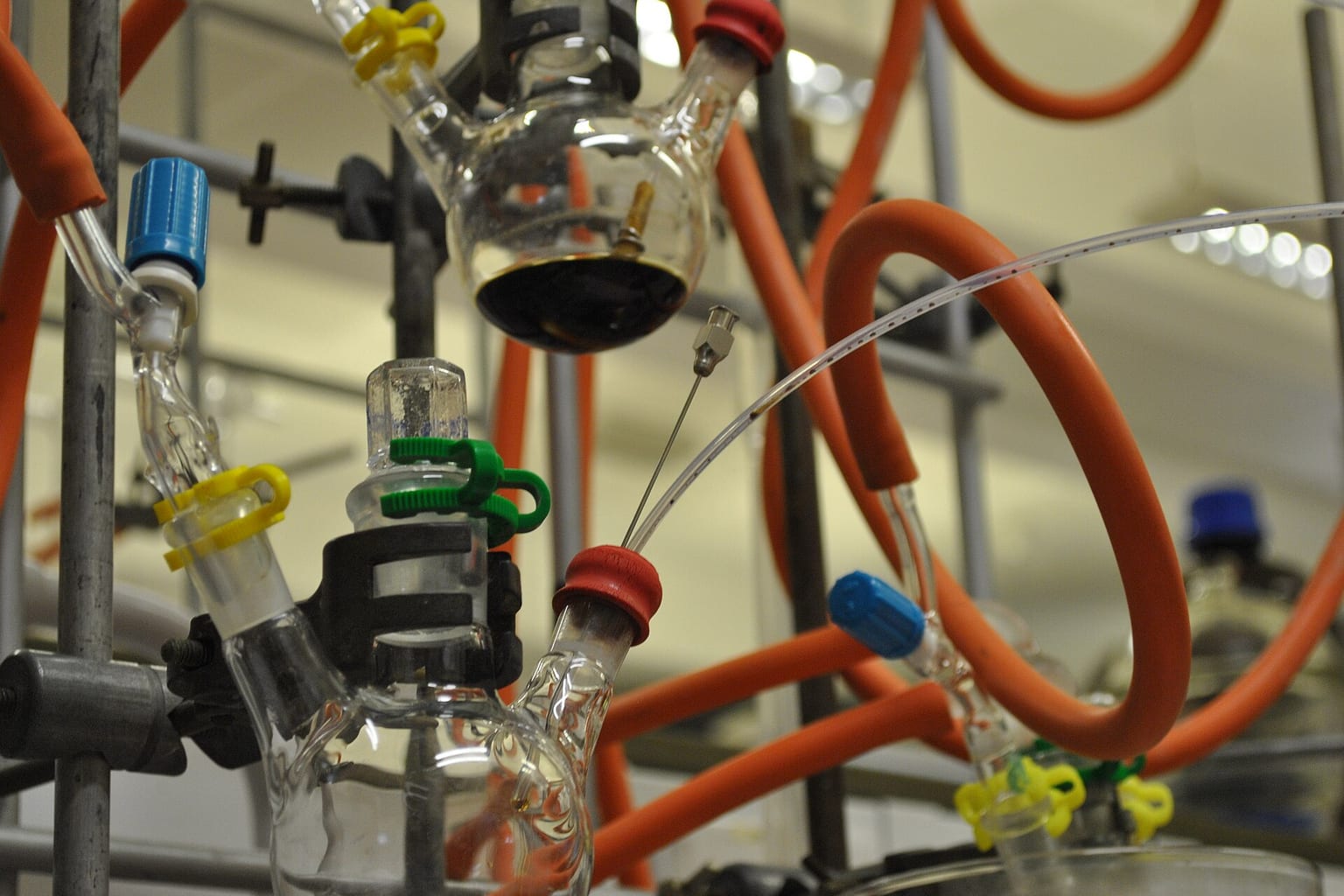
Almost everything in the night sky is hydrogen, the first element of the periodic table. Yet for more than a century, the hydrogen atom has been almost out of reach for chemists who build molecules. A team at University College London has now generated it in a flask, in a liquid, at 30°C, with a standard LED lamp and two commercially available chemicals. The results were published in the Journal of the American Chemical Society.
The atom in question is not the hydrogen gas sold in canisters, which is two atoms bound together, nor the hydrogen ion or the proton. It is a single electron orbiting a single proton. That unpaired electron makes it a radical, the most fundamental reactive species in chemistry, and it was long reachable only with brute force. In 1912, Irving Langmuir split hydrogen gas over a tungsten filament heated above 1,700°C. In 1922, James Franck used mercury vapor and ultraviolet light instead, a method that remained in use for decades but needed toxic mercury and specialized lamps. In 1991, Robert Crabtree at Yale University showed that these atoms could do useful chemistry, such as breaking carbon double bonds in olefins, a building block of plastics, but his method still failed in liquids.
The Londoners' route runs through a mixture. Hydrazine and thiophenol form an intermediate that absorbs near-ultraviolet light. That light moves an electron, which produces a short-lived, highly unstable species that falls apart and releases a hydrogen atom. The team's goal was not the fleeting atom itself but its use: the atom they generated reacts with organic molecules, adding onto carbon double bonds to form more stable single bonds, and removing halogens.
What this changes is mainly the bench. A chemist who needs this reactive species no longer needs a toxic vapor, an extreme temperature or a special lamp, only a flask, a light and two reagents from any chemical supplier. The method also works in a liquid, which is where most synthetic chemistry is done. Crabtree had pointed in 1991 to uses such as the discovery of new drugs, and the approach now opens that kind of chemistry to ordinary laboratories. The team does not put a date on applications, and the published work does not describe production at industrial scale.
Sources — read the originals(Paris time)
Read next
Comments
Loading the thread…
Sign in to leave a comment. Sign in