In the lab, brain tissue sorts Braille letters and steers a robot dog
On a bench at the University of Bristol, a few millimetres of human brain tissue, grown from cells in a dish, is now sorting touch signals. A tactile sensor scans a Braille character and turns what it feels into patterns of electrical stimulation. Those pulses travel into the organoid, the tiny lab-grown model of the human forebrain, and come back as a pattern of activity that a conventional learning algorithm then reads as a letter.
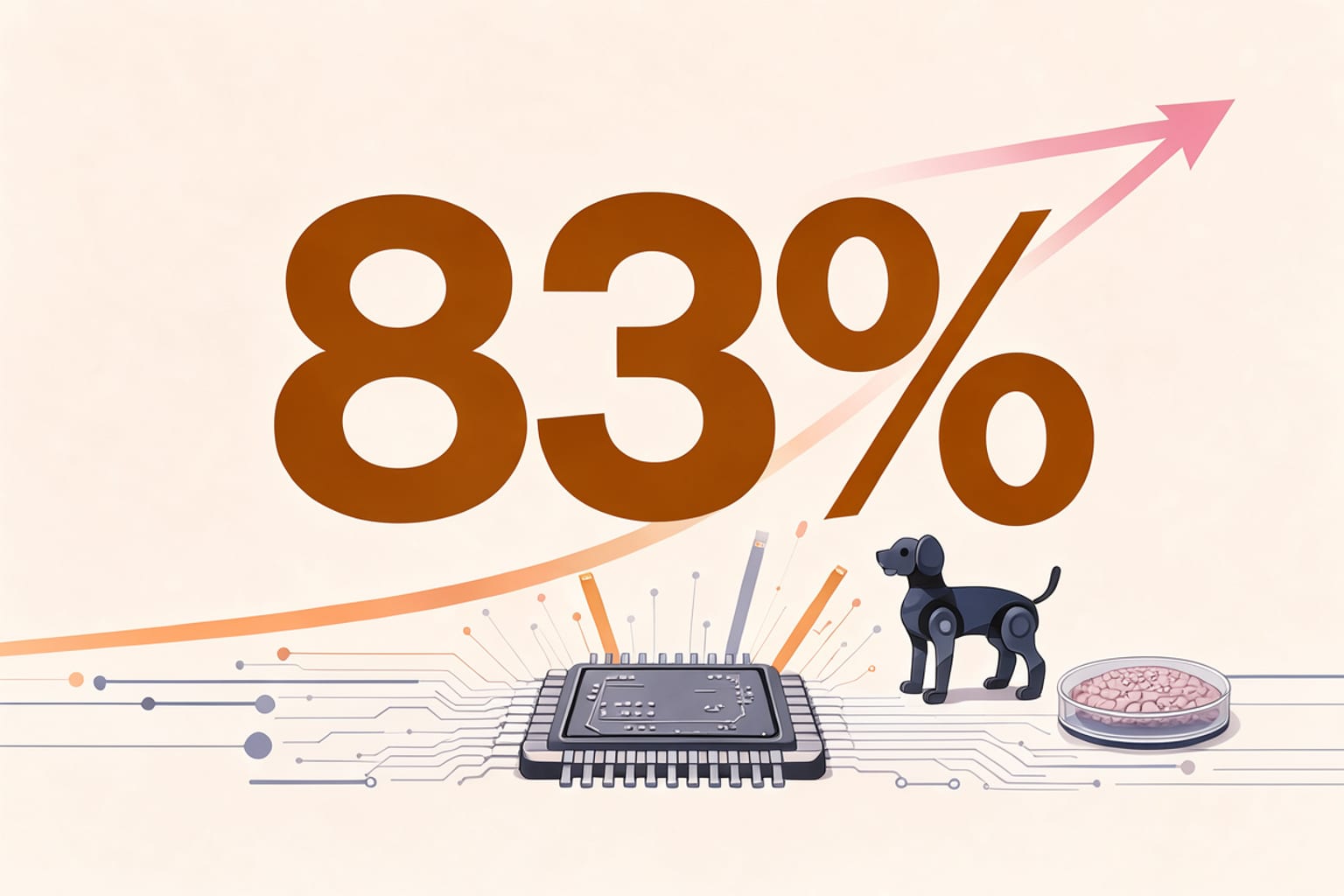
The figures show how much one piece of tissue can carry. Each organoid, built from around 10,000 nerves and supporting cells, identified the correct letter with 61% accuracy on its own. Combining the responses of three organoids lifted accuracy to 83%, and the combined system held up better when the team added artificial noise. The organoids were never trained to read Braille: they used a fixed encoding of the letters, and the algorithm did the classification. The study shows that living tissue can transform touch information while keeping useful patterns, not that it has learned to read.
The biggest test came from a collaboration between Cortical Labs and Honda Research Institute Europe. Cortical Labs' CL1 biological computers were connected to a virtual agent that had to head toward a simulated odour source, choosing between moving forward, turning left or turning right. The researchers tried about 1,300 configurations of the electrical signals, logging more than 4,000 hours of real-time interaction across dozens of biological units. Only 12 configurations learned consistently across episodes, and under comparable conditions those optimised agents beat conventional reinforcement-learning benchmarks at navigation. The work will be presented at NeurIPS, the machine-learning conference, in Sydney. The method behind it, called an Embodied Neurocomputation Framework, treats the unpredictability of neurons as an engineering problem to be systematically tuned.
For robots, the most visible step is the dog. Cortical Labs used the firing rate of its cultured neurons to steer a robot dog through a small space. Brett Kagan, the company's co-founder and CEO, puts the gap plainly: robots are now capable at physical control but "still struggle with the higher-order control required to learn quickly or adapt when conditions change." If researchers can reliably harness neurons' efficiency and their capacity to adapt, biological computing could one day be the preferred choice for machines working in unfamiliar conditions far from home. That is a long road: the sources note that keeping the tissue alive remains a challenge, and none of these demonstrations suggests that biological computers will soon run warehouses or drive taxis.
Comments
Loading the thread…
Sign in to leave a comment. Sign in