Korean lab remeasures strontium frequency 50 times more precisely
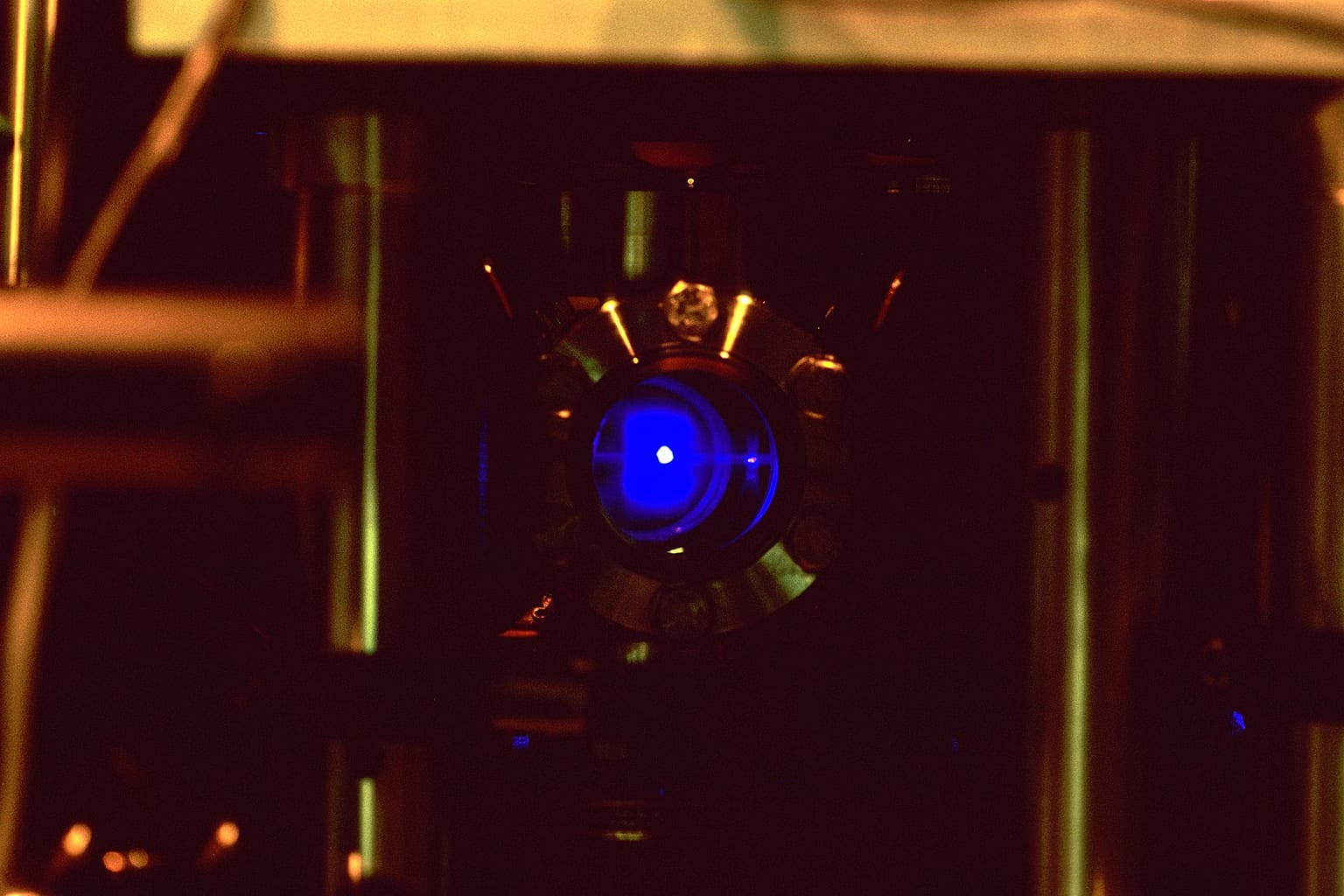
For 88 years, the number that tells a laser where to sit to catch a strontium atom has rested on a measurement made in 1938, when researchers compared sunlight with the arc light of strontium. The Korea Research Institute of Standards and Science, known as KRISS, has now measured that frequency again, and the new value carries an uncertainty reduced by more than 50 times. The measurement concerns the 461-nanometer optical transition of strontium, and the result is published in the journal Metrologia.
The old figure was never precise enough for today's work. Strontium is used in optical lattice clocks and quantum sensors, where fast-moving atoms must be slowed and trapped by lasers tuned to the exact resonant frequency of one atomic transition. Without a reliable number, experimenters have had to observe the atoms' response directly and adjust the laser by trial, much like turning the dial of an analog radio to find a station. The new value replaces that search with a reference point, and the uncertainty now sits at about 5 megahertz, after what the team describes as a yearlong campaign of precision measurements.
The key tool is a "photonic grating chip", developed by KRISS with the Korea Advanced Institute of Science and Technology and the National NanoFab Center. Its surface carries a fine grating that diffracts and reflects light in set directions when placed inside a vacuum. Conventional setups align several external mirrors, and each one can pick up mechanical vibrations; the chip removes much of that source of error, and a single chip can generate laser beams in several directions, which simplifies the optical setup. Once equipment errors were reduced, the researchers determined the frequency with two methods built on different principles. One reads how the atoms respond to light as the laser frequency changes; the other deduces the frequency from the velocity distribution of an atomic beam slowed by lasers. The two results agreed within their margins of error, and the final value combines them according to international guidelines.
The measurement is tied to Korea Standard Time, the national time and frequency standard that KRISS maintains, and that standard is linked to the International System of Units, so the figure can be compared with the same reference anywhere in the world. For the people who build these devices, the gain is practical: a shared, accurate starting point instead of a number that has to be rediscovered at each laboratory. Dr. Jae Hoon Lee, principal research scientist in KRISS's Atomic Quantum Sensing Group, put the stakes this way: "the main significance of this research is not simply that we remeasured a single frequency value, but that we proactively delivered an accurate measurement reference point for next-generation quantum technologies."
The team expects the value to help free next-generation quantum devices from bulky external atomic frequency references, especially when combined with optical frequency synthesis technology now under development, and to speed up the miniaturization and commercialization of cold-atom devices. Those are expectations, not products: the result is a single measurement of one transition, and it still has to be taken up by clock and sensor builders. KRISS gives no timeline for commercial devices and names no industrial partner.
Comments
Loading the thread…
Sign in to leave a comment. Sign in