Lab camera catches 11 frames from femtoseconds to nanoseconds
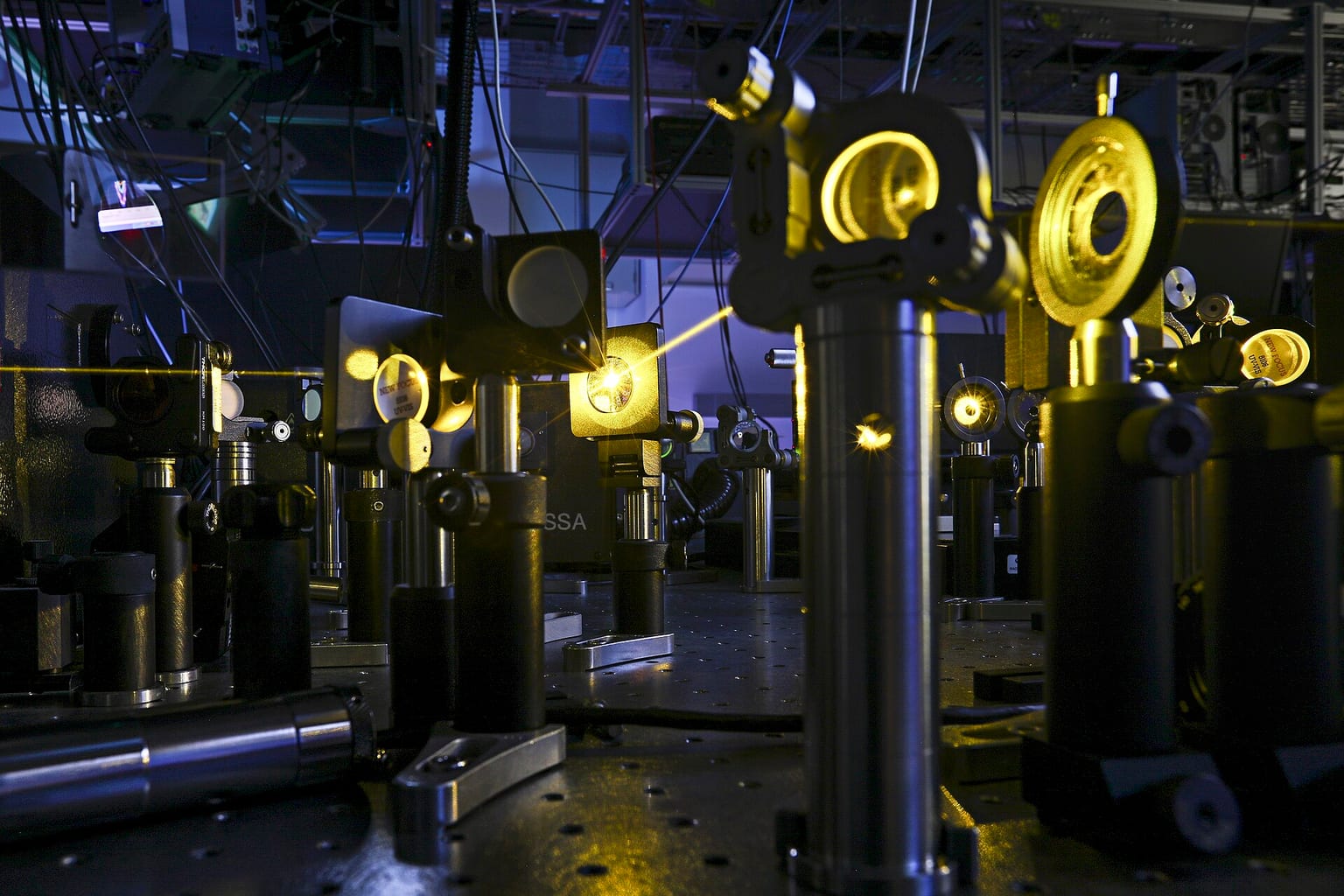
A laser pulse hits a glass sample. In the first 100 femtoseconds, the material starts to change. Within 10 nanoseconds, shock waves run through it and material is ejected. In a laboratory experiment reported in the journal Optica, a team at the University of Tokyo has captured that whole sequence in 11 frames, in a single shot.
Conventional ultrafast photography works on microsecond (millionths of a second) and millisecond (thousandths of a second) timescales, and takes its images at evenly spaced, or nearly evenly spaced, intervals. That suits events that unfold steadily. It misses the moments where a process changes fastest, because not every important change happens at neatly spaced intervals.
The team, led by associate professor Keiichi Nakagawa of the Department of Bioengineering, spends its frames where the change is fastest. Its method, logarithmic ultrafast photography, places frames closely together at early times and farther apart later. It is implemented in STAMP (sequentially timed all-optical mapping photography) and uses BRIDGE (band-resolved individual delay generation), which extracts wavelength bands one after another and lets each band be timed independently while still being mapped to a specific instant of the process. The outcome is 11 frames covering about five orders of magnitude in time, from around 100 femtoseconds to 10 nanoseconds. Keitaro Shimada, a postdoctoral researcher in the Nakagawa group and lead author, put the goal simply: “We wanted to find a way to connect these very different timescales in a single measurement.”
For researchers in laser processing, materials science, plasma and shock-wave research, and biomedicine, the gain lies in events that are hard to repeat exactly. Nakagawa argues that “recording the early and later stages of the same event can reveal relationships that might be lost when a sequence is reconstructed from separate experiments.” The team proposes these fields as the main uses. Those remain proposals: the demonstration is on glass and on hydroxyapatite, the mineral of bone and teeth, and no date is given for use beyond the laboratory.
The limits are concrete. Each measurement is one shot, so each event yields one sequence of 11 frames in this setup. The sources reviewed do not give the image resolution, the cost of the equipment or its footprint, which will decide how far the method can travel out of a specialist lab.
Comments
Loading the thread…
Sign in to leave a comment. Sign in