Lab sensor detects 8-zeptomole reactions near quantum limit
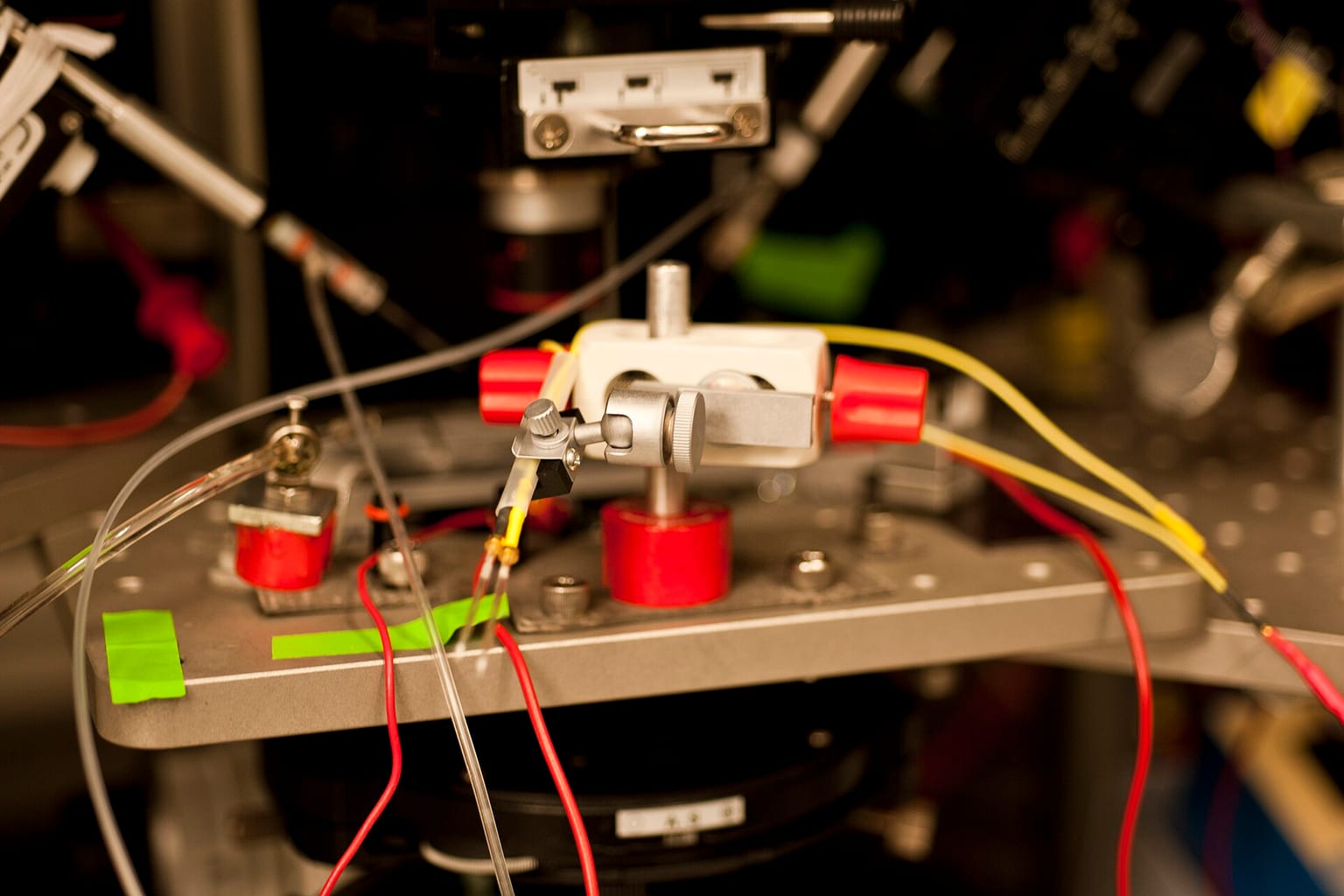
Ravi Saraf was not an electrochemist when he started. He is a professor of chemical and biomolecular engineering at the University of Nebraska-Lincoln, and he taught himself the field from the ground up. His lab-built instrument now measures reactions involving 8 zeptomoles, roughly 4,800 molecules, according to a study in ACS Measurement Science Au. A zeptomole here is a quantity that includes roughly 600 molecules.
Conventional electrochemical sensors measure the total electrical current produced on an electrode's surface. When several reactions happen at once, their currents blend together, and speeding up a reaction raises the signal along with the electrical background that can drown it. That is why distinguishing many reactions on one electrode has been hard, and why Saraf's team spent more than a decade on the problem.
SEED takes a different route. The researchers attached methylene blue molecules to DNA on a gold electrode. As the molecules were reduced and oxidized, they switched between colored and colorless states, and SEED read those changes with light. Because the readout is optical rather than electrical, Saraf says the device is 'sort of blind' to the background, which let the team work at higher speeds. In the ACS Sensors paper, the system quantified 250 zeptomoles, roughly 150,000 molecules, on a spot about 20 micrometers across, and about 2% binding of target molecules produced a 27% change in the signal. The team reports that the 8 zeptomole result brought it to the limit set by counting electrons, where statistical fluctuations become significant.
For patients, the most direct use would be early detection. Saraf says the technology could lead to better early diagnoses of diseases such as cancer, and to better assessment of injury from high-energy radiation. The team is pursuing microRNAs, molecules whose blood concentrations change with disease, as a first target. The results are from a lab-built instrument, though, and the team has not announced a date for clinical or field use. Its stated next step is to make SEED smaller and practical for real-world use.
The reach could extend beyond medicine. Because many reactions can run on the same chip, in the same beaker, under identical conditions, researchers could compare catalysts and corrosion-resistant materials quickly. As Saraf puts it, 'We can do hundreds of reactions on the same chip in the same beaker under the same condition.'
Sources — read the originals(Paris time)
Read next
Comments
Loading the thread…
Sign in to leave a comment. Sign in