Magnon handedness switched with a magnetic field
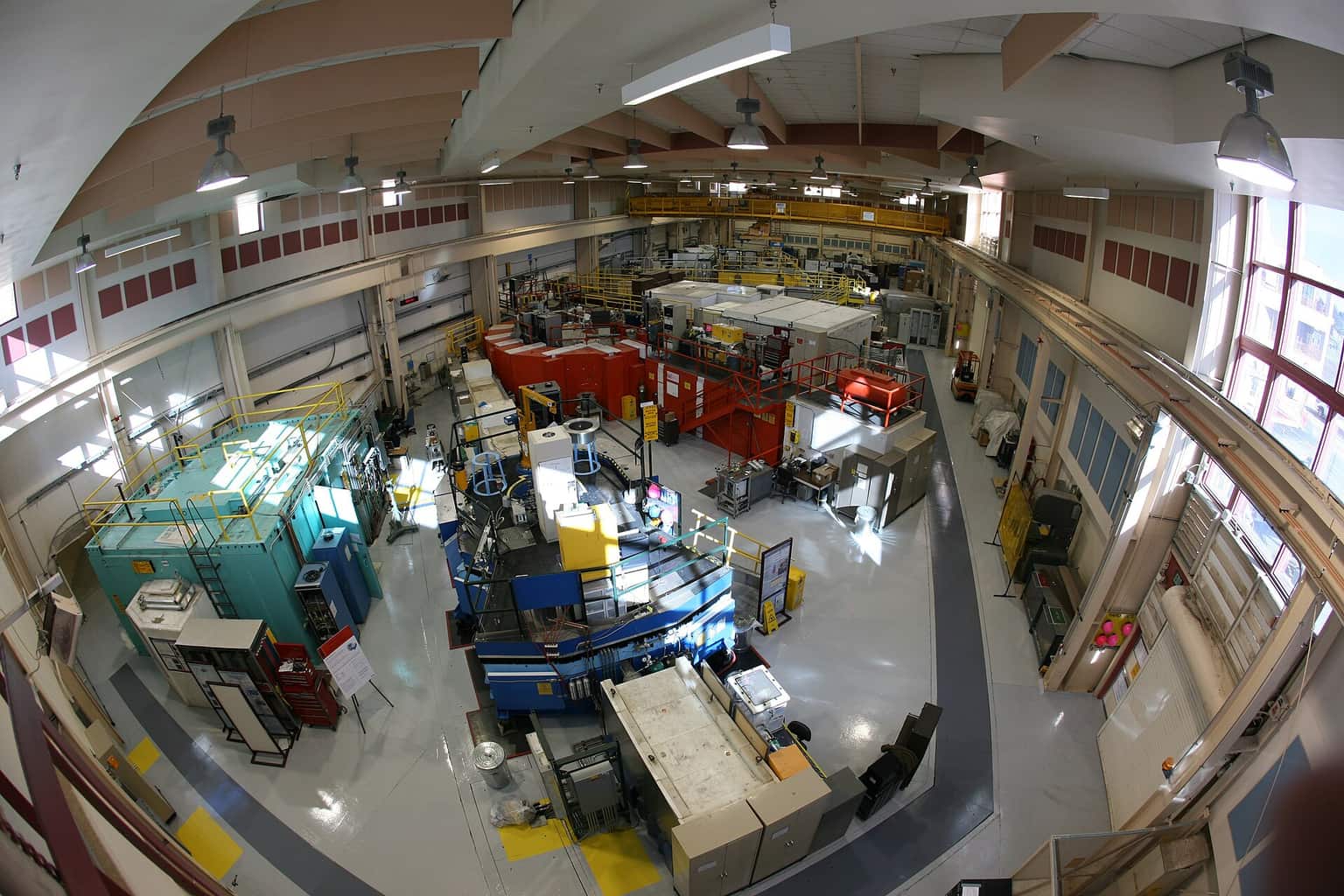
“Well, that’s funny. I wonder why that is.” That was Rob McQueeney’s reaction to a puzzle in his group’s measurements at the Ames National Laboratory, part of the U.S. Department of Energy (DOE). In one material, magnons crossed without interacting. In another, they interacted and avoided crossing. Working through the difference, the team realized that one wave was left-handed and the other right-handed, and that the two were mixing. The team reports that changing the material’s magnetic state with an external magnetic field switches the behavior of the magnons.
Magnons are tiny waves of magnetic motion that travel through magnetic materials, and they can be right-handed or left-handed, like a spinning top turning clockwise or counterclockwise. Because they transmit energy and information without moving electrical charge, researchers see them as possible building blocks for high-efficiency computing. The natural place to study both handedness types is a ferrimagnet, a material with two kinds of magnetic atoms whose moments point in opposite directions. Their moments are unequal, so they never fully cancel, and the material hosts right- and left-handed magnons in two separate bands. Normally, exciting one handedness takes a different amount of energy than the other, so the bands stay apart.
The group found that under the right conditions the two states mix. The paper, “Chiral Magnon Mixing by Symmetry-Breaking in Collinear Ferrimagnets,” by Dhurba R. Jaishi and colleagues, was published in Physical Review Letters. It used inelastic neutron scattering, a method that probes magnetic motion inside a material, on TbMn₆Sn₆ and ErMn₆Sn₆. An independent summary of the paper reports that the measured sign change of the chiral signal in ErMn₆Sn₆ matches the calculations. According to the arXiv version of the paper, the mixing comes from breaking a symmetry through magnetic anisotropy, the directional preference of the magnetic atoms, and the authors write that this can be tuned by varying the rare-earth element or with an applied field.
The result so far is a lab result on two materials. The mixing has been shown in these compounds, and the energy needed to switch handedness is described only as relatively little energy, without a figure. Phys.org’s account of the work describes the uses in quantum information and quantum computing as potential, and the researchers give no timetable for a device.
For researchers in quantum information, the gain is a control knob: right- and left-handed magnons can be easily combined and switched, which the authors present as new possibilities for magnetic-based quantum technologies. McQueeney put the change simply: “Magnons have certain advantages for moving information. But manipulating the handedness was not a solved problem. And now it is.”
Sources — read the originals(Paris time)
Pages consulted while writing
Read next
Comments
Loading the thread…
Sign in to leave a comment. Sign in