Nanofoam on locust antennae boosts chemical detection in the lab
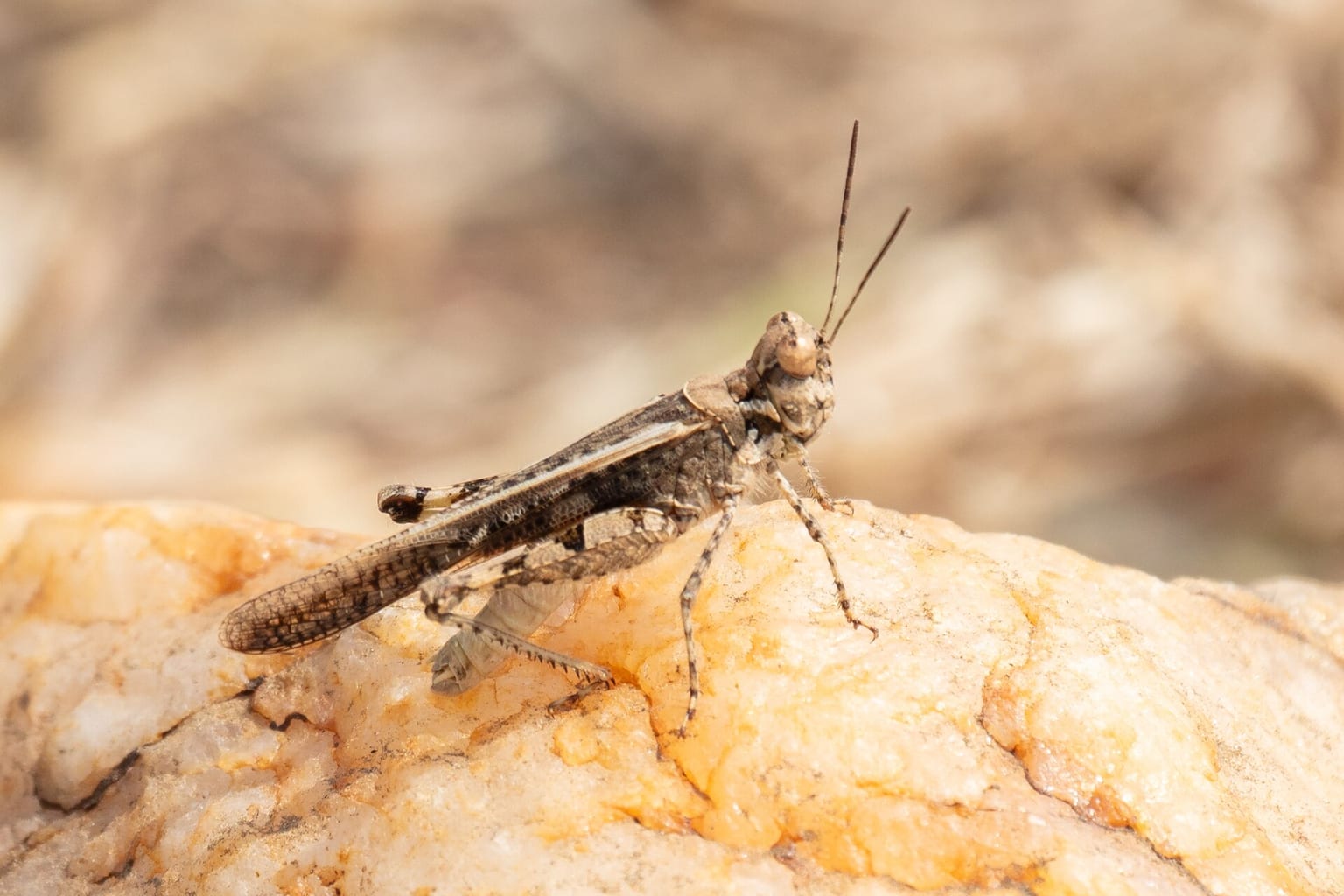
A locust's antenna is about to become a sensor. In Barani Raman's lab at Washington University in St. Louis, a thin collagen foam loaded with nanomaterials is applied to the insect's antennae or wings, where it can detect and collect trace chemical signatures. The foam, the team reports, does not interfere with the insect's other functions.
Insects have long been imagined as field agents in places people cannot enter. The obstacle is that their sense of smell is extraordinary but narrow. Each antenna carries 50,000 olfactory receptor neurons, the nerve cells that catch odour molecules, and they pick up faint smells that guide the locust's behaviour. Even so, the insect cannot identify a wide enough range of compounds. Synthetic sensors make the opposite trade: they are very accurate on specific molecules, but they do not match a living animal's agility.
The answer rests on a technique called SERS, short for surface-enhanced Raman scattering, which boosts the signal of molecules sitting on or near nanostructured metal surfaces. It is especially useful for trace chemicals. Singamaneni's lab designs these nanomaterials, and Raman's lab maps the locust's sensory circuits. The collagen foam is ultralight and highly porous, and it gathers molecules on the insect's body. The biology handles the broad range of smells, while the nanomaterial helps identify particular chemical species, a key difficulty since researchers often do not know which molecules they are targeting.
In a series of tests reported in Advanced Materials, locusts equipped with the foam outperformed both locusts without it and synthetic chemical sensors. Odour detection improved for every chemical tested, including the chemical signature of TNT. The reporting gives no figure for how much better the detection is, and all of these results come from the laboratory.
For search-and-rescue teams or troops in a war zone, the appeal is a sensor that goes in first. A hybrid system could, in principle, send locusts ahead to flag chemical vapours before responders enter a site. That remains the team's vision rather than a device: the study is a lab result, and neither the team nor the university gives a timeline for field use.
Comments
Loading the thread…
Sign in to leave a comment. Sign in