Oxygen nuclei smashed in a collider recreate early-universe matter
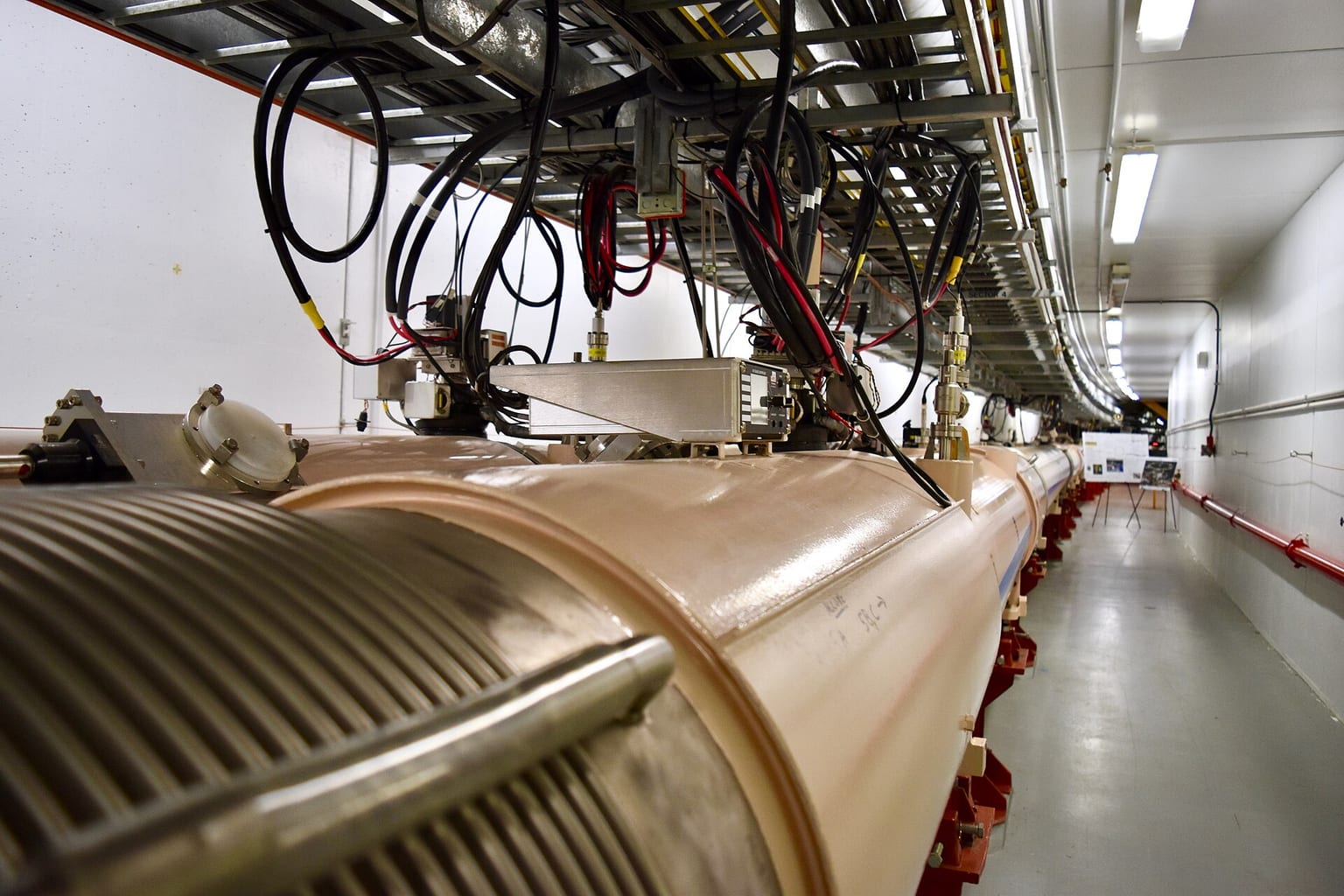
Two oxygen nuclei, each made of eight protons and eight neutrons, hit each other at nearly the speed of light inside the Relativistic Heavy Ion Collider (RHIC) at Brookhaven National Laboratory, in the United States. The impact breaks the nuclei apart and frees their protons and neutrons into the quarks and gluons they are made of. The result is quark-gluon plasma (QGP), the matter that existed during the first few microseconds after the Big Bang, and a tool for working out how protons, neutrons and atoms were first formed.
The plasma is too short-lived to be watched directly, even at RHIC or at the Large Hadron Collider (LHC) at CERN. Physicists therefore study the particles that fly out of each collision, recorded by detectors such as STAR, the Solenoidal Tracker at RHIC. The main clue is jet quenching. Energetic sprays of particles lose energy as they travel through the hot, dense matter left after the nuclei collide, and that loss is considered a signature of QGP. Studying the plasma also helps with other questions, such as the limits of nuclear stability and the search for exotic particles like X-particles. "One of the most powerful ways scientists study the QGP is by identifying where its signatures appear — and just as importantly, where these signatures turn off," said Li Yi, a professor of physics at Shandong University involved in the work.
Gold was the benchmark. Gold nuclei, with 78 protons and 118 neutrons, showed jet quenching, and their lower-energy particles moved together like a perfect liquid with no resistance. The RHIC team wanted to know whether a much lighter system would produce the same signature. Its oxygen-oxygen collisions, run at 200 GeV (200 billion electron volts) at RHIC in 2021, showed 20 percent suppression of high-energy particles from jet quenching. That is lower than the figures for gold and lead, but the researchers say it is still proof that QGP formed. Researchers at CERN have also studied oxygen-oxygen collisions, which lets the two teams compare their findings.
Rongrong Ma, a STAR physicist at Brookhaven National Laboratory, described the goal: "We are pushing the boundaries in two ways to explore the minimal conditions for creating a QGP, both in terms of the nucleus size by looking at these small oxygen-oxygen collisions, but also by looking at data from lower collision energies — and we still see this crucial QGP signature."
For now, the gain is for physics rather than for any device. Theorists who study the early universe and nuclear stability get a smaller, simpler reference point than gold collisions, and experimenters can check their results against CERN's. The collisions also show how far the signature survives as the system shrinks, which is the boundary the team set out to find. No date is given for the next findings. The new sPHENIX detector, now part of RHIC's setup, should bring much more to light in the coming period.
Comments
Loading the thread…
Sign in to leave a comment. Sign in