Radio waves align EVs on wireless chargers within 2.32 mm
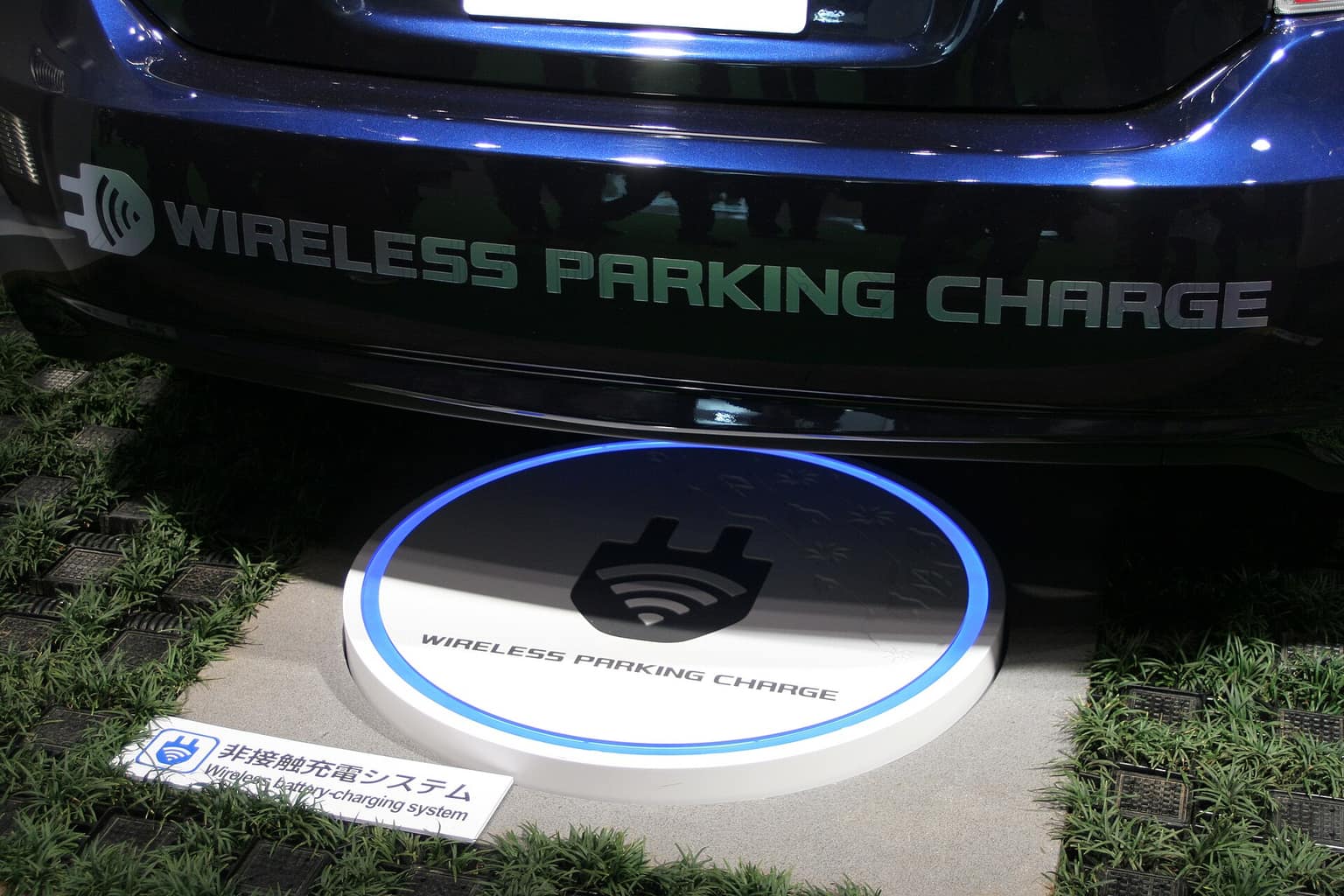
Park an electric car over a pad on the ground, and it charges with no cable. The idea is simple, but the execution is not: wireless charging only works well when the receiver coil under the car sits almost exactly above the charging pad. A few centimeters of offset can lower efficiency and lengthen the charge. A team from the University of Osaka, working with Tokai Rika Co., Ltd. and the University of California San Diego, has built a way to guide the car into place using ultra-wideband (UWB) radio, the short-range technology found in some digital car keys. In laboratory tests, the median position error was 2.32 millimeters and the orientation error 0.25 degrees.
The obstacle is the alignment itself. Existing magnetic positioning systems generally work best when the coil is already close to the pad, and cameras can struggle with rain, dirt or poor lighting. The Osaka method works differently. Four UWB devices mounted around the car's receiver coil communicate with antennas placed around the pad. The system first uses the travel time of the radio signals to estimate the car's rough location. It then uses phase differences, the tiny shifts in how the waves arrive at each device, to refine both position and heading. Distortions specific to each installation are measured in advance and corrected, and the team says that correction matters: without it, the median position error was about five times larger.
The results come from a scaled-down vehicle mockup and from repeated measurements at a fixed stopping position, not from a real car moving into a bay. The study was published on August 26, 2026, in the IEEE Open Journal of Vehicular Technology, with Ryotaro Hada as first author. Hada describes the hardest part as the engineering rather than the mathematics: "Turning a computational method into a working system required considerable trial and error."
The practical gain is clearest for vehicles that cannot ask for help. Autonomous cars and robotaxis that must recharge between trips would not need a person to line them up, and a car that reaches the pad accurately charges more efficiently. Hada's team hopes the result leads to a world where EVs charge "simply by parking, much like smartphones placed on wireless chargers."
The next step, according to the researchers, is testing with full-size vehicles, outdoors and during actual power transfer. Until then, the 2.32-millimeter figure describes a model under controlled conditions.
Sources — read the originals(Paris time)
Read next
Comments
Loading the thread…
Sign in to leave a comment. Sign in