A gallium oxide module switches one megawatt
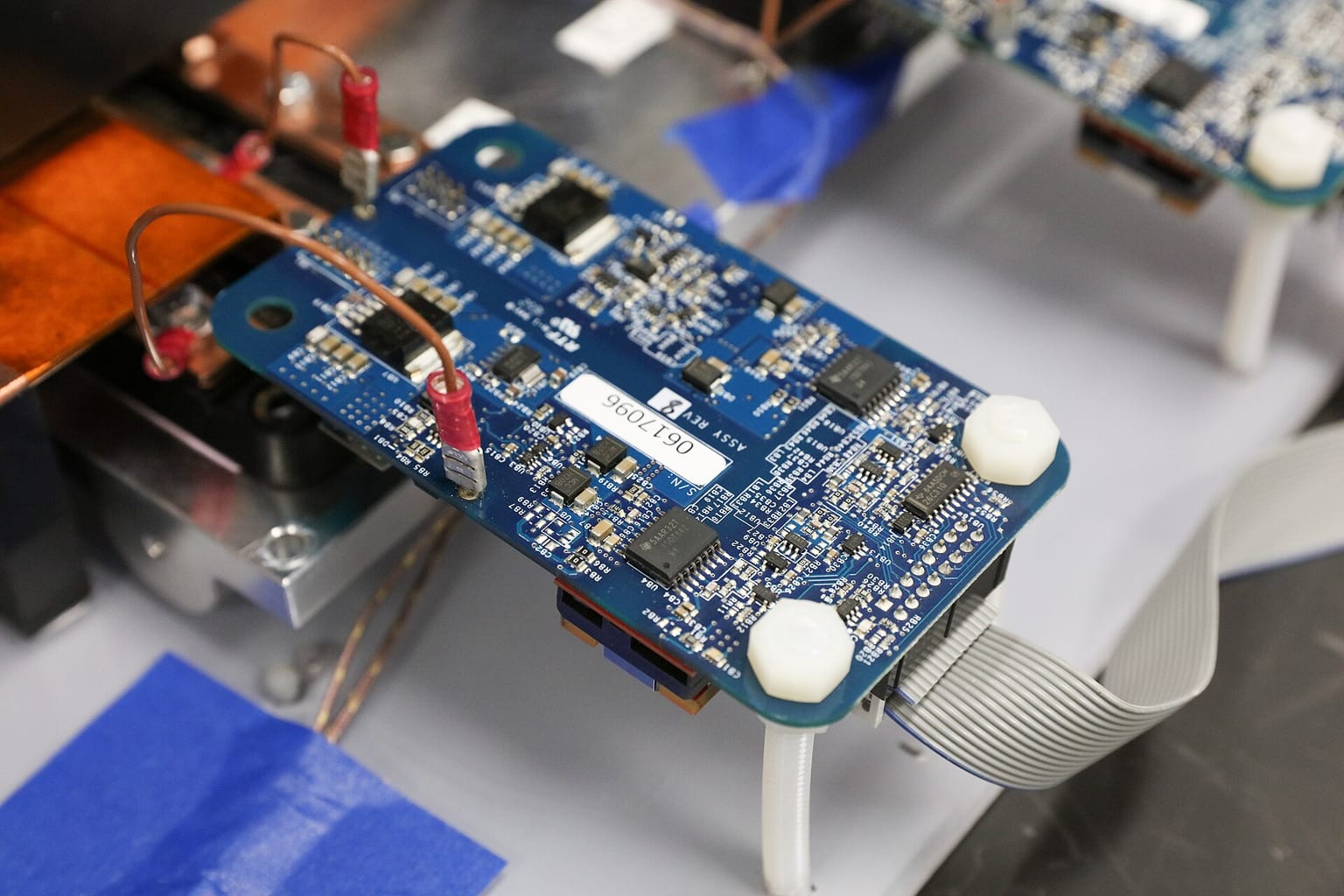
A single packaged gallium oxide device conducted 234 amperes at 1,000 volts during pulsed operation. The team then wired six devices into one module, and that module switched 1,000 volts and 1,000 amperes repeatedly at 1 kHz, a peak power of one megawatt. The work comes from researchers at the University of Hong Kong, led by Yuhao Zhang, Hehe Gong and Xin Yang, with Guo-Quan Lu of Virginia Tech and Jiandong Ye of Nanjing University.
Power semiconductors act as the switches that control and convert electricity, in AI data centers, electric vehicles, renewable systems and power grids. Silicon devices are approaching their physical limits, and silicon carbide and gallium nitride have already brought large gains in efficiency and power density. Gallium oxide belongs to a newer class called ultra-wide bandgap (UWBG) semiconductors, and it withstands extremely high electric fields. Its drawback has been heat: the material does not conduct it well, and packaging several devices together becomes harder as voltage and current rise. That is why practical gallium oxide devices stayed at low power. The team says the result represents more than two orders of magnitude more power capability than previously demonstrated with UWBG technologies, and Gong described it as the first UWBG multi-chip module to reach the megawatt level.
The team's approach was to design the semiconductor and its package together, as one system. The new "junction-side cooling" architecture places the heat-generating region of the device close to the cooling path, and a high-permittivity insulating layer helps spread the electric field around the device. Together, these let heat escape more efficiently while improving the voltage the module can handle. Zhang said the team's aim was to manage the electric field, heat flow and mechanical stress at once. The single device remained functional at junction temperatures above 250°C.
So who benefits, and when? The team points to pulsed-power uses, where very large amounts of electrical energy must be delivered within microseconds. It names high-voltage protection for future power grids, advanced medical systems, particle accelerators and fusion-energy facilities, and adds that the fast switching could allow smaller and more efficient power-conversion systems. These are potential uses, not announced deployments. The results were obtained in the laboratory, under pulsed operation, and the sources give no price, production volume or calendar.
The study builds on the team's earlier work on combining device and package design, which was selected as a Technical Highlight at the 2025 IEEE International Electron Devices Meeting. A 2025 News & Views article in Nature Electronics, titled "Powering the ultrawide-bandgap era", also highlighted the direction. For now, the module shows that a material once limited by heat can switch at megawatt levels, which is the first step for the applications the team lists.
Sources — read the originals(Paris time)
Read next
Comments
Loading the thread…
Sign in to leave a comment. Sign in