AI agent runs an atom-scale microscope from plain-English requests
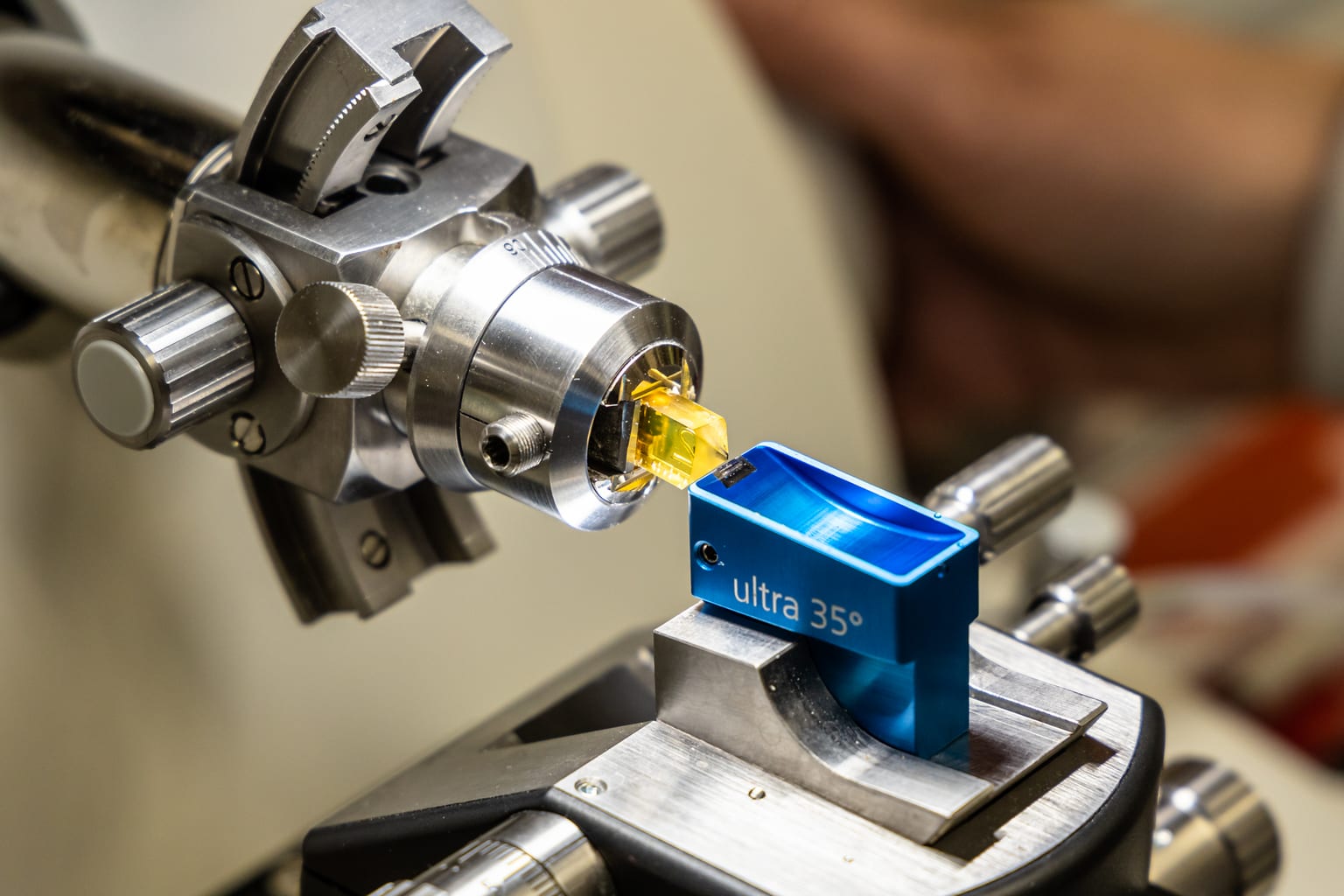
Running one of the world’s most powerful electron microscopes used to take weeks of training. At Lawrence Berkeley National Laboratory, a researcher can now describe an experiment in plain English, and an AI agent runs it on the instrument.
The instrument is a transmission electron microscope, which shows where atoms sit in a material. That arrangement decides how strong the material is, how it conducts electricity, how a battery stores energy and how a drug binds to a cell. The agent was built at the Molecular Foundry, a U.S. Department of Energy user facility at Berkeley Lab, where scientists from universities and companies travel to use microscopes that image structures roughly half the size of a hydrogen atom. The bottleneck was human. Some visiting researchers arrive with a semester of electron microscopy coursework and still need weeks of hands-on training, while one detector produces about 700 gigabytes in 15 seconds, far too fast to process by hand.
The team had already automated repetitive jobs, such as imaging large numbers of nanoparticles. But those routines worked like a factory line, said Peter Ercius, the staff scientist who led the study: they did exactly what they were programmed to do, broke when something unexpected happened, and could not be changed by anyone who was not a robotics engineer. Instead of starting over, the team rewrote them in the Model Context Protocol, an open standard that gives an AI a fixed set of specific, pre-written actions rather than open-ended control. With that toolkit, the agent chains steps together, even for requests no one programmed. “It was pretty amazing that it worked out of the box,” Ercius said.
In practice, the agent adjusts magnification, tilts the sample, refocuses the beam and chains together dozens of small steps. The team tested it on electron tomography, which can take hours. Early on, the agent confused rotating the sample with rotating the scan direction, and a short written explanation fixed it. Stephanie Ribet, a research scientist at the Molecular Foundry, then pushed it toward ptychography, a technique that reconstructs high-resolution images from diffraction patterns. Connecting an AI to scientific hardware is harder than connecting it to literature or data pipelines, she said, and the protocol gave the team a way to bridge the two. The release does not say how many researchers have used the agent so far.
For researchers, the gain is in time. The agent is tied to the National Energy Research Scientific Computing Center, a DOE supercomputing facility, and to Crucible, a Molecular Foundry data platform that organizes experiment metadata. Raw data can be processed in seconds instead of hours, and a scientist can ask which settings were used on a sample weeks earlier without digging through files or notebooks. Morgan Wall, who leads Crucible’s development, said users can talk to one interface instead of juggling five scripts on five computers.
The approach could extend to other instruments with an open interface, and Wall’s team is helping other nanoscale research centers adopt Crucible. The aim, the release says, is not to replace expertise but to extend it, giving new and experienced researchers a faster path from idea to experiment. Ercius expects such assistants to democratize this type of work. The study was published in the journal npj Computational Materials and supported by the DOE Office of Science.
Sources — read the originals(Paris time)
Read next
Comments
Loading the thread…
Sign in to leave a comment. Sign in