Battery-free glasses prototype reads health signals from blinks
Your eyes blink roughly 14 to 20 times a minute, and each blink is motion that normally goes nowhere. At Northwestern University, a team led by Nivedita Arora has built a pair of glasses that turns that motion into power for its own health sensors, with no battery at all.
The prototype is called GlassTENG. It draws energy not only from blinks but also from smiles, jaw clenches and eyebrow raises. Its sensors read those movements, along with the wearer's pulse, to track bruxism (teeth grinding), fatigue and cardiovascular health. The key component is the triboelectric nanogenerator, or TENG: a thin layer that produces a brief electrical charge when two different materials touch and then separate. Here, the materials are the sensor and the skin of the wearer's face. The movement of the face is itself the energy source, which is why the device needs no battery to charge or replace.
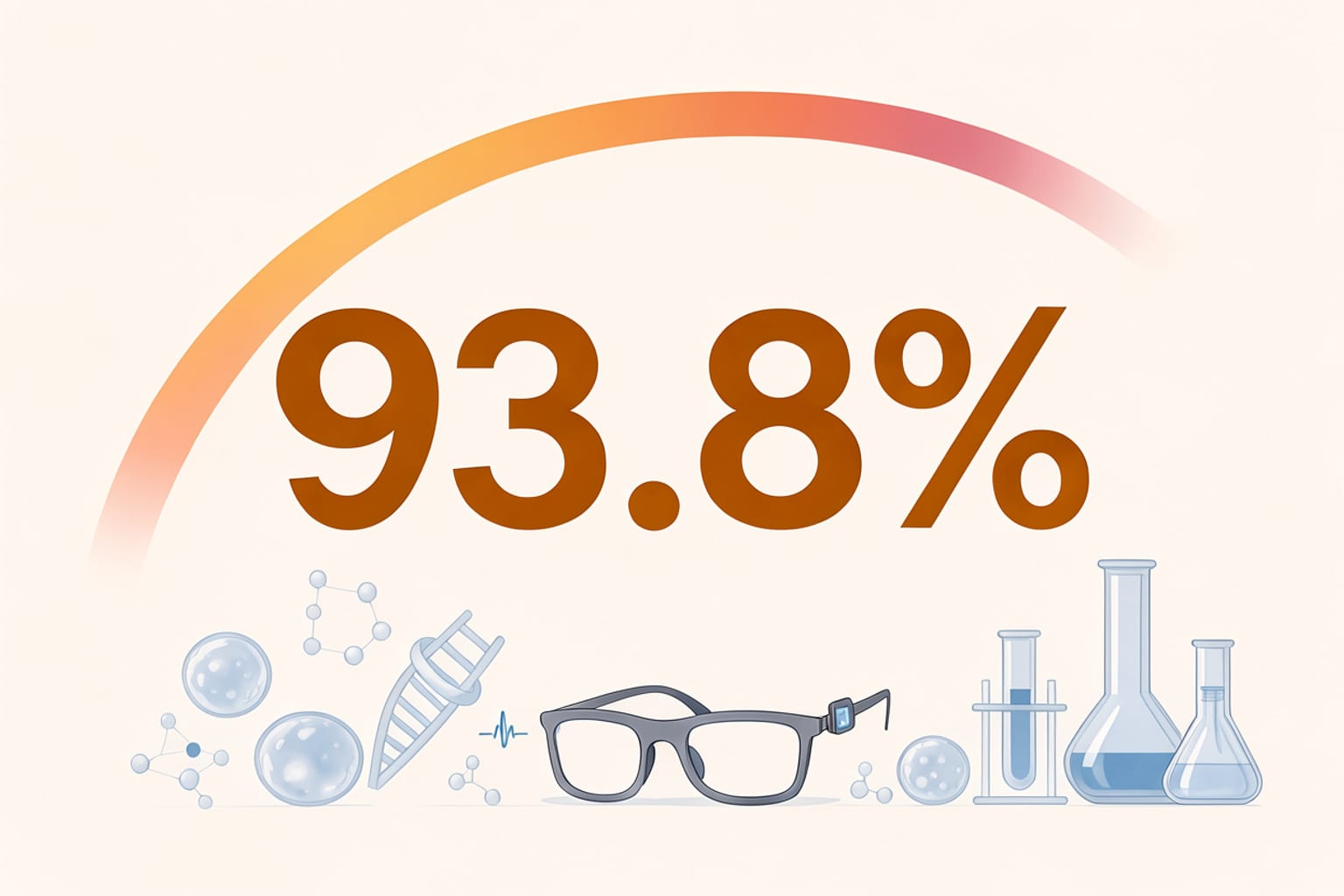
The frame carries three sensors. One sits on the nose bridge, near the angular artery, and picks up pulse, blinks and eyebrow movement. A second rests on the temple and tracks pulse and jaw activity. The third sits closer to the ear and detects chewing and teeth clenching. Each action produces its own signature: 50 to 100 millivolts for the pulse, 200 to 500 millivolts for blinks and eyebrow raises, and up to 1.5 volts for strong jaw movements. A machine-learning algorithm trained on examples analyzed signals from 20 volunteers and reached an overall accuracy of 93.8% in identifying the activity. Teeth clacking was recognized 99% of the time, jaw clenching 96%. For the pulse, tested separately on 10 seated, resting participants, the glasses differed from a reference chest strap by an average of 1.82 beats per minute.
The limits are clear, and the researchers name them. Talking was identified correctly only 55% of the time and was mistaken for eating in 37% of cases, because both activities move the jaw and engage the temporalis muscle, at the side of the head, in similar ways. For now the glasses send their data by Bluetooth to a phone or tablet. The team's next step is on-device computation, which would let the frames react on their own. The reporting does not give a date for that, nor any figures on wear duration or large-scale testing. What the work shows is that the face can power its own sensors, and that a frame people already wear could in principle become a health monitor without a charger. The results will be presented at the UbiComp/ISWC 2026 symposium in Shanghai this week.
Comments
Loading the thread…
Sign in to leave a comment. Sign in