Brain microscope gains 250-fold efficiency
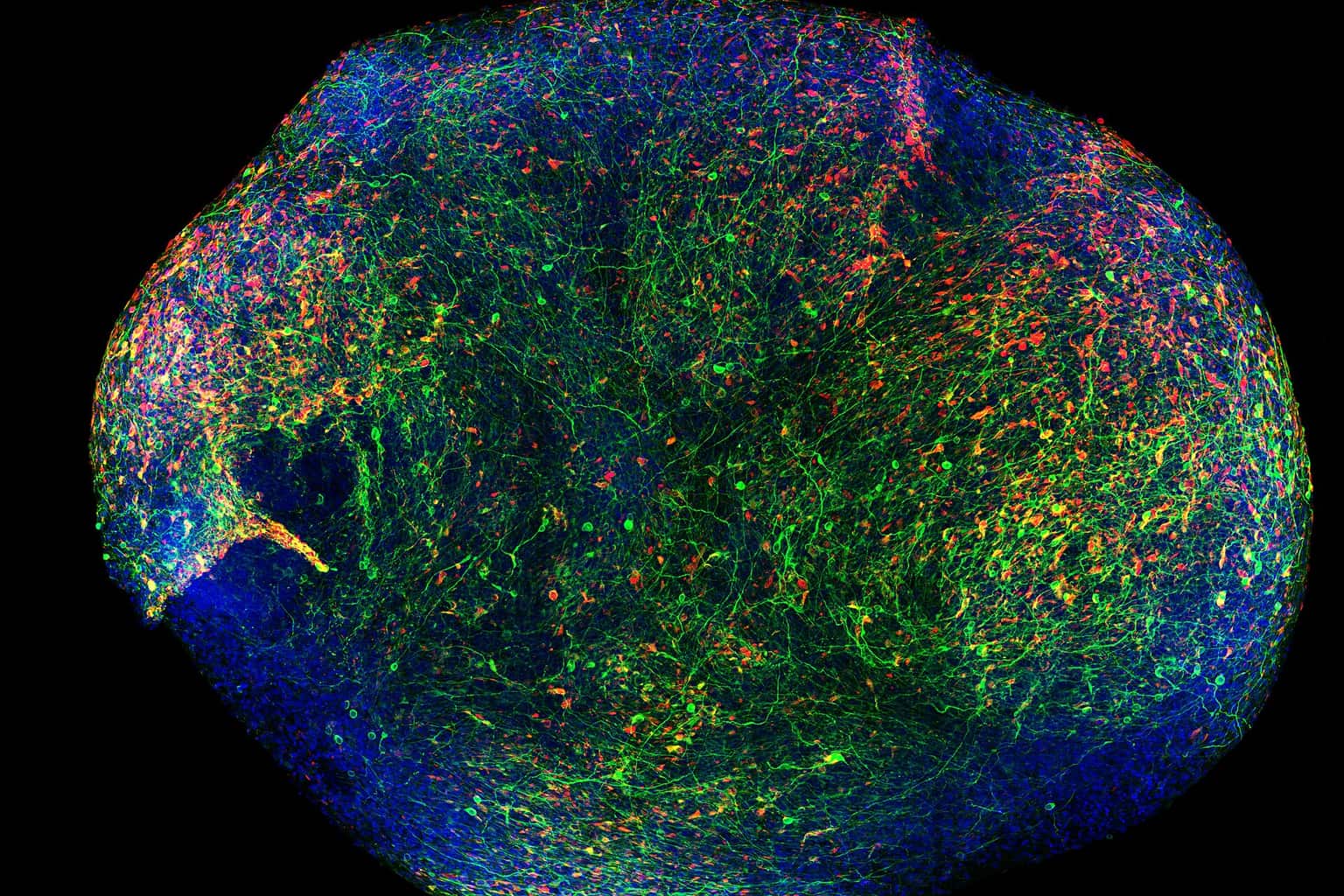
Light scatters as it travels into brain tissue, and past a certain depth a neuron's glow disappears into the background haze. A Rockefeller team has now rebuilt its three-photon microscope from the ground up, and in mice the result is a roughly 250-fold increase in imaging efficiency. The platform, Three-photon Ultra-Deep Imaging, or TrUDI, lets researchers image through the entire mouse cortex and record neural activity in deep regions such as the hippocampus and striatum, without surgically removing the tissue above them. The paper appears in Nature Methods.
Three-photon microscopy is the most promising route to depth, since it generates less background fluorescence than the more widely used two-photon method, which reaches about 0.8 millimeters. The catch is power. Reaching deeper means putting more laser energy into the brain, and that heats and damages living tissue. The deepest functional recordings achieved so far reached about 1.2 millimeters, while the team's calculations put the theoretical limit for three-photon imaging in the mouse brain near 2.3 millimeters.
Rather than tune one component, the team started with computer models of the theoretical limits and optimized every part of the system. It delivers fewer but much more energetic laser pulses at the same average power, and it redesigns how the microscope focuses and collects light. A targeting scheme identifies neurons and activates the laser only as it passes over them, reducing laser exposure by up to 80% during long sessions. Vaziri explains the logic: a single optical change might add a factor of four or five, easy to overlook, but because each improvement multiplies the others, the combined system reaches about 250 times the efficiency.
For neuroscientists, the immediate change is that circuits spread across the depth of the brain can be recorded in one session, instead of being stitched together from shallow layers or accessed through surgery. The report describes this in mice only, and it gives no date for when other laboratories could use TrUDI.
What opens is a way to study one of neuroscience's hardest questions: how groups of neurons deep in the brain work together to produce behavior. Until now, the tools for watching those groups at depth have stopped well short of the regions where they sit.
Sources — read the originals(Paris time)
Read next
Comments
Loading the thread…
Sign in to leave a comment. Sign in