Cold atoms in a lab simulate matter-antimatter pair creation
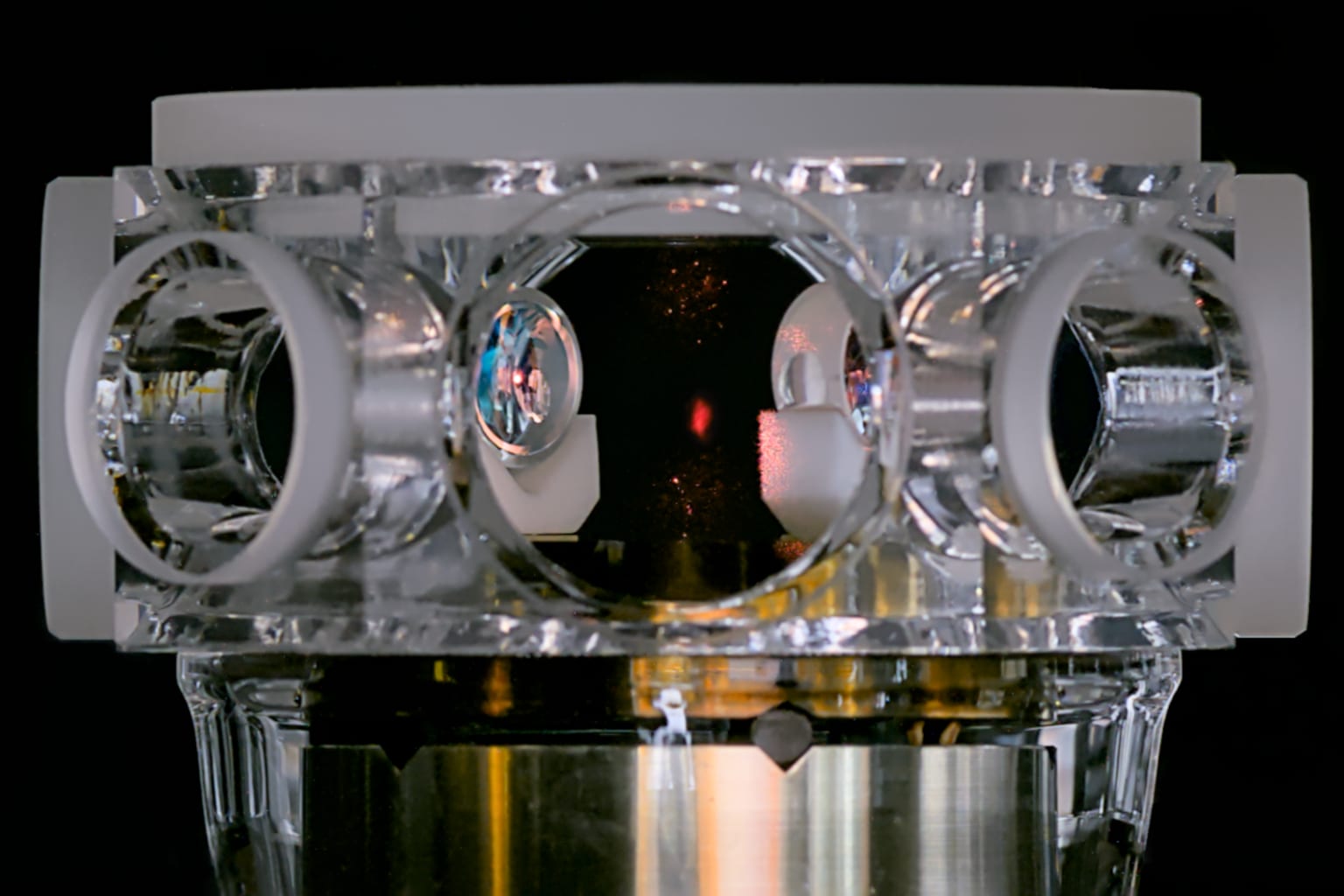
In a straight row of tiny laser traps, every second one holds two rubidium atoms, and the ones in between stay empty. That is the set-up Zhen-Sheng Yuan and his colleagues at the University of Science and Technology of China built to reproduce, in a lab, a process physicists have predicted for decades and never seen in its original form.
Quantum electrodynamics, the theory of light and electrically charged particles, says that a strong enough electric field can turn part of its energy into matter: a particle and its antimatter partner, with the same mass and opposite charge, born from the vacuum. This is the Schwinger effect. The fields needed to trigger it are far stronger than any laboratory can produce, so the process is strongly suppressed and very hard to catch directly.
The trick is an analogy. The team's chain of atoms encodes what they call a 'false vacuum', a state that can release energy by creating a particle-antiparticle pair. By letting atoms hop between neighboring sites in a way that mimics pair creation, and by tuning a background electric field, they control how the process unfolds. A quantum gas microscope photographs the atoms at successive times, so the researchers can watch the simulated creation happen.
The measurements show how the process responds to its conditions. When the simulated particles are heavier, or when the electric field dominates the other interactions in the model, fewer pairs form. With the simulated mass set to zero, the system produces oscillations that resemble the collective excitations predicted by the Schwinger model, and the team links pair production to the vacuum persistence amplitude, which yields long-lived oscillations in some physical limit.
For physicists studying rare quantum-field processes, this gives a controllable benchmark that can be adjusted at will, instead of waiting for fields that no experiment can reach. The model is still a one-dimensional chain, and it simulates pair creation rather than producing antimatter. The team plans to study what happens when the simulated particles meet, collide and scatter, and it hopes to extend the platform to two dimensions and to other gauge theories, where phenomena such as string breaking would become accessible.
Sources — read the originals(Paris time)
Read next
Comments
Loading the thread…
Sign in to leave a comment. Sign in