First tunable three-component quantum system, built
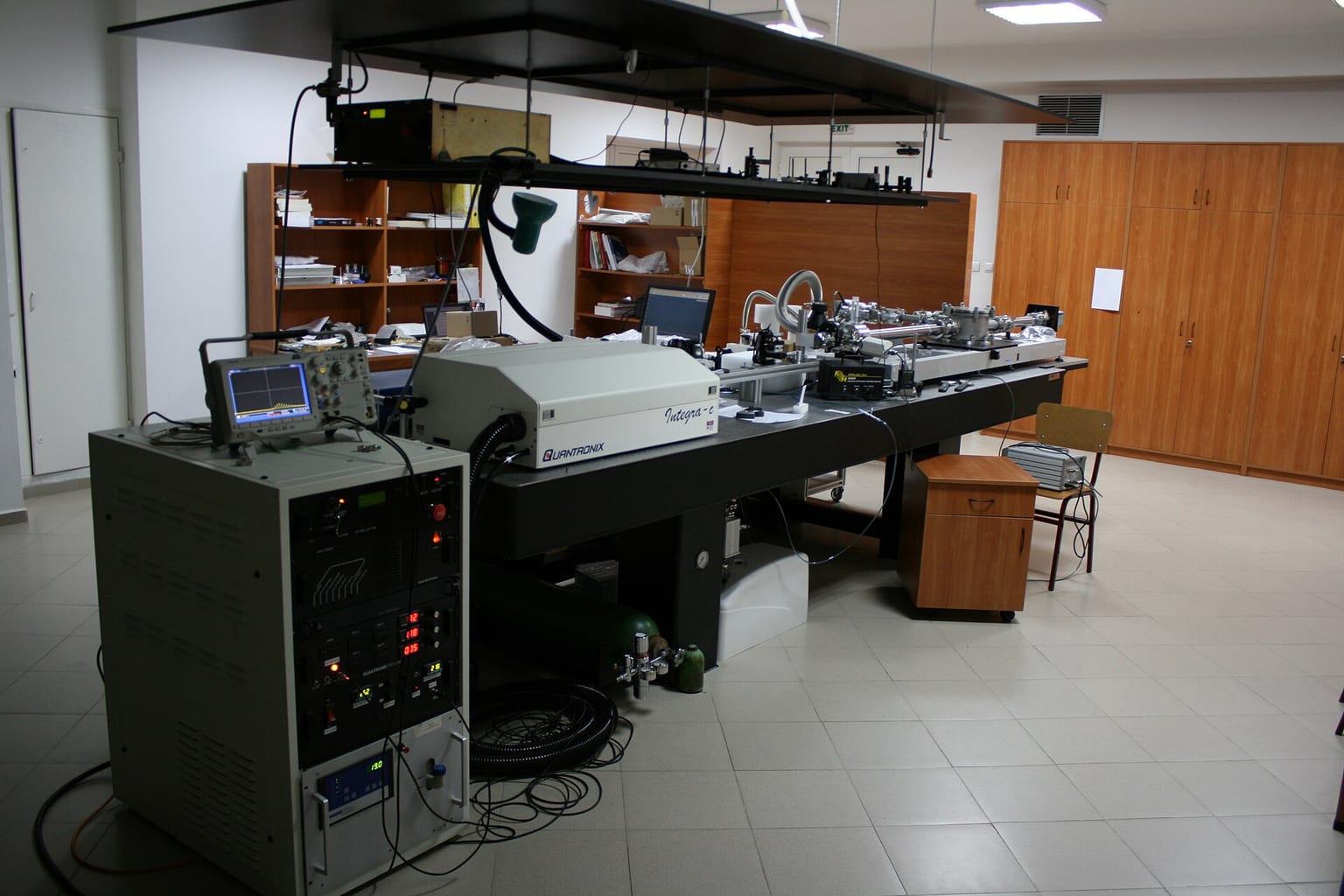
Ultracold atoms, held in a grid of light, now behave like the electrons of a solid, and for the first time each one can be seen. An international team from Germany, Thailand, India, China and the United States has created a three-component Hubbard system with tunable interactions in the laboratory. The researchers used a quantum gas microscope to make the individual atoms visible. The study, published in the journal Science, was led by Peter Schauss, who works at the University of Hamburg and in the Cluster of Excellence “CUI: Advanced Imaging of Matter.”
The Hubbard model is one of the central models for describing how fermions, particles such as electrons, interact on a lattice. Its standard version considers two spin states, spin-up and spin-down. It has been studied for decades, and it is considered particularly promising for understanding high-temperature superconductivity. “Although the Hubbard model is important and simple to write down, it isn't easy to solve,” said Kaden Hazzard, associate professor of physics and astronomy at Rice University and co-author of the work. “Theorists have been banging our heads on the two-component Hubbard model for decades, yet there are still major open questions.”
The mechanism works like this. In an optical lattice, the atoms tunnel from one site to another, effectively swapping places. Identical fermions cannot occupy the same site. When two distinguishable fermions meet on one site, an interaction energy appears that depends on the magnetic field. By placing atoms in different internal states, the team realized three distinct types of fermions. The result resembles nuclear physics, where quarks can have three different colors, even though the system remains very different from the electrons of solid-state physics.
The experiment produced several results. The team observed a Mott state, in which interactions suppress the double occupation of sites and strong interactions keep particles from flowing freely, which produces insulating behavior. The researchers note that high-temperature superconductivity emerges near Mott states. Schauss said the setup proved “surprisingly stable”: three-body collisions could in principle destroy the system quickly, but the measurements went through and a Mott insulator was observed. The team also identified many other phases, which depend on the strength of the interactions. In the same system, ferromagnetic correlations between two states and antiferromagnetic correlations between two others can occur. A method to count the triply occupied sites gave values that agreed with numerical calculations performed by collaborators at Rice.
For theorists, the immediate gain is a testing ground. The experiments give them a system whose parameters can be adjusted and read atom by atom, which allows sophisticated numerical calculations to be checked directly. Hazzard said these comparisons will help refine the theoretical tools in turn. The study is a foundation rather than a finished application, and the researchers give no date for the work that would follow.
The next step is already set. The team plans to further refine the interactions in its model, so that it can study lattice models of quantum chromodynamics in the laboratory.
Sources — read the originals(Paris time)
Read next
Comments
Loading the thread…
Sign in to leave a comment. Sign in