Eight tests could reveal whether lab-grown brain tissue has a mind
Imagine hearing ba, ba, ba, ba, bu, over and over. After a while, the brain learns the pattern. Then comes ba, ba, ba, ba, ba: the listener consciously perks up, because the expected bu is missing. Lucia Melloni of Ruhr University Bochum, in Germany, and Stanislas Dehaene of the Collège de France, in Paris, now propose to run a version of that test on brain organoids. Their framework appears in Neuron, in a special issue on the tissue, published on 11 November 2026.
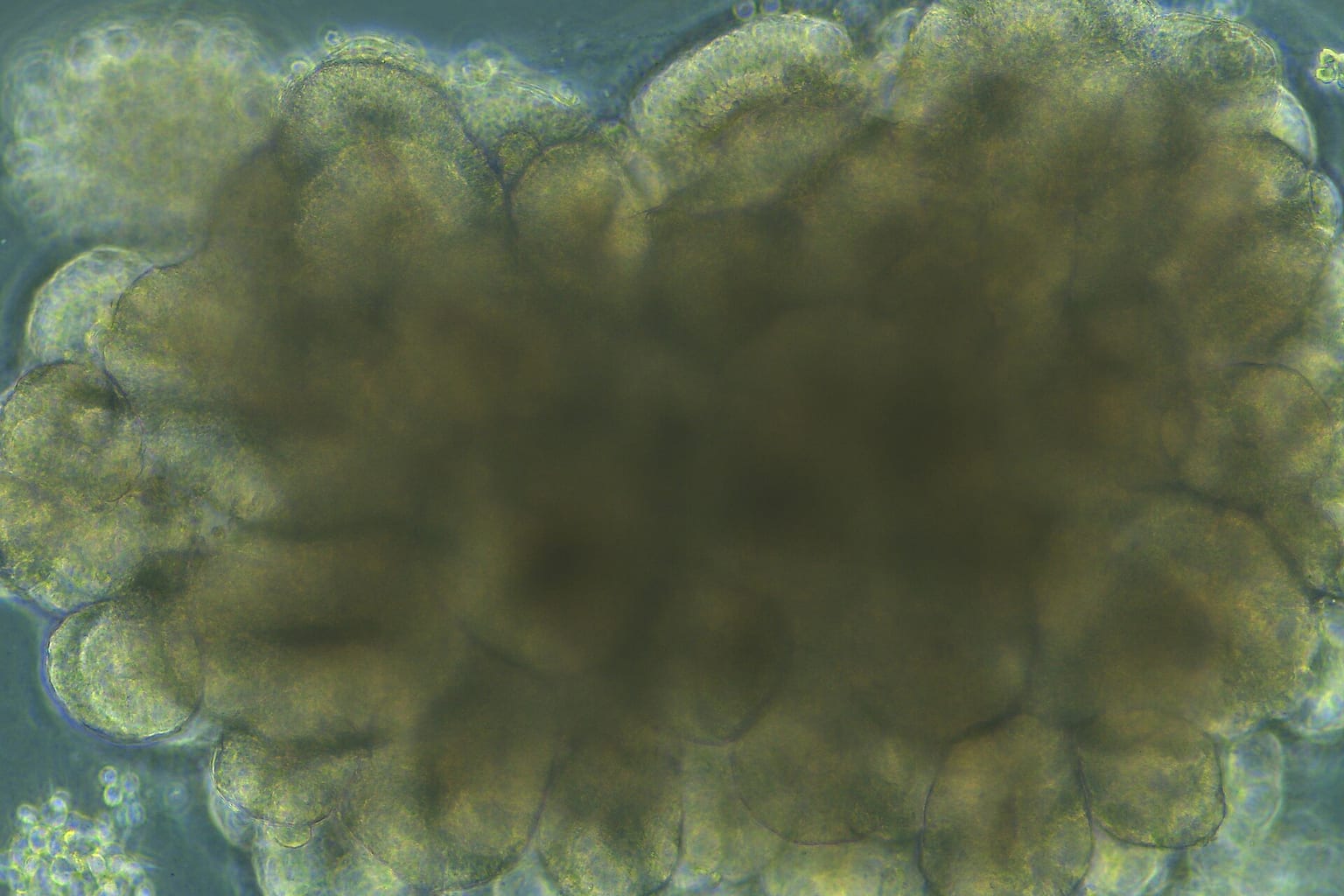
Organoids are grown from human pluripotent stem cells, cells that can turn into many cell types. Under specific chemical treatments, they form tiny cell clusters that behave like particular brain regions, the heart or the gut. Some have already been implanted into mouse embryos, where they formed connections with the embryo. Researchers have also coupled four organoids into an assembloid that reconstructed a pain signaling pathway; it reacted to capsaicin, the active compound in chili peppers. Melloni is careful about what that means: a reaction is not proof that the tissue feels anything.
The proposed test works like this. Scientists stimulate the tissue with different sequences of electrical signals and measure its electrical response, to see whether it reacts to the absence of an expected signal, as the listener does. Melloni and Dehaene propose eight tests that require varying degrees of complex neural processing, some of them linked to consciousness in adults. "If an organoid responds to several of these tests in a certain way," Melloni says, "that would be evidence that it has developed something akin to a mind." Even then, stimulus responses alone do not establish subjective experience.
The limits are real. Current organoids differ from a normal brain in size, number of neurons and maturity, and they lack sensory input and behavioral output, according to a review of human brain organoids published by Springer. The prevailing consensus among researchers is that they should currently be regarded as non-conscious entities. Kenneth Kosik, a neuroscientist quoted by Live Science, says consciousness may be possible, but not in the near future.
For the rest of us, the payoff is indirect but real. Melloni expects brain organoids to yield insights into curing certain diseases and into how the human body responds to climate change. She also wants an international board to regulate the field, and a first debate with all the relevant actors took place at the Asilomar Conference in California in 2025, which she attended. The authors give no date for when the tests could be run, so for now the framework is a method on paper.
Sources — read the originals(Paris time)
Pages consulted while writing
Read next
Comments
Loading the thread…
Sign in to leave a comment. Sign in