First direct mass limits on early black hole pairs, from pulsars
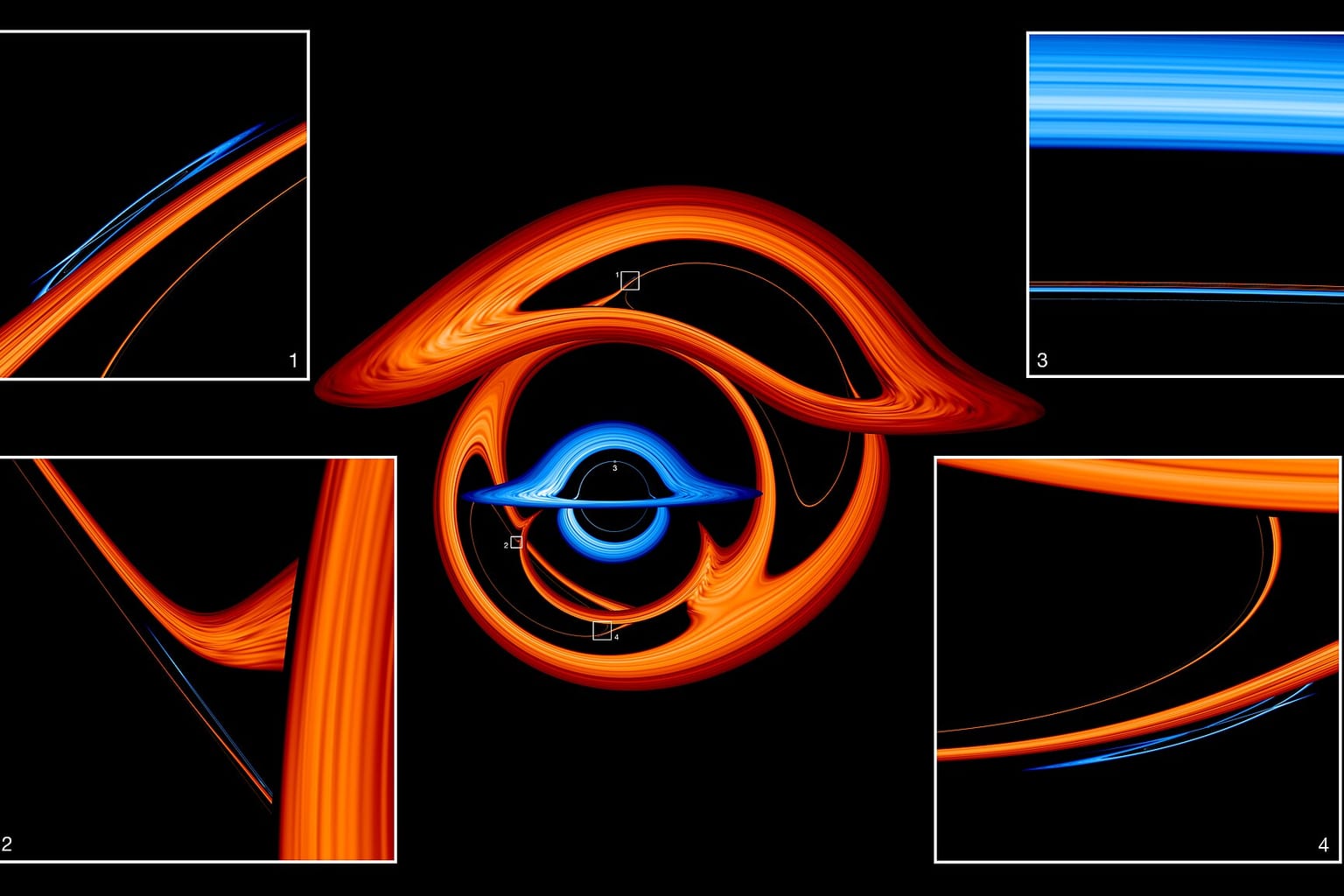
A black hole already weighing billions of times the mass of the Sun, less than a billion years after the Big Bang: that is what telescopes such as the James Webb Space Telescope (JWST) have revealed, and astronomers still cannot say how these giants grew so fast. A team led by Yiqin Chen at Beijing Normal University has now placed the first direct limits on pairs of such black holes in that early era, known as the cosmic dawn, using gravitational waves detected through pulsars.
When two supermassive black holes orbit each other, they stir the spacetime around them and send gravitational waves rippling outward. For pairs this massive, a single orbit can take around a year, which makes their waves far too slow for detectors on Earth. Astronomers instead use pulsar timing arrays: networks of rapidly spinning neutron stars spread across our galaxy, which flash with the regularity of cosmic clocks. A passing gravitational wave shifts the timing of those flashes in a pattern shared across the whole array.
The obstacle was distance. Standard searches ignore the expansion of the universe, which stretches gravitational waves as they travel, and that stretch can lead to wrong mass estimates for distant pairs. Chen's team built a method that accounts for this strong redshift. A wave arriving at Earth was emitted at a higher frequency, when the black holes were orbiting more tightly and producing stronger waves, and this brightening can outweigh the dimming caused by distance.
The researchers analysed 18 years of observations of 30 pulsars from the Parkes Pulsar Timing Array in Australia. They combined this with the known positions and redshifts of two targets: an ultrabright quasar observed less than 900 million years after the Big Bang, and one of the most distant galaxies ever spotted by JWST, seen less than 300 million years after the Big Bang. For both, the team ruled out pairs of around 10 billion solar masses or more. These are limits, not detections: they bound the masses of any pairs in these systems, and lighter pairs remain outside what the current data can reach.
For astronomers, the result changes the logic of the search. Greater distance does not necessarily make black hole pairs harder to detect, which opens a new way to hunt for them and could help explain how such massive black holes appeared so early. The team now expects the constraints to tighten. Parkes is combining its data with other arrays, and the future Square Kilometer Array is expected to sharpen pulsar timing. Combined with dedicated searches for short gravitational-wave bursts, these studies could bring less extreme pairs within the reach of observations.
Sources — read the originals(Paris time)
Read next
Comments
Loading the thread…
Sign in to leave a comment. Sign in