Search finds a spinning dead star in 10 hours, not 600 years
Every three hours, NASA's Fermi Gamma-ray Space Telescope sweeps the entire sky, and its observations are released openly as soon as they are processed. In that archive, which now holds 18 years of data, sits a spinning star that the previous best search method had missed. An international team has now found it using the equivalent of 10 hours of computing time on a standard processor, a search in which the old method missed the pulsar, although a standard processor would have needed 600 years to run it.
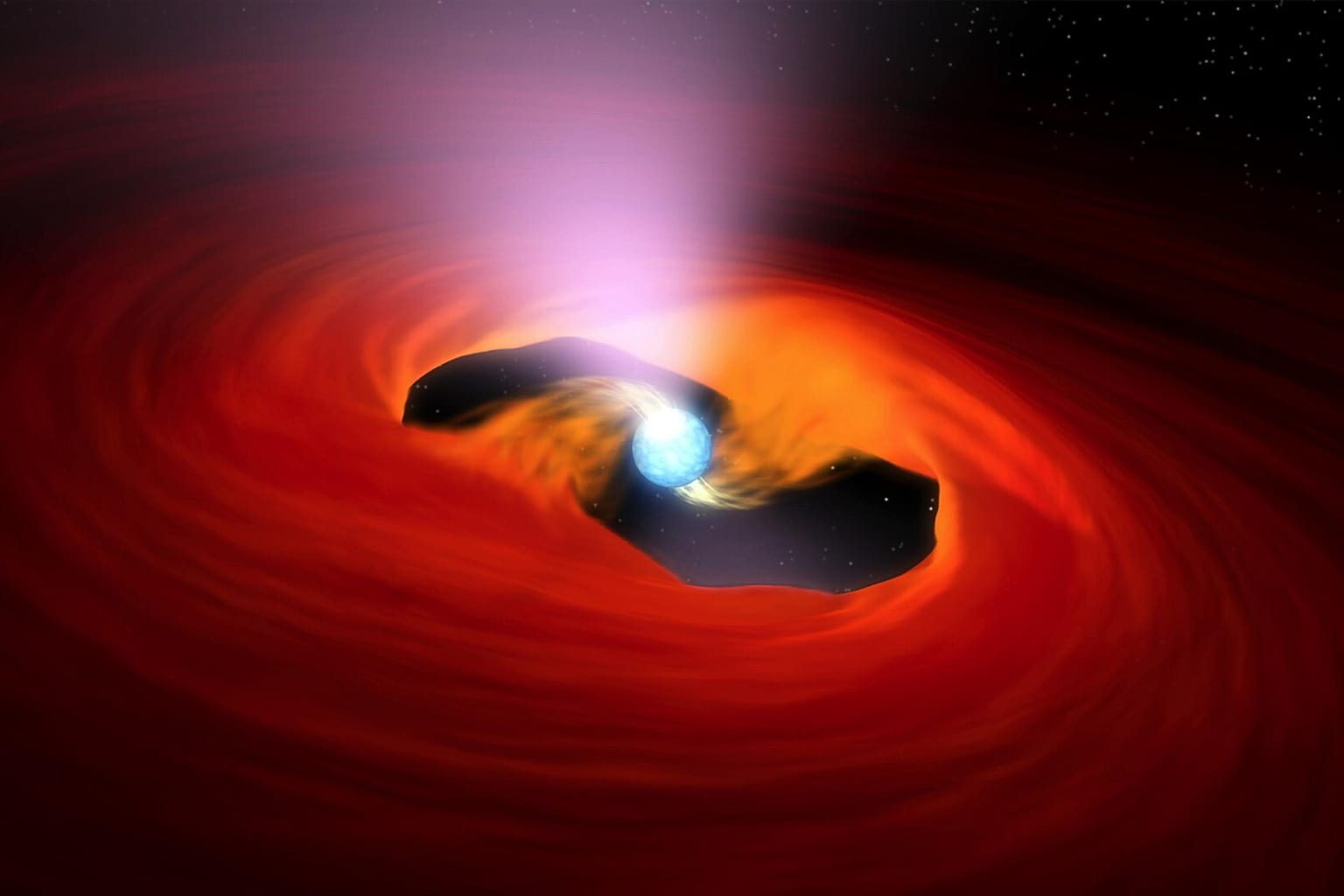
The star is a pulsar: the dense core left when a massive star's core collapses, a neutron star that spins fast and sweeps beams of radiation past Earth like a lighthouse. Finding one in gamma-ray data is hard. Fermi catches only a tiny number of photons from any given pulsar, mixed in with noise from other gamma-ray sources and the wider universe. To pick the signal out, researchers must guess three unknowns at once: how fast the star spins, how quickly that spin is slowing, and exactly where it sits in the sky.
Trying every combination is out of reach. “We have a four-dimensional grid, and we must search each direction with millions of trials in it,” said lead author Daniel Pook-Kolb, a scientist at the Max Planck Institute for Gravitational Physics in Germany. “There’s just not enough computing power on Earth to do it.” The usual workaround was to cut the data into chunks and hand them to volunteers, whose idle computers ran the searches. Even so, identifying a single pulsar typically took hundreds of computer-years.
Dotan Gazith and Barak Zackay, of the Weizmann Institute of Science in Israel, took a different route. They recast the search as a geometry problem: finding the shortest vector in a high-dimensional lattice, which is simply a regularly spaced array of points. The algorithms for that task were built by cryptographers trying to break encryption designed to resist future quantum computers, and they have also been used to make satellite navigation more efficient. “We have nothing to do with cryptography in our analysis here,” Gazith said, “but those algorithms can help us solve the problem of searching for pulsars in our data.” Each trial ran on a single processor core, the kind found in an ordinary laptop. Once a candidate appeared, the team checked it against the full Fermi data set, and the signal was far too strong to be chance. The results were published on 19 November 2026 in Physical Review Letters.
For astronomers, the change is practical. The team says the method is about a million times faster than before, which turns a search that once took hundreds of computer-years into one that takes hours of computer time. The team’s next target is harder: pulsars in binary systems, where a pulsar orbits another star. Those have long been considered out of reach, because the companion’s gravity distorts the signal. Colin Clark, an astrophysicist at the Max Planck Institute who co-authored the study, said the data probably hold “tens or maybe even hundreds” of pulsars that nobody has yet found. That is an estimate, not a count. The plan is to combine the new algorithm with the volunteer computers of the Einstein@Home program, and to extend the searches to those binary systems.
Sources — read the originals(Paris time)
Pages consulted while writing
Read next
Comments
Loading the thread…
Sign in to leave a comment. Sign in