A space telescope spots 60 new cosmic sources in a blind spot
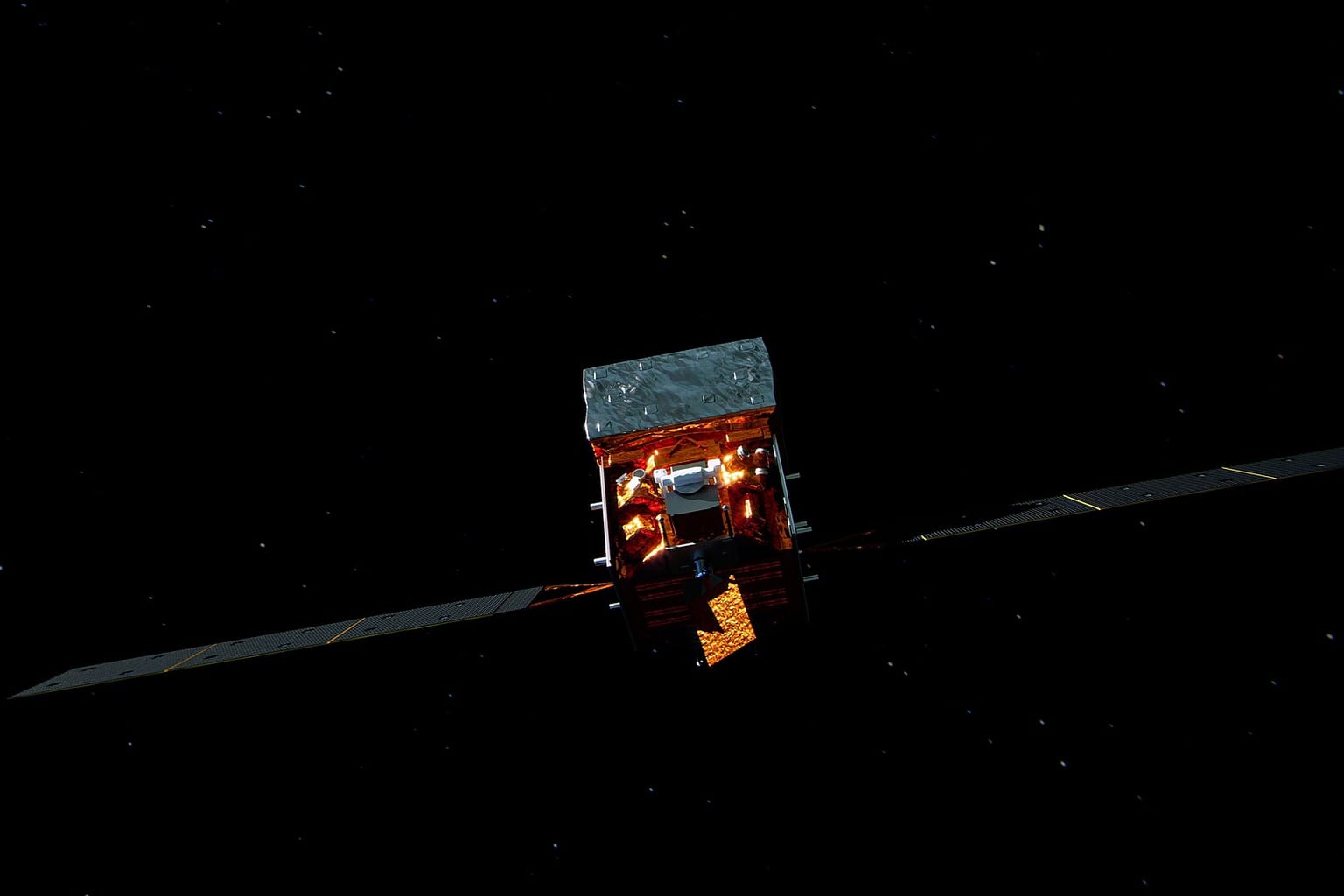
For nearly two decades, one band of cosmic light has been almost invisible to astronomers. In early November, NASA released a catalogue that fills part of that blank: 450 sources of gamma rays between 20 and 200 MeV, the unit physicists use for this energy, which sits between the X-rays and the highest-energy gamma rays. According to the international team that built it, 60 of those sources had never been detected in gamma rays before. The paper was published in The Astrophysical Journal Supplement Series.
What changes for astronomers is the picture of the most violent objects in the sky. Of the 450 sources, 377 match a known object seen in radio, optical or X-ray data. Most of the rest are far outside our galaxy: 325 sources are extragalactic. Almost half of the whole list is made of flat-spectrum radio quasars, a type of blazar, meaning a supermassive black hole that points one of its two jets of plasma straight at Earth. The catalogue confirms that these blazars release most of their energy in exactly this band. For anyone studying black holes and their jets, that is a measurement they did not have before.
The gap has a simple cause. Gamma rays pass straight through mirrors, so the usual telescope cannot focus them. The Fermi Large Area Telescope, known as Fermi-LAT, works more like a particle detector in orbit. When a gamma ray hits a layer of tungsten, it turns into a pair of particles, an electron and a positron, and the instrument traces their paths back to the source. At around a gigaelectronvolt, that trail points clearly to one place. At 20 MeV, the particles scatter, and a single photon can only be placed in a patch of sky about 20 degrees wide, more than 40 times the size of the full moon. Add the glow from the Sun and from distant galaxies, and the signal is hard to pick out. The team's answer was time: 14 years of data, combined with advanced statistical methods, separated 450 sources from that background.
Closer to home, the catalogue lists 52 sources in the Milky Way. Most are pulsars, the spinning remnants of stars that exploded as supernovae. One stands out: gamma rays that appear to come from M2, a globular cluster, which, if confirmed, would be the first time this cluster has been seen at gamma-ray energies.
The most open part of the list is the 73 sources with no clear counterpart at other wavelengths. Sixty of them appear to be new gamma-ray discoveries. The team notes that some may be overlapping signals from neighbouring objects, but at least some could be exotic cosmic accelerators that nobody has yet observed. One of them, 2FLE J0340.8+5258, also seems to have been detected by a Chinese observatory and appears to emit light across nine orders of magnitude in energy. The limits are real: the faintest sources are harder to find in the plane of the galaxy, which the researchers attribute to Fermi-LAT's sensitivity at these energies. And the telescope itself seems to have squeezed out nearly everything this data set can give.
The next step is an instrument built for this band. NASA's Compton Spectrometer and Imager, COSI, is designed to observe gamma rays between 0.2 and 5 MeV with a germanium detector, a type of sensor that only became available in the last few years. No launch date is given in the material available. Combining its observations with 14 years of Fermi data is the approach the team points to for finally closing one of the longest-standing blind spots in the high-energy sky.
Sources — read the originals(Paris time)
Pages consulted while writing
Read next
Comments
Loading the thread…
Sign in to leave a comment. Sign in