First look at a star swallowing its companion, in Andromeda
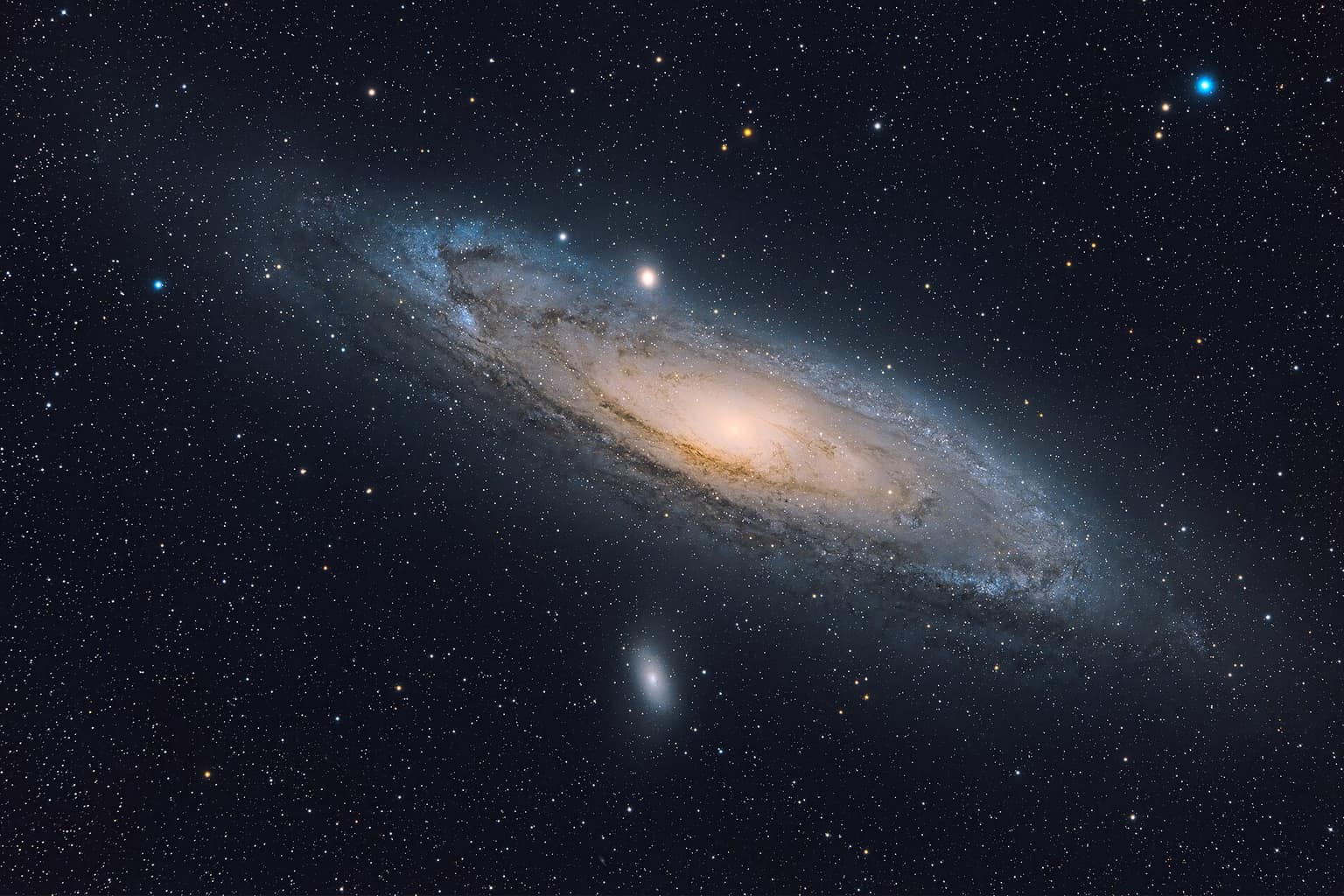
One day in October 2025, a star in the Andromeda galaxy began to brighten. Within a week it had reached its peak. The outburst was the visible end of a story that had been unfolding for years: a smaller star sinking into the outer layers of a giant, until the two merged. This time, astronomers caught the story while it was still happening. NASA's James Webb Space Telescope observed the system in December 2025, and its data gave researchers the last evidence they needed to reconstruct the sequence, from before the merger to just after it. They nicknamed the surviving star Bao.
Such events are hard to catch in time. "Stellar mergers are very, very difficult to observe in real time because they are hard to predict," said Viraj Karambelkar, a NASA Hubble Fellow at Columbia University in New York and first author of the new paper in Nature. His team had been following the system since 2023. Bao first stood out in February 2023, in data from NEOWISE, a NASA infrared survey now retired. One account places the start of the inward spiral in 2018, earlier than the team's first flag.
When the eruption came, the team had a rare window. Webb observed Bao only 47 days after the eruption peaked, the earliest follow-up ever made of an event of this kind, according to the team. "Absolutely mind-blowing," Karambelkar said of the result, because the data showed what the system looked like before, during and immediately after the merger.
Before that, the two stars had spent millennia circling each other as a binary pair, two stars bound by a shared orbit. The larger one was an extraordinary object. The team concluded that it was seven times as massive as the Sun, 350 times its radius and 18,000 times brighter. "It was an absolute beast of a star, completely outshining its companion in the data," said Karel Temmink, a PhD student at Radboud University in Nijmegen, Netherlands, who led the simulations. The smaller star, slightly less massive than the Sun, was the one that would be swallowed.
The merger itself went faster than the waiting. Once the smaller star touched the surface of the giant, their union took only seven orbits, or about seven years. Other known mergers between two smaller stars took thousands of orbits. The phase that followed is called a common envelope: the gas around both stars is shared between them. The companion plunges through that gas, and the drag drains its orbital energy, so it spirals inward. "As the companion continues its orbit, it keeps peeling off the primary star's outer layers, and that gas flows away into the surrounding space," said Kishalay De, an assistant professor at Columbia University.
The early stage is subtle. De said that when a companion starts to interact with the outer surface of its partner, it produces "a slow brightening, which we clearly saw in Bao's data." The peak, however, was fast. Co-author Nadia Blagorodnova, an associate professor at the University of Barcelona, said the team had expected an outburst from such an extended star to take years. "One day, its brightness started rising and within a week, it peaked!"
Rebuilding the sequence required a model that matched what Webb saw. Webb's mid-infrared observations, which are sensitive to heat and to dust, revealed the material the giant had shed over centuries. The team's ongoing simulations were updated until one matched that dust. That model also produced the first mass estimate for the smaller companion, which is now, in NASA's words, demolished.
A merger was not the only possible outcome for this pair. In other systems, both stars survive the process, losing a lot of mass but remaining independent in tight orbits. Over time, such pairs can end in spectacular ways, from black holes to stellar explosions. Webb's data established that the stars merged here, which is why the case stands out.
Bao is also, according to a follow-up study of the event, the brightest event of its kind ever found in Andromeda, and the fourth such event recorded in that galaxy in the last 40 years. Theory already links mergers to blue straggler stars and blue supergiants, so each well-documented case gives astronomers a test of those links. For anyone curious about how stars age and transform, the case shows the process in a neighboring galaxy rather than only in models.
The next step is to look again. A follow-up study of the event argues that it will be crucial to observe AT 2025abao, the system's catalogue name, years after the event with space telescopes, especially in the infrared.
Sources — read the originals(Paris time)
Pages consulted while writing
Read next
Comments
Loading the thread…
Sign in to leave a comment. Sign in