Radio images reveal Betelgeuse's hidden companion Siwarha
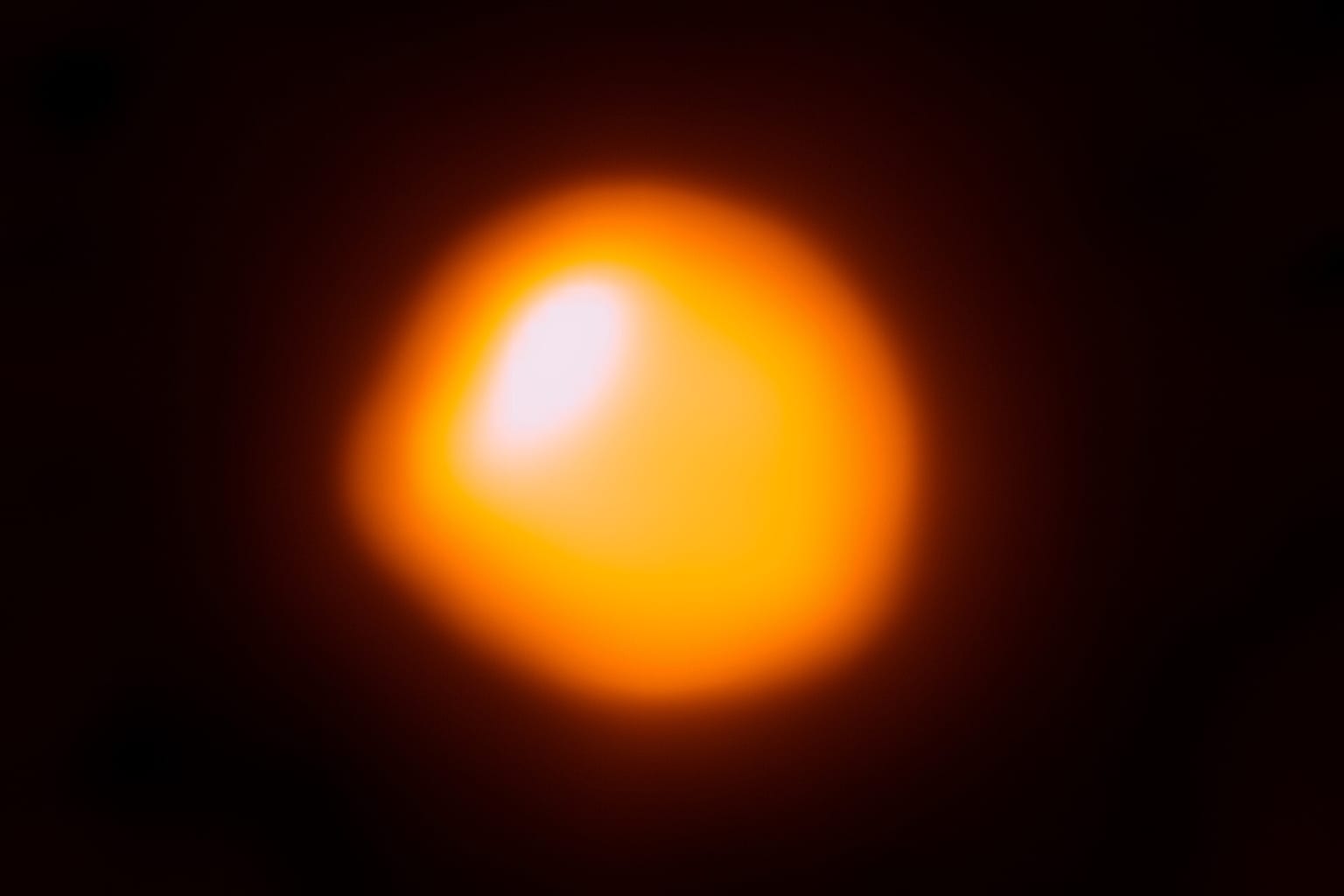
Betelgeuse, the red supergiant that marks the shoulder of Orion, has a houseguest nobody could see until now. Radio images show that the star's outer atmosphere is being stirred by Siwarha, a smaller and hotter companion that orbits so close to Betelgeuse that it moves through the gas itself. The star's visible surface does not show the disturbance, but the radio layers do.
Betelgeuse drew wide attention in late 2019 and early 2020, when it dimmed to its faintest in more than a century of record-keeping. A new study led by Dr. Lynn D. Matthews of MIT Haystack Observatory, with colleagues from the Center for Astrophysics | Harvard & Smithsonian, the University of Manchester and the European Southern Observatory, shows that the star's extended atmosphere has largely recovered. Its brightness temperature at radio wavelengths has climbed back to more typical levels. The gas now measures around 3,500 kelvin near a radius of about 2.7 times the star's own size. An earlier study by Matthews, published in 2019, had found that same atmosphere unusually cool, a sign that a shock wave from convection deep in the star had disturbed the outer layers before the dust-forming outburst.
The team also confirmed a long-suspected “temperature minimum”, a cool layer between the visible surface and the chromosphere above it. ALMA's highest-frequency measurements reached closer to the surface than any earlier radio observation, and found gas at roughly 2,200 kelvin, more than 1,000 degrees cooler than the photosphere, the visible surface layer. That cool zone coincides with the “MOLsphere”, a shell of molecular gas that infrared observations had suggested for years but that radio waves had rarely probed so directly.
Siwarha was proposed in 2024 to explain Betelgeuse's 2,100-day brightness cycle, and it has since been supported by direct imaging and spectroscopic studies. Its name means “her bracelet”, in line with Betelgeuse, which means “the hand of al-Jawza” in Arabic. The companion is too faint to detect directly at radio wavelengths, by the team's estimate tens to hundreds of times too faint. The researchers instead measured the star's “ellipticity”, the slight egg-like shape of its radio-emitting atmosphere, across several observing periods. The star looks more elongated when the companion is at its greatest apparent separation, and rounder when it passes in front of or behind the star. “This companion is orbiting so close to the star that it actually passes through its extended atmosphere,” Matthews said. The effect is like ripples on a pond that reveal something moving beneath the surface.
For astronomers, the result shows that radio observations can track an unseen companion through its effect on a giant star, and resolve the disks of nearby stars in the process. Confirming it will take observations across more of Siwarha's orbit, especially at frequencies that the current data sample poorly. The team expects the Next Generation Very Large Array, still in development, to make such studies far more routine and to give a sharper view of how red supergiants like Betelgeuse shed material in their final stages.
Sources — read the originals(Paris time)
Read next
Comments
Loading the thread…
Sign in to leave a comment. Sign in