Fragile MOF crystals etched at room temperature
Blast a crystal of metal–organic framework with an ion beam and, in the usual process, it collapses into ruined cavities. For years, the only way to protect these porous materials during the cutting of microscopic patterns was to freeze them with liquid nitrogen, in costly cryogenic equipment.
Metal–organic frameworks, or MOFs, are porous materials that link metal ions with organic molecules. The idea dates from 1974, when Richard Robson, a chemistry professor at the University of Melbourne, began building such structures with copper ions and a four-armed organic molecule. Their pores can trap pollutants, drive chemical reactions and hold gases. They are also candidates for chemical sensors and electronic devices, but those uses depend on shaping them, and dry etching, which uses energetic particles to remove material, is precisely what damages them.
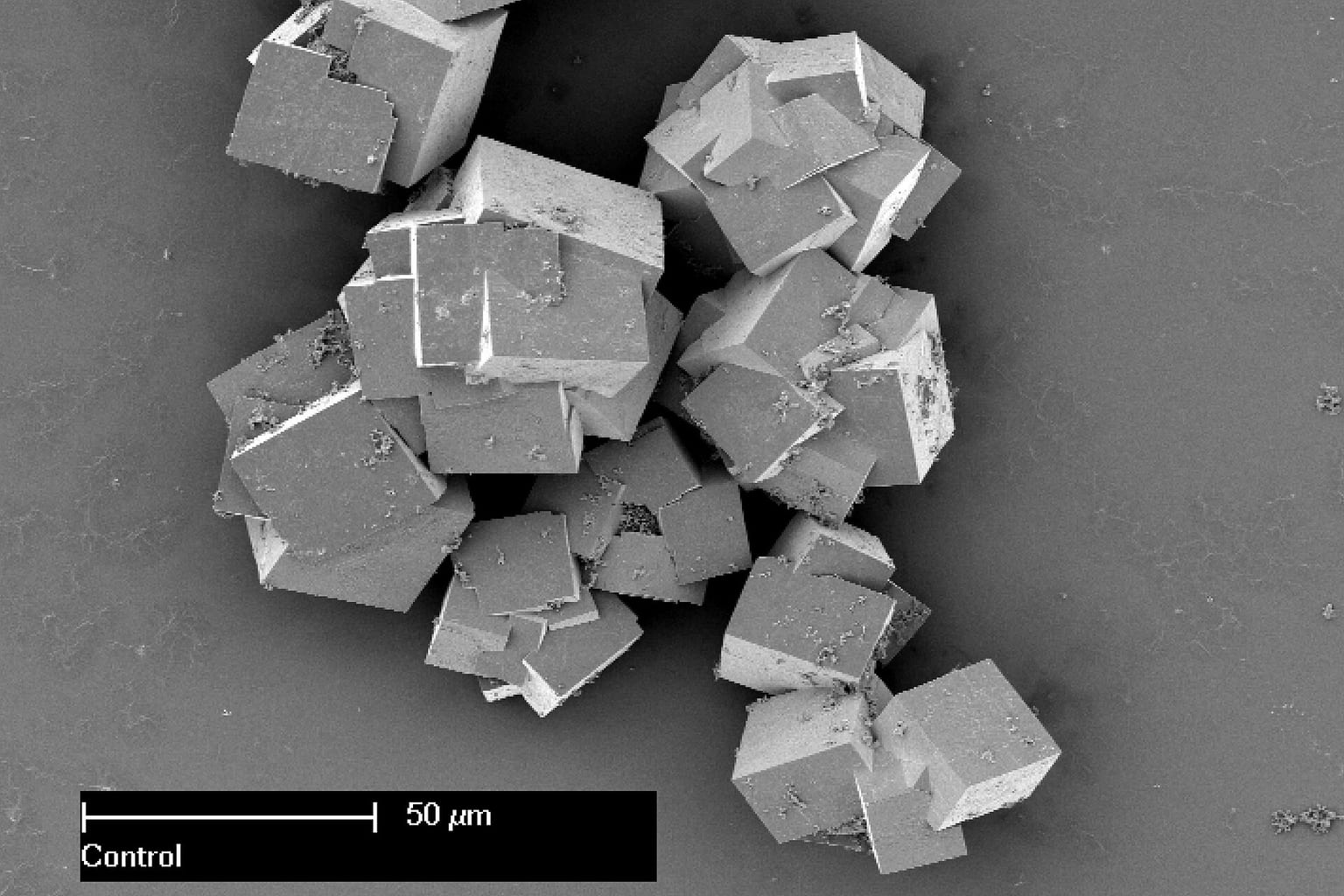
Team led by Yumeng Zheng and Kentaro Kinoshita at Tokyo University of Science filled the pores of Cu₃BTC₂, a copper-based MOF, with four imidazolium-based ionic liquids, which occupied 50%–60% of its pore volume. They then etched the material with a focused gallium ion beam at room temperature. Without the liquid, the beam left large cavities in the crystal structure. With it, the researchers obtained lines 130–300 nm wide, and all four treated samples were harder than the untreated MOF, while their stiffness stayed largely unchanged. Thermal analysis showed that the treated material decomposed at higher temperatures. The researchers suggest that the liquid absorbs heat and redistributes the charge that builds up under the beam, and that it may screen local electric fields.
For device makers, the immediate change is the removal of the cooling step. The researchers expect the approach to make MOFs easier to build into practical devices, and Interesting Engineering reports that manufacturers could then use existing microfabrication machinery. The study does not give a cost figure, and it covers a single MOF, so whether the method works on the other MOFs the team mentions remains to be shown. With around 100,000 MOFs known today, that question is the one that matters for the field.
The team is now looking at the devices it expects to benefit: high-sensitivity sensors, separation and analysis devices, and catalytic devices. Kinoshita describes the technique as a possible foundation for linking the properties of MOFs with practical devices.
Sources — read the originals(Paris time)
Read next
Comments
Loading the thread…
Sign in to leave a comment. Sign in