Hidden neighbor explains first known 'disappearing planet'
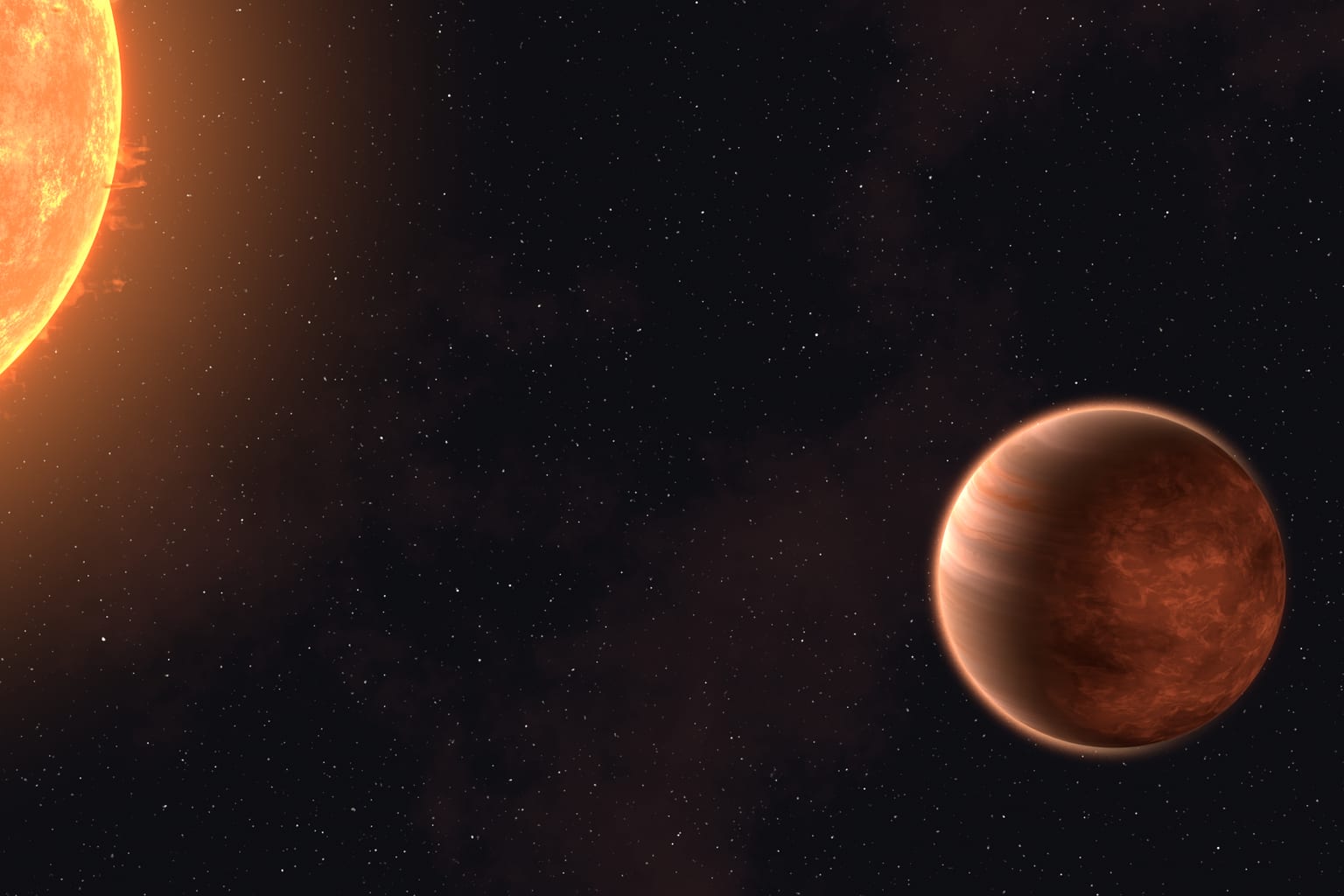
A planet about 1,000 light-years away dimmed its star each time it passed in front of it, for seven years. Then, in 2026, the dimming stopped. NASA's Transiting Exoplanet Survey Satellite, TESS, had recorded those transits in images taken between April 2019 and March 2026, and the astronomers who studied them, led by UCLA, report in The Astrophysical Journal Letters that the planet has not gone anywhere. The planet is TOI-2535 b, a hot Jupiter, a gas giant that whips around its star in 8.25 days, ten times faster than the 88 days Mercury takes to orbit the Sun.
A transit is the small dip in a star's light when a planet crosses its face, and it is visible only when the star, the planet and Earth line up closely. TOI-2535 b's transits stopped following a regular schedule. They ran up to six hours early or late, grew shorter and shallower, and then failed to appear at all in 2026. The team's explanation is an unseen neighbor. Its calculations show that the two planets pull on each other's orbits, making each wobble like a spinning top. As the wobble tilts TOI-2535 b out of alignment, its transits disappear from view. "This is the most extreme example we've seen because the two planets are interacting so strongly," said Samuel Yee, a postdoctoral fellow at UCLA and the paper's corresponding author. Erik Petigura, a UCLA astrophysicist and co-author, offers a familiar comparison: the Moon's orbit is tilted, which makes eclipses rarer, and that tilt is a relic of its violent formation.
The case matters because hot Jupiters are common among the planets found so far, yet they rarely have massive neighbors close enough to affect their orbits. Hundreds have been discovered. Their existence first puzzled scientists, because existing models of planet formation suggested they needed a lot of ice to form. Yee and Petigura describe two ways such a planet could migrate inward: a violent route, in which a near-collision throws it into an elliptical orbit before the star pulls it in, or a gentle route, in which it drifts in along with other planets in the protoplanetary disk. The gentle route is expected to leave a flat system with no tilted orbits. Yee argues that the close neighbor makes a slow spiral more likely: "it probably migrated by slowly spiraling in instead of getting flung in." A separate arXiv paper on another star, TOI-1355, describes an eccentric hot super-Jupiter that also leaves its transit alignment, through what the authors call nodal precession.
For astronomers, the gain is a method: a transit that drifts, shrinks and vanishes can point to a hidden companion, and it is how the team reached its conclusion. The study rests on one system, so it does not yet show how common such tilted systems are. The next milestone is timing. TOI-2535 b will next transit its star in 30 to 50 years, but its hidden neighbor may come into view sooner.
Sources — read the originals(Paris time)
Pages consulted while writing
Read next
Comments
Loading the thread…
Sign in to leave a comment. Sign in