NASA Models Show LISA Could Detect Planets Around White Dwarfs
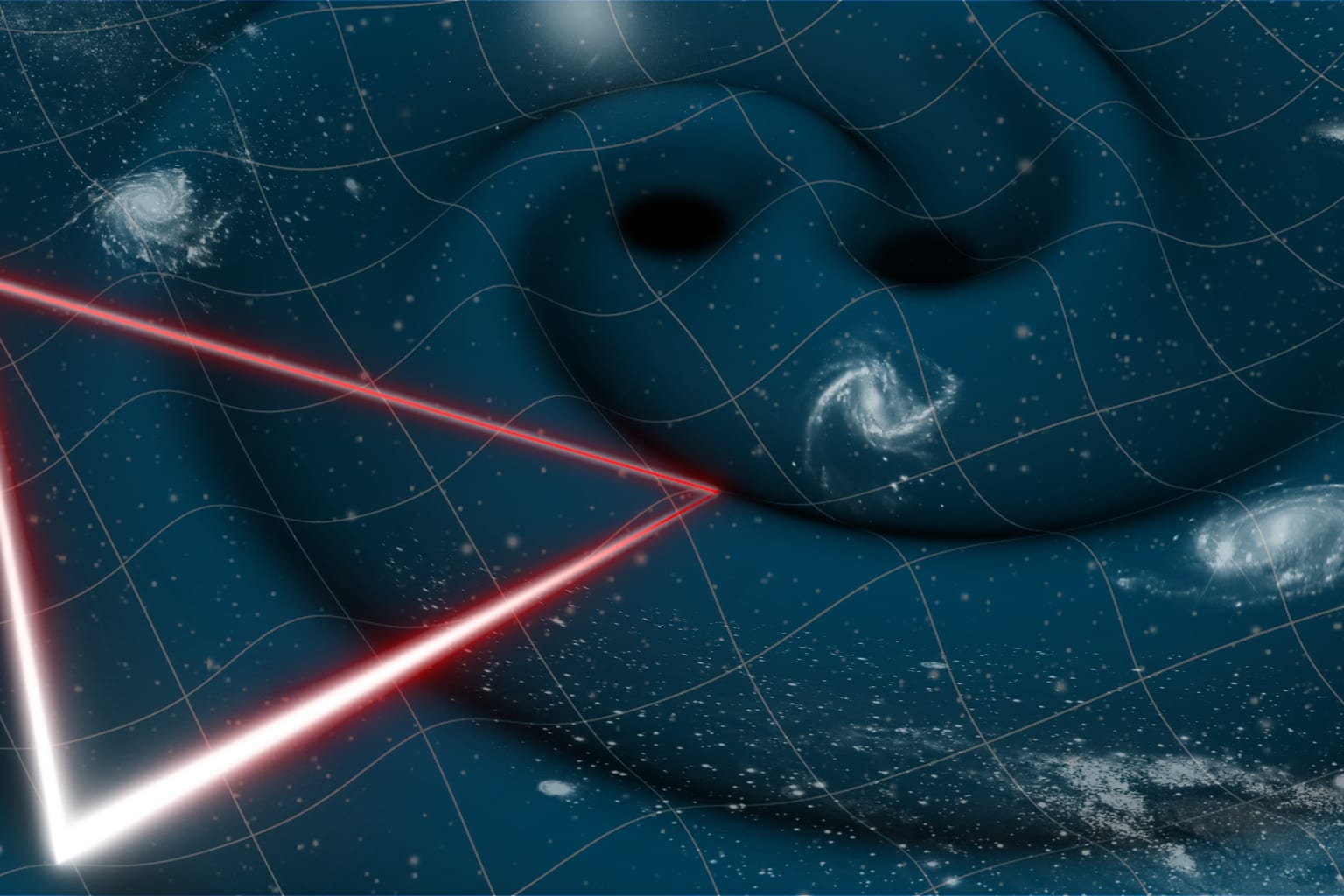
Two white dwarfs locked in orbits shorter than an hour send out gravitational waves so regular that, for a space antenna, they sound almost like a steady hum. NASA researchers now argue that a planet hiding in that hum would leave a readable trace. Two papers published in The Astrophysical Journal detail how the LISA (Laser Interferometer Space Antenna) observatory could reveal a new population of exoplanets across the Milky Way.
The logic borrows from a method that already works on starlight. Astronomers find planets around nearby stars by watching for the small wobble a planet's gravity imparts on its host, which shifts the star's spectrum toward red and blue. Scott Noble, a theoretical astrophysicist at NASA Goddard, describes the same effect for gravitational waves: a sufficiently massive planet makes the binary move, adding a Doppler modulation to the signal. Casey McGrath compares it to radio, where the main carrier frequency feeds sidebands that carry messages. Here, the sidebands carry news of a planet.
The prize is unusual. White dwarfs are the Earth-sized remnants of stars like the Sun, and a few isolated ones have planets, but none has yet been found around a binary white dwarf. LISA detections would therefore describe a distinct population. Astronomers estimate that the Milky Way holds 10 million double white dwarf systems with orbital periods under an hour, and expect LISA to resolve about 10,000 individual systems.
Detection alone is not proof. The second paper, co-authored by Mary Anne Limbach of the University of Michigan, proposes confirming each candidate with the James Webb Space Telescope. A planet in such a system emits more infrared light than its two stars do, and Webb can pick up that excess out to at least 500 light-years. In a test case at that distance, the team finds that Webb could detect a planet of about five times Jupiter's mass, while LISA could detect a sub-Jupiter planet under ideal conditions. Limbach puts the stakes plainly: the joint detections are what establish that the gravitational signals come from genuine planets rather than false positives.
For exoplanet researchers, the method turns a space antenna into a planet finder that can probe a part of the galaxy telescopes cannot easily survey. The next milestone is the mission itself: led by ESA, LISA is slated for launch in the mid-2030s, and NASA is supplying its telescopes, other critical hardware and engineering support. Once the first candidates arrive, the team says, validating them with Webb will decide which of them are real planets.
Sources — read the originals(Paris time)
Read next
Comments
Loading the thread…
Sign in to leave a comment. Sign in