In China, robots learn their jobs from people wearing cameras
In a Dongguan supermarket, Wang Lin, 23, stocks shelves with sensor gloves on her hands and a camera fitted to her helmet. Every movement is recorded. The startup Strange Attractor processes the footage and resells it to companies building the software that will act as a robot’s brain. Wang is one of many paid to do this: cobblers, hairdressers, florists, factory workers and cleaners are also recording their skills.
The idea is simple to state. A robot learns a task much as a trainee does, by watching it done. The field is called embodied AI, meaning artificial intelligence that lets a machine perceive its surroundings and act accordingly. The usual alternative is teleoperation, in which a person pilots the robot remotely. MindOn, a Shenzhen startup, says it trains its model on human motion captured by body trackers and first-person cameras instead. Strange Attractor says it collects data in around 1,600 places in China and 1,000 abroad. Its founder, Kang Yu, calls today’s robots “like babies.”
A helmet camera records more than hands. Researchers writing about ActiveScale, a paper on robot perception, note that a person’s head movements reflect the visual intent behind each task: where they look, and why. Other academic work posted on arXiv treats recordings of everyday human tasks as a promising source for robot learning. Data is the expensive part. Previously, a company could spend tens of millions of yuan on training data for a single application scenario, a recent Chinese research report says.
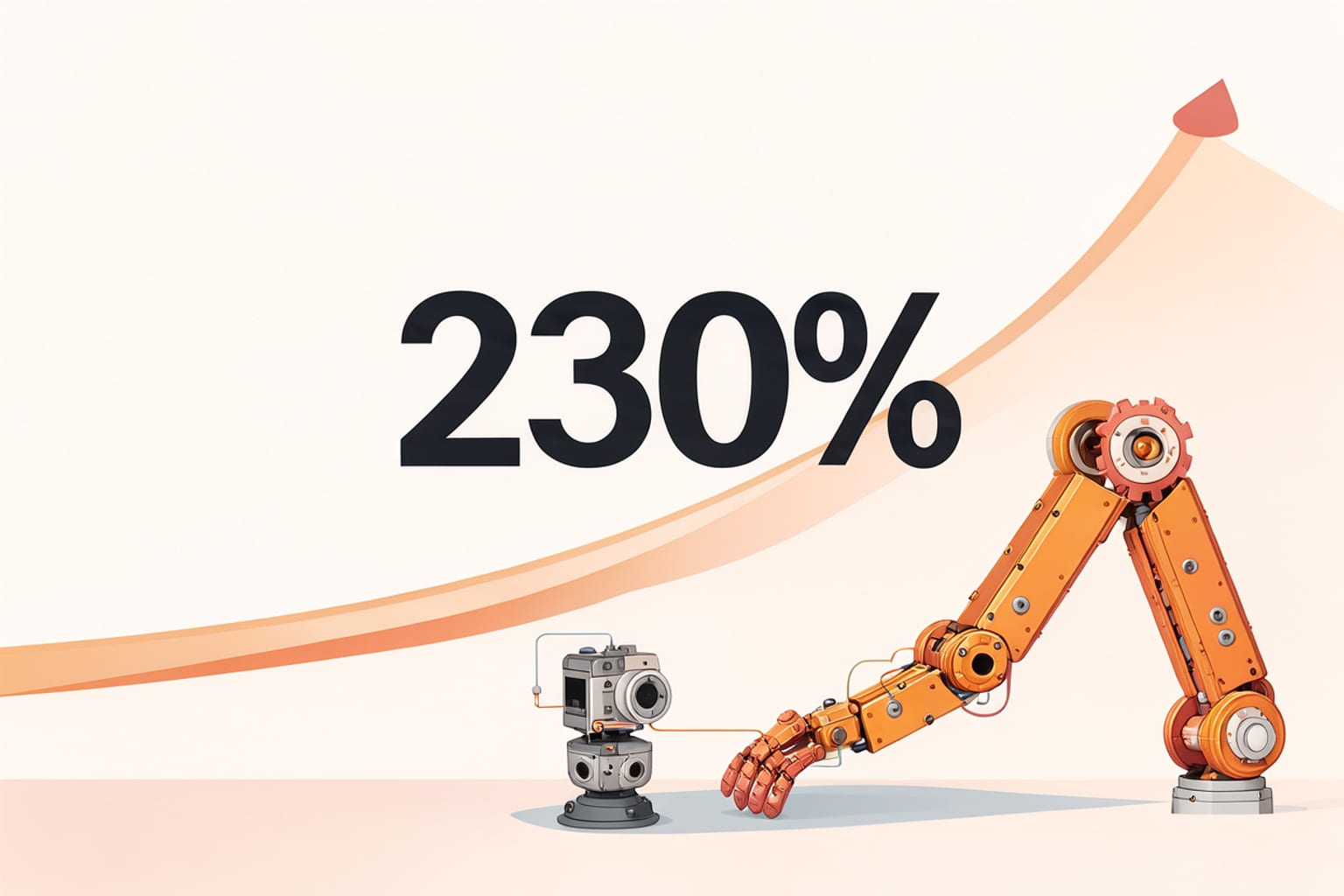
Governments are now paying to make that data abundant. More than 70 embodied AI training grounds had opened in China by the end of June 2026, the same report says. Local governments have funded 40 training centers, Rest of World reports. People’s Daily described a facility of over 10,000 square meters in Shijingshan, where 100 humanoid robots train. A company working with the local government in Suqian targets 10 million hours of robotics training data over two years. Tax data show industrial spending on embodied AI robots rose 230% year on year from January to May 2026.
The effects already reach daily work. In Shenzhen, a park refreshment stand runs on two humanoids: one grabs a cup and pulls a lever to swirl an ice cream, the other makes coffee. Each treat costs around $4. A person still refills the beans and empties the grounds, while an AI model drives the robots’ movements, according to their maker, AI² Robotics. The company says 200 of its humanoids are deployed in China, and up to 300 coffees sell a day at that park.
Shenzhen, home to 18 million people, is where such tests move fastest. Dermot McGrath of the advisory firm ZenGen Labs says developers can test a part and deploy it “faster than almost anywhere.” At a logistics center, two arms from X Square Robot handle parcels of different shapes and flip them so labels face up. At battery giant CATL, humanoids from Spirit AI already plug in high-voltage connectors, a task that is dangerous for people.
The limits are real. Robots still struggle on their own with complex tasks such as cleaning or ironing. Arnold Pei, vice president of X Square, says homes are harder, because lighting, floors and objects vary. Pavlo Zvenyhorodskyi of the Carnegie Endowment for International Peace describes robots as mostly confined to well-defined, repetitive tasks. The reporting gives no figure for how much headcam data improves a robot’s skills, and does not say whether the coffee robots learned from it.
Kang Yu expects large-scale deployment of AI-powered robots in China next year, though he says they won’t be very intelligent at first.
Sources — read the originals(Paris time)
Pages consulted while writing
Read next
Comments
Loading the thread…
Sign in to leave a comment. Sign in