Wearable rig captures 100 hours of human motion for robot training
A worker at a workstation, a camera strapped to the forehead, five small trackers on the head, both hands and both ankles. Body motion and finger movements are recorded, and touch too with the Wuji gloves. That is the setup Yunsong Zhou, Xuekun Jiang and their colleagues built to record 100 hours of human activity, packaged as a dataset called EgoExplorer and described in an arXiv preprint, the online server where researchers post papers before peer review.
The problem they target is well known. For a humanoid robot to complete a task, it has to coordinate locomotion, posture and contact with objects at the same time, and human demonstrations are the most direct way to show it how. Collecting them, however, is hard, and the authors argue that existing datasets give only partial views of this coordination. Their answer favors portability: a GoPro HERO13 camera filming from the wearer's point of view, five VIVE Ultimate Trackers, gloves that record finger articulation, and custom 3D-printed mounts and straps. The Wuji gloves also record tactile data, which the MANUS gloves do not.
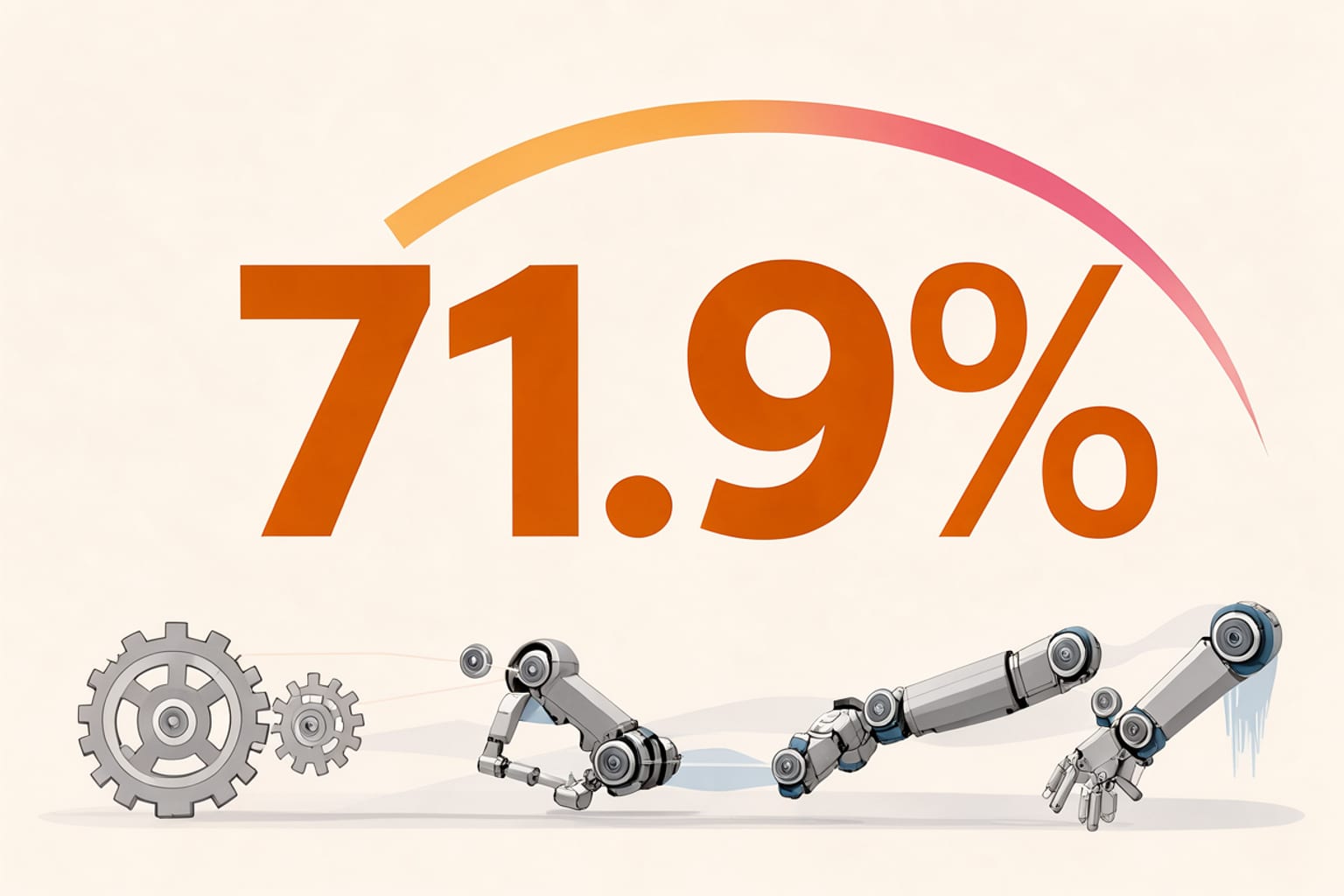
The harder part is software. The Calibrate-Complete-Constrain pipeline first fixes the wearer's body geometry and how each sensor is attached, so that mounting offsets are not confused with real movement. It then estimates joints that no sensor tracks, using movement patterns learned beforehand, and checks that the result matches the sensor data, stays smooth over time and respects the wearer's body shape. Against tracker-fitted reference measurements, the authors report that the method reduces body-point error by 71.9% relative to the strongest baseline. In preliminary learning experiments, generating video, movement and touch data together gave better results than generating each one separately.
The robot test is the most limited step. The team trained a controller for a simulated Unitree G1 humanoid to follow movements adapted from two of the recordings, and the robot completed both sequences without falling. The authors state that this did not demonstrate precise object interaction or good performance on unfamiliar tasks, and that the study did not test deployment on physical robots.
What changes, and for whom, is clearer on the data side than on the robot side. Teams training humanoid controllers could record demonstrations outside a motion-capture lab, in the workplaces where the tasks actually happen, which the authors say favors lightweight, portable capture systems. The authors say EgoExplorer could train other controllers in simulation first; they give no timeline for tests on real robots, which remains a longer-term prospect.
Sources — read the originals(Paris time)
Read next
Comments
Loading the thread…
Sign in to leave a comment. Sign in