In lab, a plain silicon grating twists light from electrons
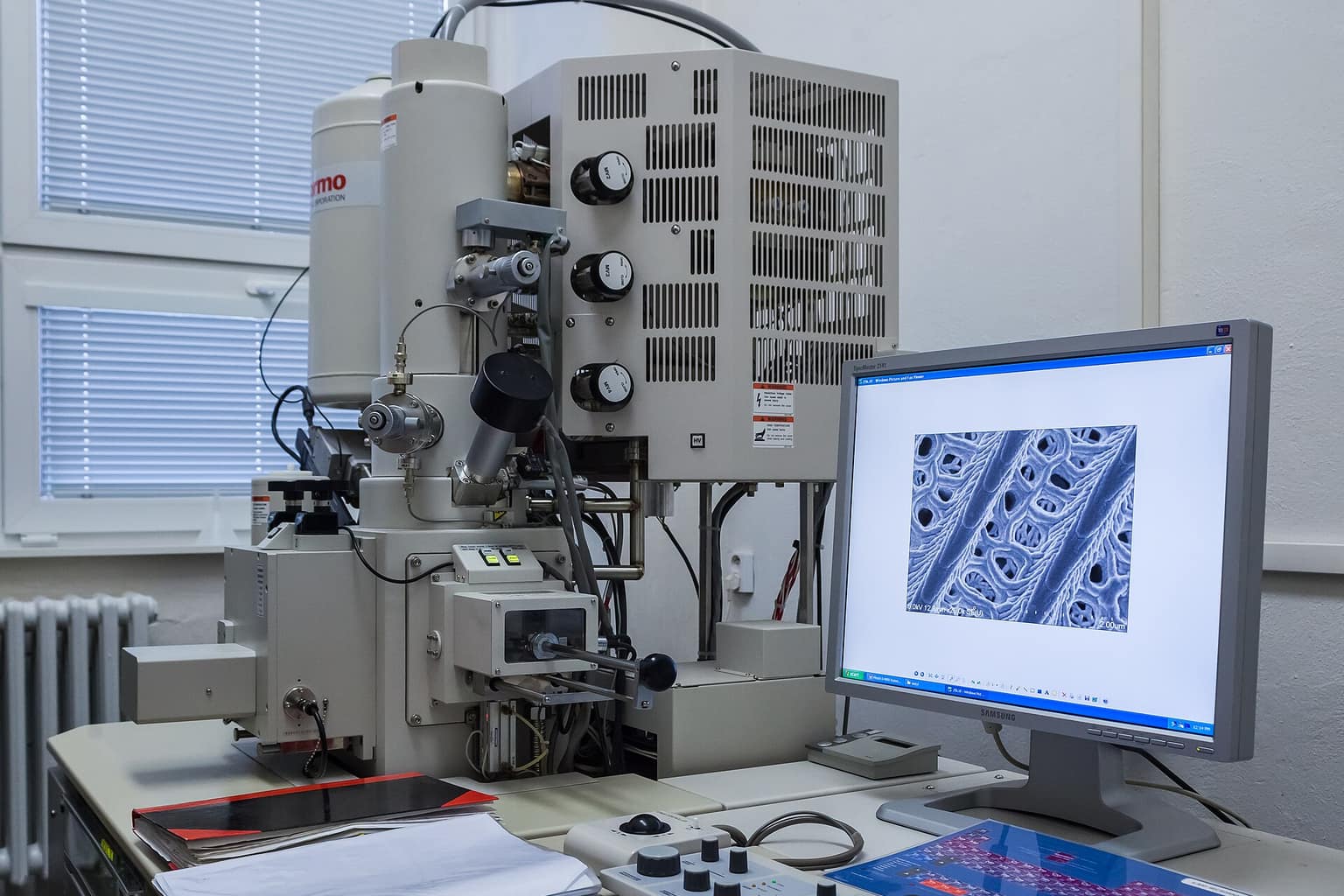
Fire an electron beam just above a plain silicon grating, a strip of silicon with a pitch of 100 nanometers, and the light that comes off carries a twist nobody had thought to measure. Since 1953, when two physicists first described the effect, the color of this Smith-Purcell radiation has been read from the electron's speed and the grating's spacing alone. Handedness, or chirality, was never part of the reading. Researchers at the Singapore University of Technology and Design (SUTD), working with colleagues in China, now report that it was there all along.
The reason it went unseen is symmetry. A moving electron drags a twisting electromagnetic field around it, and the grating can convert that field into circularly polarized light. In three-dimensional simulations, the emission is left-handed on one side of the beam, right-handed on the other, and linearly polarized in the middle, the only place earlier two-dimensional models had looked. Measurements taken along the plane of symmetry see the two opposite contributions cancel each other out.
The team broke that symmetry in two ways. Rotating the grating relative to the beam let them tune the chirality: at a 30-degree twist the value climbed to 0.726, on a scale where 1 is purely one-handed light and 0 means no net handedness, and reversing the twist flipped the handedness. Shifting the beam from the center toward one edge, with the grating fixed, gave one handedness along one edge and the opposite along the other. Shrinking the pitch from 120 to 100 nanometers pushed the value to 0.87, the highest yet reported for Smith-Purcell radiation and more than double the previous best. Simulations for the shifted beam predict values of up to 0.98.
The shifting runs also produced a surprise. Emission was strongest with the electron beside the grating rather than above it, because the sharp corners of the grating scatter the electron's field into light remarkably well. Dong said the result showed that where the electron travels relative to the structure can matter as much as the structure itself. Because neither method depends on a delicate optical resonance, the effect is broadband, tunable from about 450 to 900 nanometers while the chirality changes only slightly. The limits are real: some materials glow under electron bombardment and can swamp the signal, and reaching X-ray wavelengths would demand even smaller structures or much higher electron energies, where quantum effects may complicate the picture.
For engineers who design free-electron light sources, the gain is a new control, the symmetry of the interaction between electron and structure, in place of ever more complicated structures. Wu's stated target is extreme ultraviolet light, prized in lithography, and the team has not announced a calendar or a device. The next frontier the researchers name is the shorter wavelengths, where Dong says the task is to generate light while preserving and controlling its chirality.
Sources — read the originals(Paris time)
Read next
Comments
Loading the thread…
Sign in to leave a comment. Sign in