In lab, first direct map of stress around a diamond atomic flaw
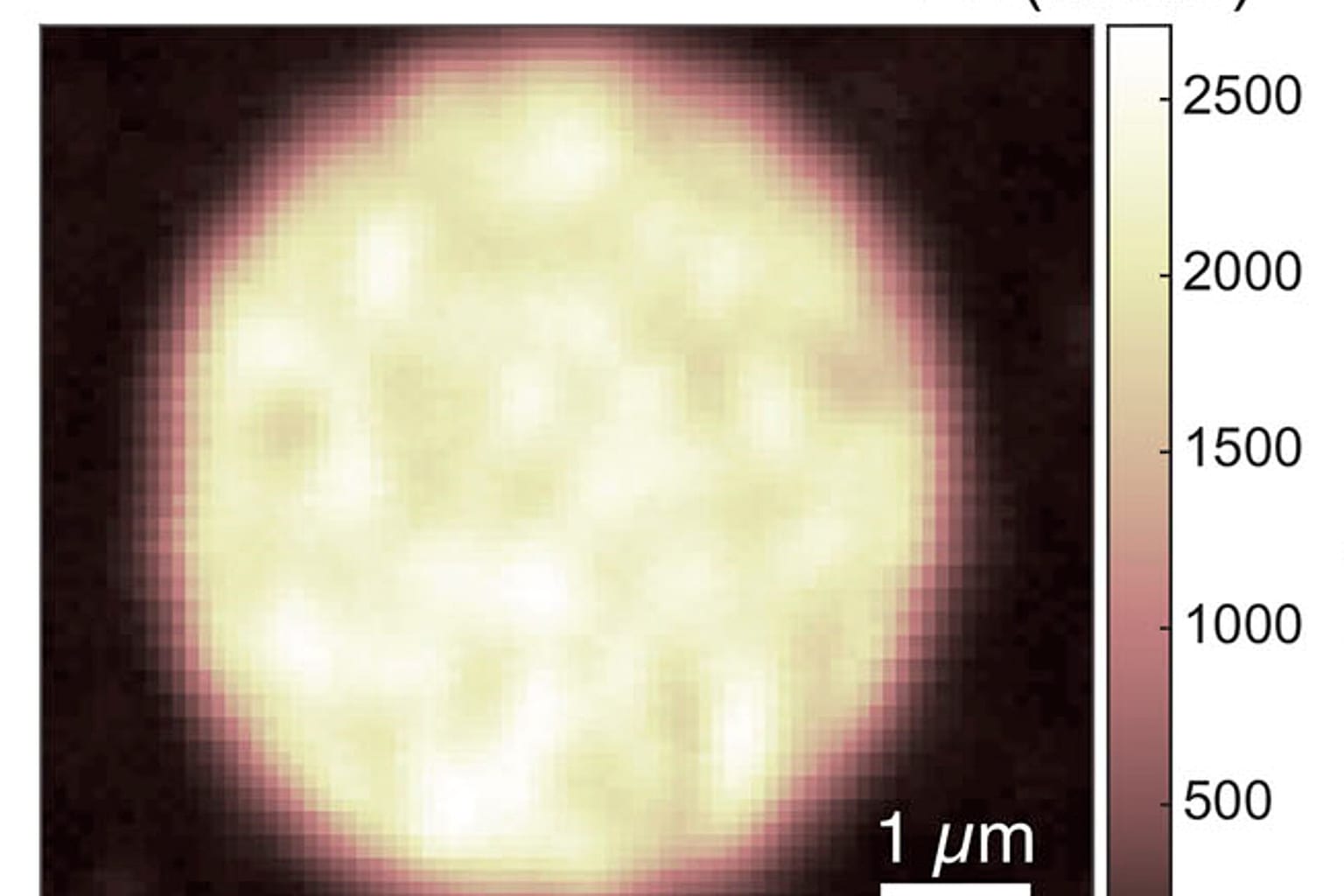
Inside a diamond, neighboring rows of atoms sometimes sit slightly out of line. These atomic-scale flaws, called dislocations, send a field of stress rippling through the surrounding lattice. For the first time, a team led by Tokuyuki Teraji at Japan's National Institute for Materials Science has mapped several components of that field around a single one, detecting stress to within around 1 megapascal.
Dislocations matter because they reach far beyond their own atoms. Across the lattice, they can strongly affect a material's mechanical, electrical and magnetic properties. More than 80 years ago, physicists used elasticity theory to derive a mathematical description of these stress fields, known as a stress tensor, which gives the stress at any point around a dislocation. That description has shaped how scientists understand how dislocations store energy and push on each other. Yet measuring the fields directly proved far harder, because existing techniques capture only some aspects of the stress, so the theory had never been fully tested.
The team used nitrogen-vacancy centers, defects where a nitrogen atom replaces a carbon atom next to an empty lattice site. Their spin states respond to stress depending on their orientation, and they can be read optically: under laser light they glow more or less brightly depending on spin, and microwaves flip the spin only at a precise resonant frequency, which shows up as a dip in brightness. Within the diamond, the centers sit in four possible orientations, and their resonant frequencies shift in slightly different ways. That makes it possible to separate the components of the stress tensor. The researchers grew a thin film by chemical vapor deposition from carbon enriched in the carbon-12 isotope, which improves spin coherence, and tuned the nitrogen concentration to keep the glow bright. Pairs of microwave pulses then allowed them to read resonant frequencies with extreme precision, roughly 10 times more precise than conventional methods.
From these measurements, the team mapped four components of the stress tensor around a 45° dislocation, which it describes as a point-symmetric distribution centered on the defect. Fitting the data with elasticity theory produced values for diamond's elastic properties that closely matched established values for bulk diamond. Teraji calls it the world's first direct experimental validation of the analytical stress tensor around a single dislocation predicted by elasticity theory. The result, published in Applied Physics Letters, is a laboratory study of one defect in one film, and no commercial timeline has been given.
For makers of power and quantum devices, the practical promise is a better way to check the crystals they grow: a direct measure of how each defect deforms its surroundings, rather than a partial picture. The team is hopeful that its combination of fine-tuned diamond fabrication and direct stress measurement could lead to important advances in these technologies, and says the approach allows quantitative evaluation and fitting of local stress fields around microscopic defects.
Sources — read the originals(Paris time)
Read next
Comments
Loading the thread…
Sign in to leave a comment. Sign in