Diamond starts in a rare hexagonal shape, simulations show
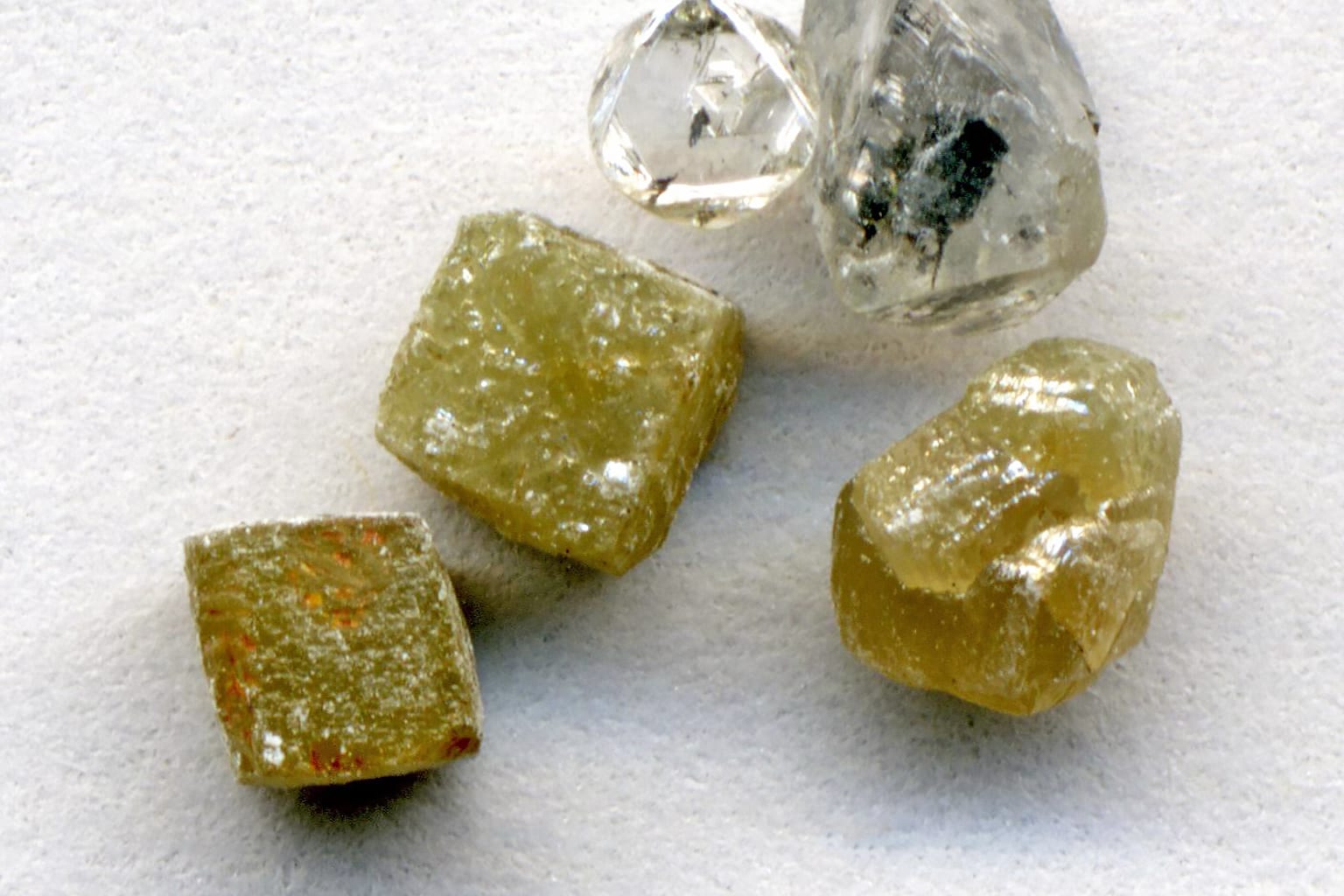
In simulations of graphite squeezed at 18 to 22 gigapascals, a unit of pressure, the first diamond to appear is not the familiar cubic kind. It is a rarer hexagonal form called lonsdaleite, in which the carbon atoms sit in layers arranged differently from ordinary diamond. Researchers from Skoltech, part of the VEB.RF Group, and from MISIS University now explain why, in a paper published in the journal Carbon and led by Sergey V. Erohin.
The puzzle is that cubic diamond is the more stable form for a large crystal. Over the pressure range studied, it has a lower bulk enthalpy than lonsdaleite, which should make it the one to form first. But a large crystal and its first nanometer-scale nuclei, the tiny clusters from which a crystal starts to grow, follow different rules. A nucleus has to rearrange its bonds, build an interface with the surrounding graphite and deform the layers around it. At that tiny scale, those costs can outweigh the advantage of the cubic structure.
That is where lonsdaleite wins. Its nucleus adapts better to the graphite around it. In the models studied, the energy barrier to forming its optimal nucleus is about half as high as for cubic diamond, and the critical number of atoms is two to three times smaller. 'In other words, at the initial stage it is energetically more favorable to create a lonsdaleite nucleus,' says Pavel Sorokin, a professor at the Skoltech Photonics Center and at MISIS University, and a corresponding author of the paper. The authors' scenario then has two steps: lonsdaleite nucleates first, and as it grows and its boundary with the graphite relaxes, it converts into cubic diamond. Not every nucleus follows that path. If the second step is hindered, lonsdaleite can persist.
To see the graphite bend around a growing nucleus, the team needed models large enough to hold that deformation. They used an interatomic potential, a set of rules describing how atoms interact, trained on quantum-mechanical calculations, and ran models of up to 700,000 atoms. Machine learning made it possible to describe those interactions at that size. The findings rest on these models.
The question is not new. A study published on ScienceDirect frames the nature of lonsdaleite as a decade-long controversy that it sets out to resolve. A separate research page from the Lawrence Livermore National Laboratory describes the structure as 'likely an intermediate state in the phase transition to cubic diamond', which is the view the Skoltech and MISIS team now supports with a mechanism.
For anyone making superhard materials, the gain is control. Knowing that a less stable structure can appear first, and why, helps predict and steer what a synthesis produces. The same understanding applies to materials that must work under extreme conditions, and to models of the interiors of planets, where similar pressures prevail.
Sources — read the originals(Paris time)
Pages consulted while writing
Read next
Comments
Loading the thread…
Sign in to leave a comment. Sign in