In the lab, laser bursts lift a UV sensor's signal 57%
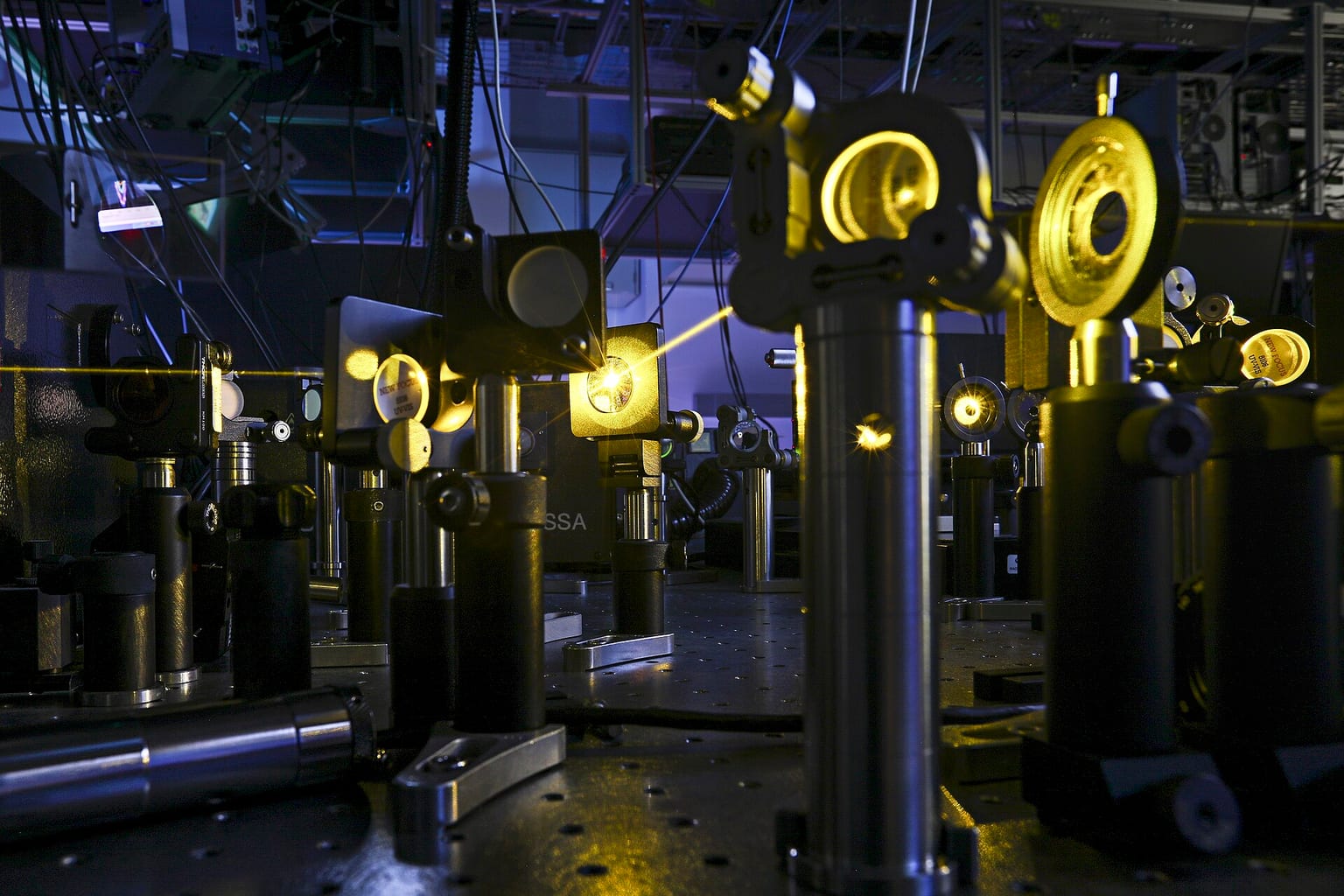
At East China Normal University, Heping Zeng's team took a thin film of amorphous gallium oxide, a material with no long-range atomic order, and struck it with programmed bursts of laser light. The integer number of sub-pulses in each burst sets the processing condition. The treated film kept its disordered structure, and a photodetector built from it produced 57% more photocurrent under UV light than an untreated one.
Strain engineering changes a material's electronic and optical behavior by altering its physical structure rather than its chemistry. It works well on crystals, whose ordered lattices deform predictably. Amorphous materials are harder: heat or mechanical treatment can make them crystallize, crack or segregate their elements. The team's method, which it calls digital cold strain engineering, avoids much of that. Femtosecond pulses deliver energy faster than it can spread through the material, which limits early heating, although the process is not entirely heat-free. The sub-pulses arrive about 1.08 GHz apart, so each pressure wave overlaps the next before it has relaxed. At constant average power, more sub-pulses means less energy in each one, which suppresses crater-forming ablation while keeping the cumulative pressure effect.
The measurements point the same way. X-ray diffraction shows a broad diffuse pattern with no sharp peaks, and atomic force microscopy finds the treated surface about 0.17 nm smoother. Ellipsometry measures a thickness decrease of about 13.6 nm, which electron microscopy supports. The ultraviolet absorption peak moves from 263 to 256 nm. The device gains are the headline: photocurrent rises from 8.2 to 12.9 nA, responsivity from 0.080 to 0.126 mA/W, about 58% more, and specific detectivity from about 4.4 × 10⁹ to 5.5 × 10⁹ Jones, about 25% more. The price is speed. Dark current rises moderately, and rise and decay times stretch from 0.2 and 1.5 seconds to 0.5 and 3.2 seconds.
Why it matters: solar-blind UV photodetectors read wavelengths that Earth's atmosphere largely absorbs, so ground-level sunlight adds little background. Zeng says this could let such devices pick up faint UV signals from flames or electrical discharges, even in daylight. The team gives no timeline and no cost, and the device results come from films made and tested in the lab.
Zeng is careful about the mechanism. The pressure simulations describe the cumulative behavior qualitatively, not the film's absolute stress, and the thinning may combine structural change with some removal of surface material. Before the method's value for manufacturing can be judged, further research has to clarify those mechanisms, and that work comes next.
Sources — read the originals(Paris time)
Read next
Comments
Loading the thread…
Sign in to leave a comment. Sign in