A laser changes its light pulses by pressing on a fiber
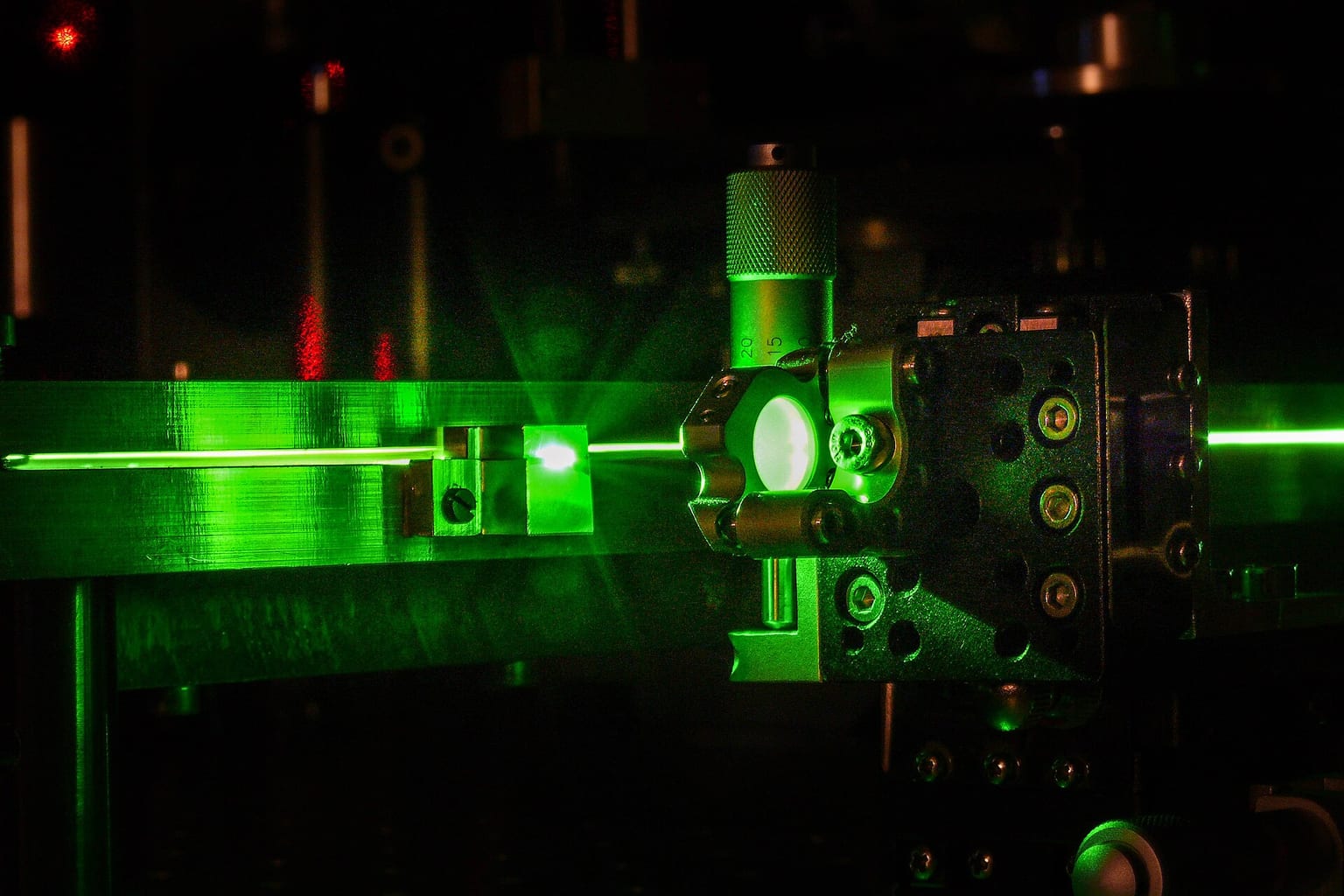
A fiber laser can now produce six distinct pulse patterns at the same pump power, without being pushed harder. A team at the Changchun Institute of Optics, Fine Mechanics and Physics, part of the Chinese Academy of Sciences, got there by pressing on a short section of optical fiber. The work, published in Optical Fiber Technology and reported on 16 November 2026, concerns a laser emitting at 1972 nanometers, near two micrometers in the infrared.
Mode-locking is the technique that turns a laser into a train of very short, evenly spaced bursts of light. Producing several pulses at once usually means raising the pump power, the energy fed into the laser, above the level that gives a single pulse. That extra power strains the components, increases the risk of damage and leaves little room to choose which pattern comes out. Earlier work on thulium-doped fiber lasers, built on glass doped with thulium, notes that multi-pulse operation typically appears above a threshold, because of nonlinear effects in a long cavity.
The team first established stable single-pulse operation. It then added a mechanical adjustment structure that applies controlled pressure to a stretch of single-mode fiber. Moving the adjuster changes the fiber's optical properties. The researchers recorded the pulse patterns, the laser power and the polarization of the light for each setting. Their simulations looked at the nonlinear refractive index, the way the glass's refractive index responds to the intensity of the light, and how that response shifts under stress.
At each adjuster position, the laser showed a different pulse pattern, and it moved between single-, double- and triple-pulse states. The power needed to enter multi-pulse operation fell from 1.72 W to 1.47 W, so control no longer depends on pushing harder. The simulations point to changes in the refractive index as the driver of pulse splitting. The journal's listing gives the same six patterns and the same threshold figures, which come from the team's own experiments.
For operators of ultrafast lasers, the gain is flexibility: one device can switch its pulse pattern through a mechanical setting, instead of a higher power that wears its parts. The authors name optical communications, high-speed signal processing and tunable mid-infrared lasers as the fields this could advance. The study gives no timeline and no industrial partner, so these uses remain possibilities for now.
Sources — read the originals(Paris time)
Pages consulted while writing
Read next
Comments
Loading the thread…
Sign in to leave a comment. Sign in