In the lab, light reads quantum states inside superconductor vortices
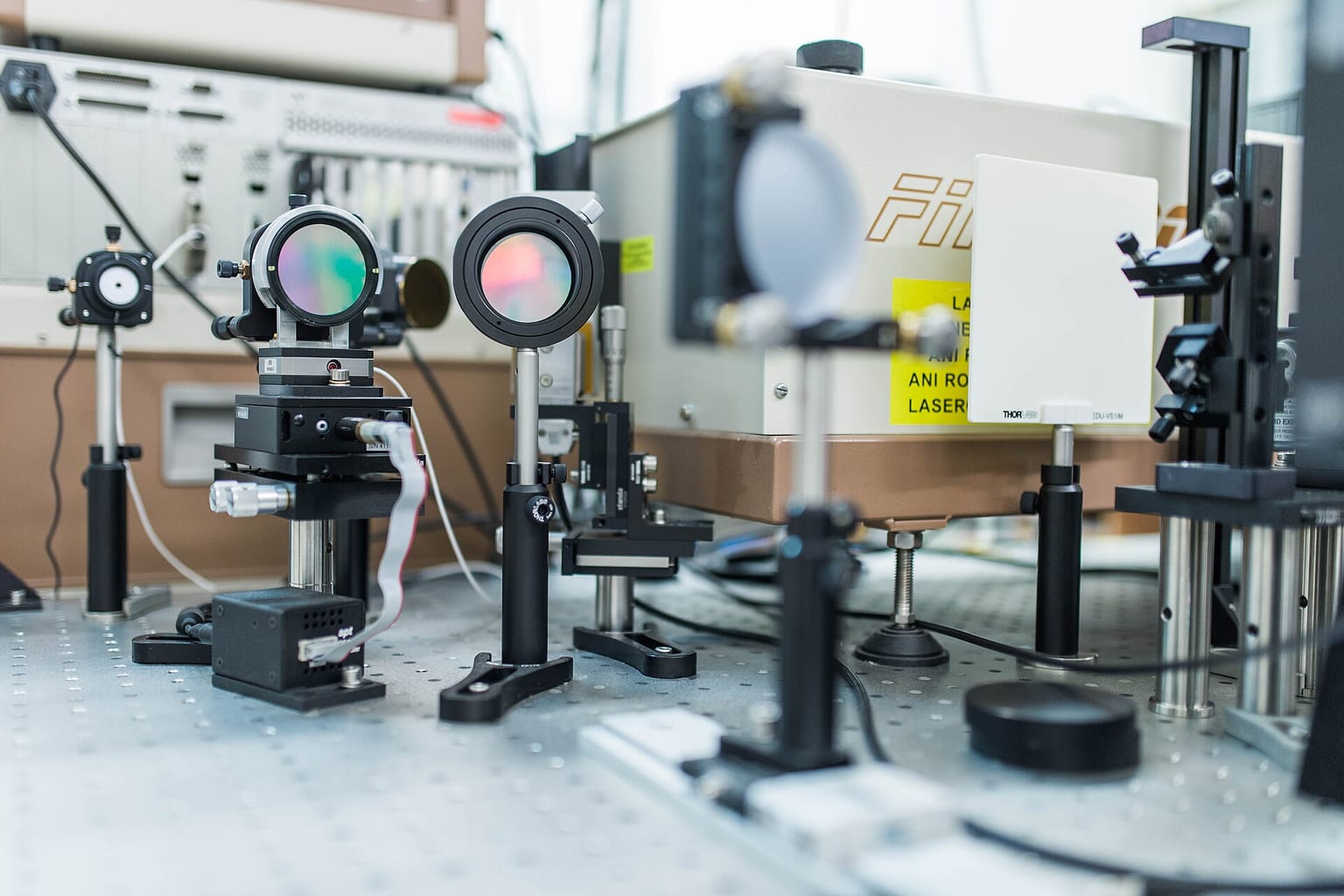
Inside a superconductor, a strong magnetic field punches tiny holes. Physicists call them vortices, and Rutgers physicist Girsh Blumberg has a simple image for them: "It's like Swiss cheese, with many holes." A Rutgers team has now used a beam of invisible light to read what sits inside those holes.
When vortices shift, the material leaks electrical energy as heat, which is why they matter for real equipment. Theorists had predicted that the particles trapped in each vortex settle into stepped quantum energy levels, like the rungs of a ladder. In most materials those rungs blur together, so proving the prediction experimentally has been notoriously difficult. The team's answer was to build the material itself: an iron-based compound with tellurium and selenium, deposited layer by layer into films 40 nanometers thick, roughly a thousand times thinner than a human hair. The narrow cores kept the rungs cleanly spaced.
The measurements took place in Tallinn, Estonia, where the films were cooled to minus 438 degrees Fahrenheit under intense magnetic fields. Terahertz radiation was sent straight through the samples. Light can twist clockwise or counterclockwise as it travels, and the particles responded to only one of those twists. They fell into two distinct groups that the researchers could tell apart and study separately. From the light measurements and calculations, the team estimated the size of the vortices, how long the particles' responses lasted, and how strongly the vortices resist changes in speed or direction.
The comparison of two recipes showed that similar superconductors can hide very different interiors. Both versions with different selenium amounts began superconducting at nearly identical temperatures, yet one recipe produced four times as many particles of the first group as the other, while the second split evenly. Two materials that look the same at their operating temperature can behave differently inside.
What changes is the way materials can be tuned. Engineers building components for power grids, MRI scanners and particle accelerators could, in principle, use polarized light to check the internal balance of a candidate material before committing to it. The work is still a laboratory study, published in Physical Review Letters, and no application timeline has been announced. The next step the team has not yet described is testing whether the method carries over to materials used in actual equipment.
Sources — read the originals(Paris time)
Read next
Comments
Loading the thread…
Sign in to leave a comment. Sign in