In the lab, silicon qubits hold 99.99% accuracy with three at once
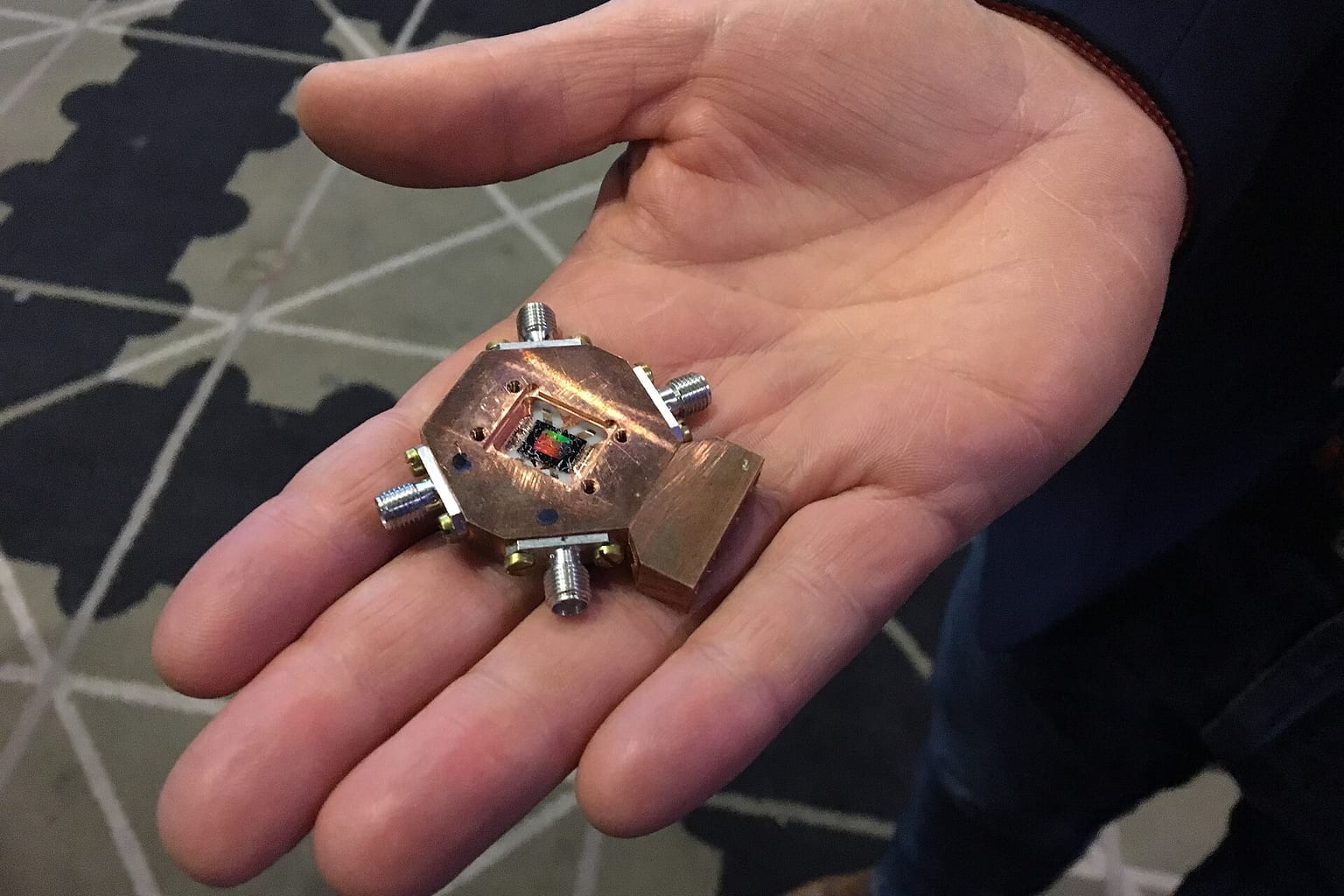
On a silicon chip, five electron spins are steered by a single microwave line, and each of them has to be pushed to the right state without disturbing its neighbours. That is the problem RIKEN's Center for Emergent Matter Science set out to solve, and in a study published in Nature Physics, its team reports that three qubits can run at once while keeping gate fidelity above 99.99%. The experiment used a five-qubit silicon array controlled through one shared microwave line.
A qubit is the quantum counterpart of a bit: it can hold a combination of 0 and 1. In silicon spin qubits, that information is stored in the spin of an electron trapped in silicon, and it is changed by microwave pulses. Silicon has a practical advantage, since the approach is compatible with the semiconductor manufacturing already used for computer chips. Its known weakness is that when several qubits are driven at the same time, their accuracy typically drops, and a quantum computer that cannot operate many qubits together stays a small machine.
The team began by pinning down the main cause of that drop: the AC Stark shift, an effect induced by the microwave control signals. It changes the effective energy levels of a qubit and shifts the phase of its quantum state. Their mitigation protocol relies on calibrations between pairs of qubits to compensate for those phase shifts. Yi-Hsien Wu, the first author, explained that the method avoids a separate calibration for every possible combination of qubits. Single qubits, run one at a time, reached fidelities well above 99.99% on each of the five qubits, with the best approaching 99.999%. Fidelity measures how accurately a quantum operation is carried out.
With the protocol, fidelities stayed above 99.99% when up to three qubits operated simultaneously. With all five running together, they stayed at approximately 99.9%, a level the authors describe as close to the practical requirements of fault-tolerant quantum computing. The residual loss comes from drive-induced decoherence, a loss of quantum coherence caused by the higher microwave power that simultaneous operation requires. Unlike the phase shifts addressed by the new protocol, this effect is not corrected by calibration, and Camenzind said that further improvements to device design could help.
For now, the result stays in the laboratory. It shows that shared control lines can be used without sacrificing accuracy, which matters for anyone who wants to wire up dozens or hundreds of qubits without a dedicated line for each one. The team's stated long-term goal is a fault-tolerant quantum computer built on silicon spin qubits, and Seigo Tarucha, who manages a silicon quantum computing project under JST's Moonshot Goal 6, calls reliable parallel control "an essential step" toward it. Neither RIKEN nor the team gives a date for a larger processor, and the study does not describe one.
Comments
Loading the thread…
Sign in to leave a comment. Sign in