Quantinuum's Helios hits 99.9995% accuracy in company tests
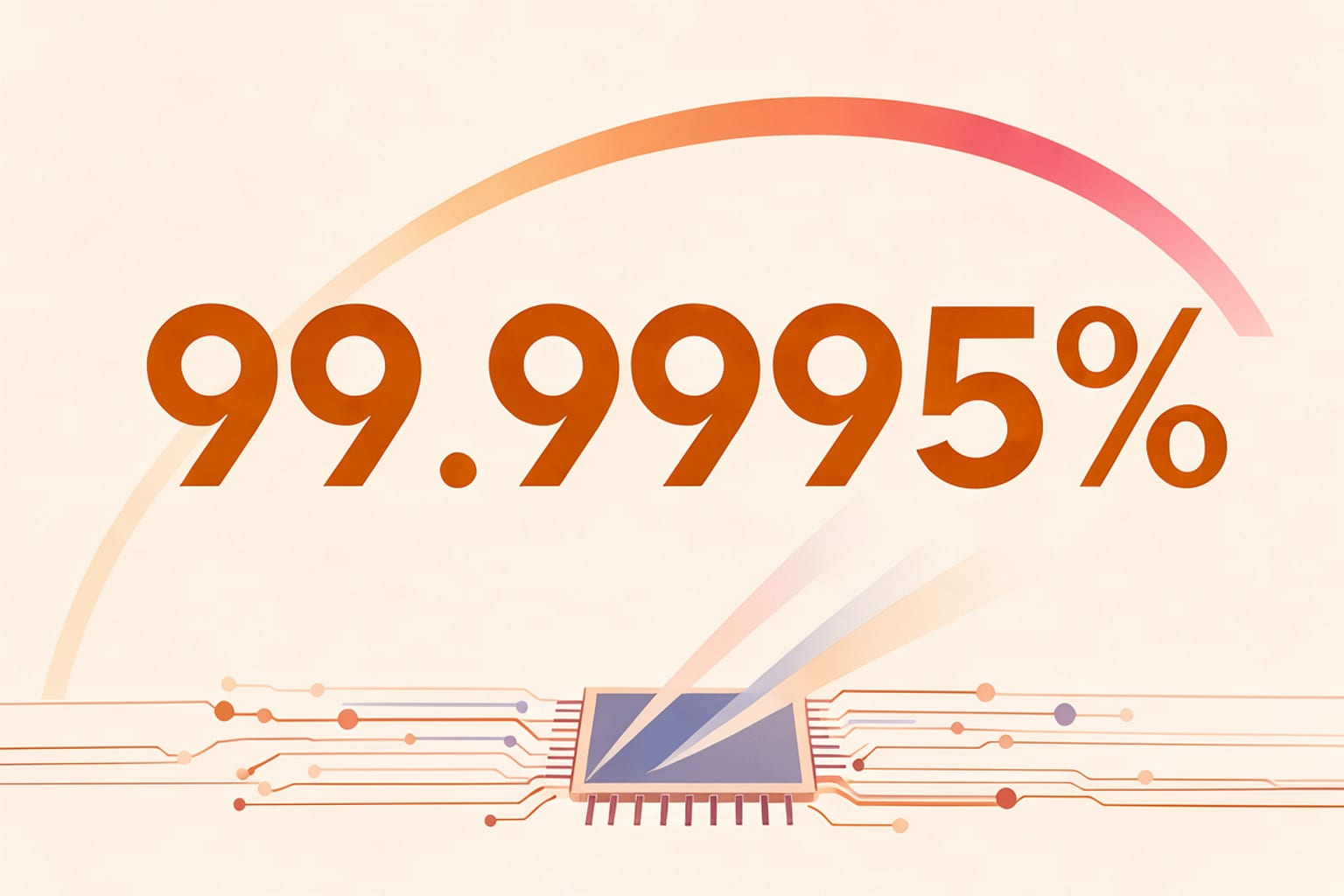
Out of a million operations, the Helios quantum computer now gets just five wrong. That is the figure Quantinuum, the Colorado firm behind the machine, reports from its latest tests: 99.9995% logical fidelity on a 98-qubit trapped-ion computer. “We’ve proven that we have the error-correction architecture and trapped-ion technology required to achieve universal fault-tolerance,” said Rajeeb Hazra, PhD, the company's CEO.
The difficulty is the qubit itself. Qubits carry quantum information, but they are highly sensitive: heat, stray electromagnetic signals, vibrations and cosmic rays can disturb their delicate states during a calculation. Error correction groups several physical qubits into one logical qubit, which protects the information better than any single qubit can. The team used a technique called a color code, which on Helios required as many as 37 physical qubits per logical qubit. Each increase in code distance, which sets how strongly information is shielded, reduced the remaining logical errors by a factor of 12. The system also combines AI decoding with real-time correction to detect and fix mistakes during a calculation.
A month earlier, the same hardware had set a record with a different method, called Helix, which used 10 physical qubits per logical qubit. Changing the correction method, without replacing the computer, raised performance. The color code uses more qubits but delivers much lower error rates. Quantinuum says its error rate is 10 times lower than its September 2026 record and 100 times lower than the best published result from competing hardware, reported by Google Quantum AI.
For the field, the next step is Apollo, Quantinuum's planned universal fault-tolerant computer, which the company expects to launch by 2029. The company says the new result strengthens that plan. Robin Blume-Kohout of Sandia National Laboratories, who was not involved in the study, said a logical qubit here is “nearly 100 times better than its component physical qubits”, and that a scaled-up version could reach useful fault-tolerant computation at a feasible size of less than a million physical qubits. For buyers and researchers, that means the question of how many physical qubits a practical machine needs now has a smaller answer than expected.
The limits are clear. These figures come from Quantinuum's own experiments, and the company presents them as its own results. A record in a benchmark is not yet a machine that solves a customer's problem, and Apollo's 2029 target is a company forecast, not a delivery date that outside parties have confirmed.
Comments
Loading the thread…
Sign in to leave a comment. Sign in