Lab: sodium battery interfaces imaged with far less electron damage
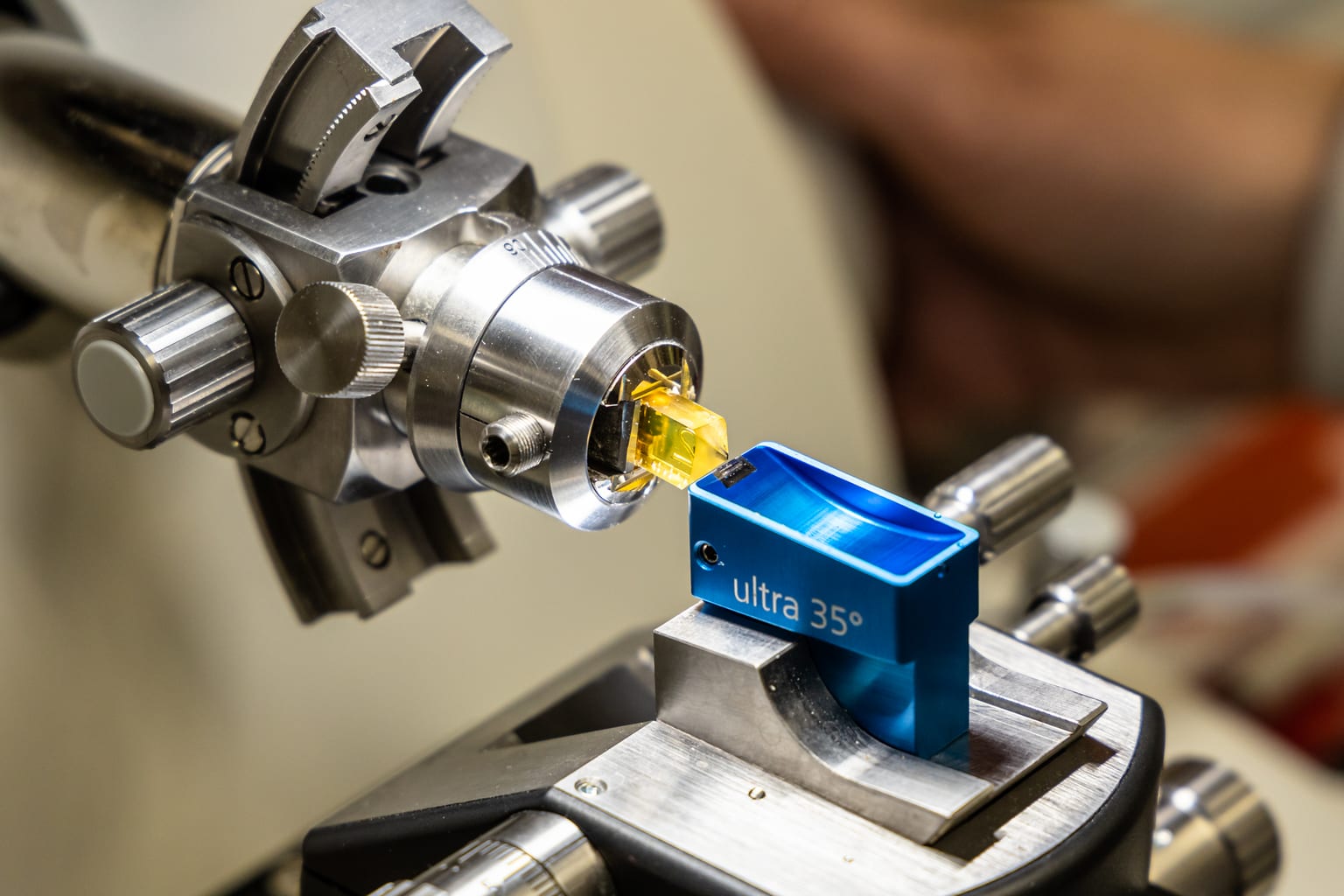
Every electron that builds an image of a battery also hits the sample. Used too hard, the beam rewrites the very material it was meant to observe. Thomas Marchese, a Ph.D. student at the University of Chicago Pritzker School of Molecular Engineering, has found a way to look at sodium battery components before that happens. His study, published in Microscopy and Microanalysis, reports usable images at 10 to 50 electrons per square angstrom before the material changes.
To see atoms, an electron microscope needs a strong beam, and the strength of that beam is called the dose. Marchese compares it to a hose: too much pressure and the sample is no longer the one the scientist wanted to study. For most materials, the dose a typical experiment can tolerate is in the tens of thousands or hundreds of thousands of electrons per square angstrom. The detectors developed with Thermo Fisher Scientific and Argonne National Laboratory collect information during the first 10 to 50 electrons, which lets the team record the structure and chemistry of the material before it degrades.
The question started with a familiar frustration. Batteries lose capacity over their life, and those losses are often attributed to side reactions and to the solid electrolyte interphase, or SEI, a layer that forms where the electrolyte reacts with the electrodes. The sodium battery studied here replaces the liquid electrolyte with a stable solid one, so that layer does not form. That makes its interfaces a cleaner subject for study, but only if the microscope does not damage them first.
The team builds on its own earlier work. In 2024, the laboratory presented what it describes as the world's first anode-free sodium solid-state battery, a fast-charging design. Earlier this year, it published guidelines for electron microscopists on clean sample preparation and on tracking beam damage as a function of dose. In the new study, samples were moved under inert gas and examined at room temperature. Cooling to cryogenic temperatures, the usual first choice for battery materials for about a decade, reduces this kind of damage, but here that benefit was absent. The team concluded that the damage mechanism differed from the one seen in earlier anode studies.
For battery researchers, the change is in the reliability of what they observe. A diagnosis of why an interface fails is only as good as the image behind it, and a method that keeps the sample intact gives engineers a more trustworthy view of the next generation of batteries. The study does not set a date for industrial use, and it applies so far to one sodium solid-state electrolyte. Still, the method gives researchers a way to check an interface before drawing conclusions from it.
Sources — read the originals(Paris time)
Read next
Comments
Loading the thread…
Sign in to leave a comment. Sign in