Lab test: modified enzyme breaks down PET plastic 9.2 times faster
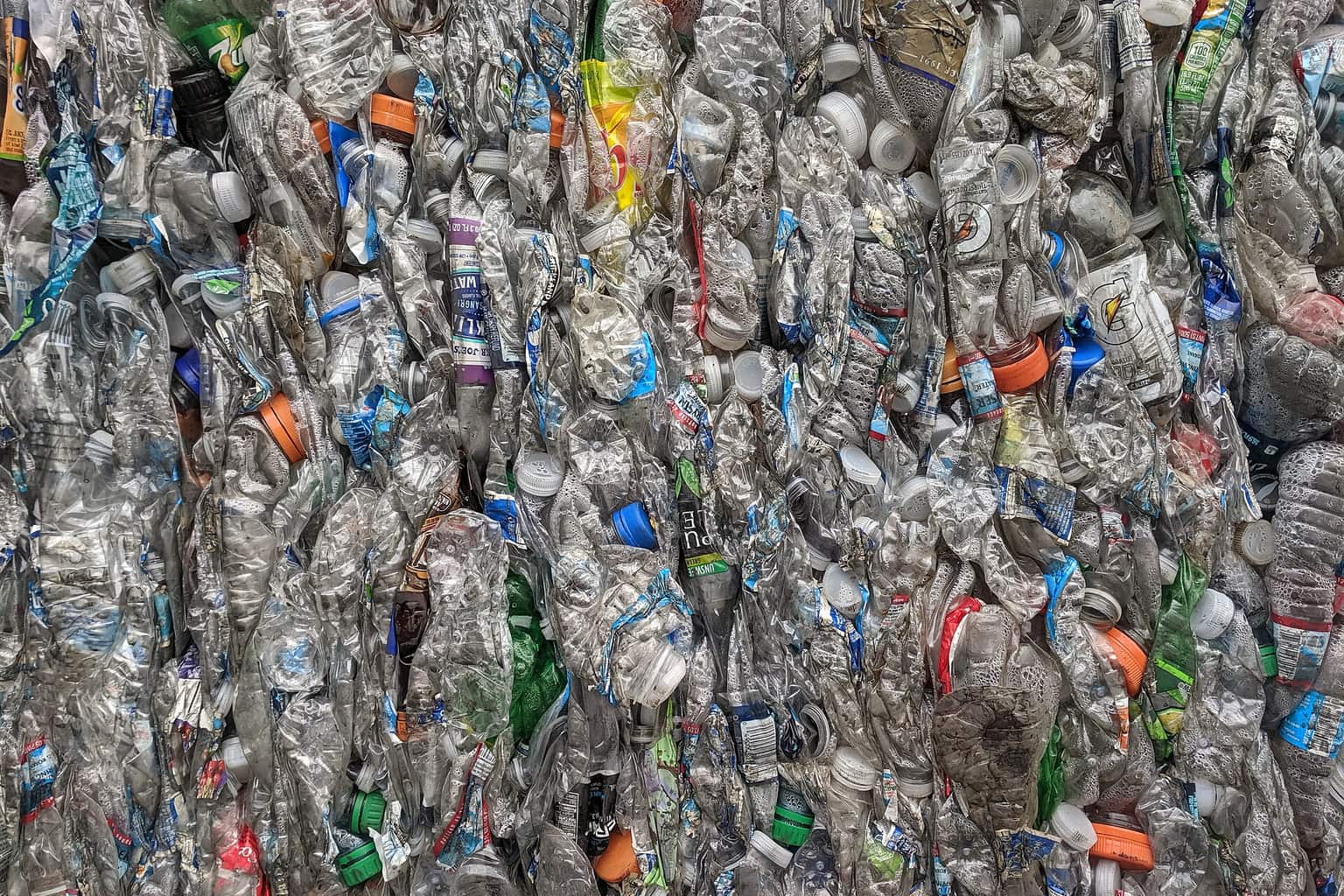
Researchers at King's College London and Rutgers University in New Jersey modified an enzyme and placed it in a liquid, where it sped up the breakdown of PET 9.2-fold in laboratory tests. Flakes cut from a used beverage bottle were also tested. The study, by Jake H. Nicholson and colleagues, was published in ACS Sustainable Chemistry & Engineering in 2026, and the flakes did not need to be heated or otherwise prepared first.
PET, the plastic in beverage bottles, food packaging and clothing, is one of the most widely used plastics. Much of it is recycled by melting and reshaping, but repeated processing affects its quality, and not all discarded plastic can be recycled that way. Enzymes offer another route: they cut the chemical links holding PET together, so the plastic can be rebuilt from its original building blocks. The problem is that many enzymes work slowly and stop working as the process goes on. The team chemically modified the surface of cutinase, a naturally occurring enzyme, to resist the heat and chemicals of the reaction. It then paired the enzyme with an ionic liquid, a specially selected liquid that loosens PET's tightly packed structure, exposing the chemical links to the enzyme and allowing the reaction to run at high temperature, 120 °C in the experiments, when PET breaks down more readily.
The gains show up over days. The modified system kept breaking PET down at a steady rate for seven days, while the unmodified enzyme in water lost much of its activity after the first day, lasting around 36 hours. The system also carried out 9.5 times as many chemical reactions over the experiments. The team's summary presents the result as tenfold and says it uses 10 times less enzyme; the measured gain in speed is 9.2-fold. From the process, the researchers isolated terephthalic acid, one of PET's main building blocks, as a pure powder, which could be used to make new plastic in place of fossil-based raw materials. They recovered 97.1% of the ionic liquid.
The limits are clear. The enzyme stopped working effectively after recovery, and no enzyme activity was detected once the liquid had been recovered, so the loop is not yet closed. The team did not test the engineered enzymes that break down certain forms of PET to a high degree in around two days. Its estimate that the same approach could cut near-complete breakdown to about five hours, while significantly reducing water use, is based on those earlier studies, not on this work. Industrial feasibility remains untested, and the energy requirements and the overall environmental and economic performance have yet to be assessed.
For manufacturers, the case rests on two levers the team names: enzymes that stay active for longer need less of them, and a liquid that can be recovered and reused could cut material costs. Dr. Alex Brogan, senior lecturer in chemistry at King's College London and the corresponding author, sees the work as a step away from an oil-based economy toward a circular, bio-based one. The team gives no timetable for an industrial application.
The next step is recovery. The researchers are working to improve enzyme recovery so that both the liquid and the enzyme can be reused, which would reduce the need for fresh materials. Brogan hopes the approach will be applied to a variety of enzymes and plastics.
Sources — read the originals(Paris time)
Pages consulted while writing
Read next
Comments
Loading the thread…
Sign in to leave a comment. Sign in