Laser repairs aircraft landing gear in one step, still
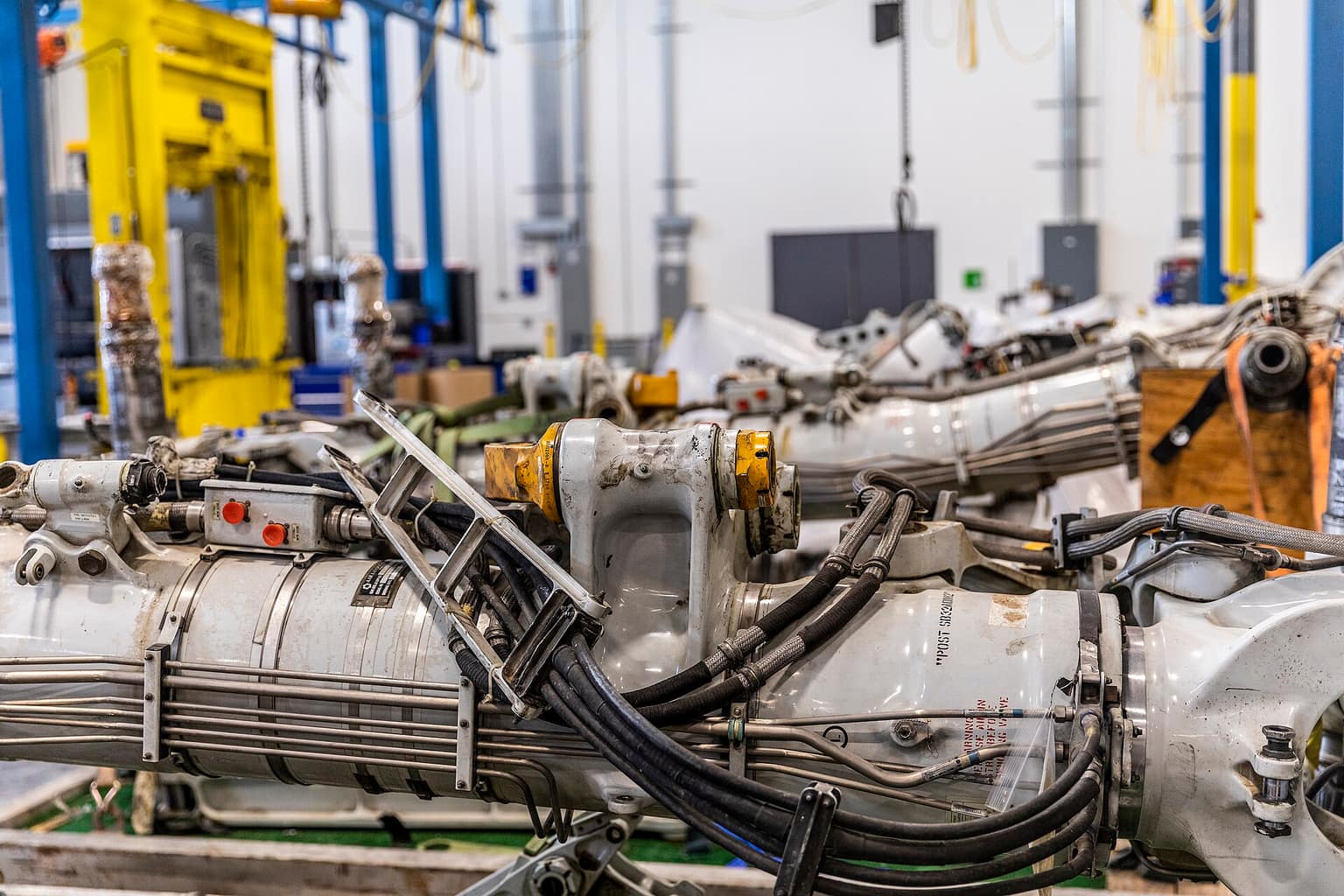
Every landing puts the landing gear through heavy stress. Wheel axles, shock-absorbing pistons and connecting pins take the force of touchdown, while bearings, bushings and seals wear down under constant friction. Ice, sand, de-icing agents and kerosene add corrosion on top. Until now, a part that had passed the limit of routine repair had one outcome: replacement.
Routine maintenance can scrape away minor damage, but only up to a certain point. Beyond it, the part is swapped out, which is expensive and keeps the aircraft out of service for longer. The traditional protective coating, chromium plating, has been pushed aside by safety and environmental concerns; restrictions on hexavalent chromium entered into force in September 2017. Welding was not an alternative either, because the excess heat changes the microstructure of aerospace steels and the geometry of the component.
The Fraunhofer Institute for Laser Technology ILT, in Germany, builds on EHLA, extreme high-speed laser material deposition. A laser melts metal powder and places it precisely where it is needed. The process is much faster than conventional methods and generates less heat, which makes it suitable for heat-sensitive, high-strength components. The new step comes right after: a hard roller presses the freshly deposited, still-warm layer. The team calls the single-step process Simultaneous Coating and Roller Burnishing, or SCaRB. Hardness, surface finish and residual stresses can be tuned by adjusting laser power, powder feed, the distance between laser and roller, the burnishing force and the roller radius. Hegenscheidt-MFD developed the burnishing tool, which Fraunhofer ILT integrated into the machine. The academic study on single-layer coatings of AISI 4340 steel describes SCaRB as an initial investigation into its fundamental principles, and notes that any repair outside the scope of the SAE International guide requires comprehensive validation.
Repairing a part is only half the job; the result must also be checked without damaging it. The team uses LAwave, short for laser-induced surface acoustic wave spectroscopy, which generates sound waves in the material and analyzes how they travel. It checks coating and subsurface quality. Fraunhofer IWS, another Fraunhofer institute, is involved on the inspection side. Liebherr-Aerospace, a partner in the LEGATO project, stresses what counts: 'whether the process is suitable for real landing gear components under load, including their materials, damage patterns and repair limits.'
For airlines and maintenance providers, the gain would be worn axles and pistons restored rather than ordered new, with the aircraft back in service sooner. That remains conditional. The durability of the repaired material is still being tested under realistic conditions, and the method must meet aerospace standards before commercial use. The next step is the one the researchers are running now: testing on real landing gear geometries under representative loads.
Sources — read the originals(Paris time)
Pages consulted while writing
Read next
Comments
Loading the thread…
Sign in to leave a comment. Sign in