Magnets placed beside glass fiber change its light
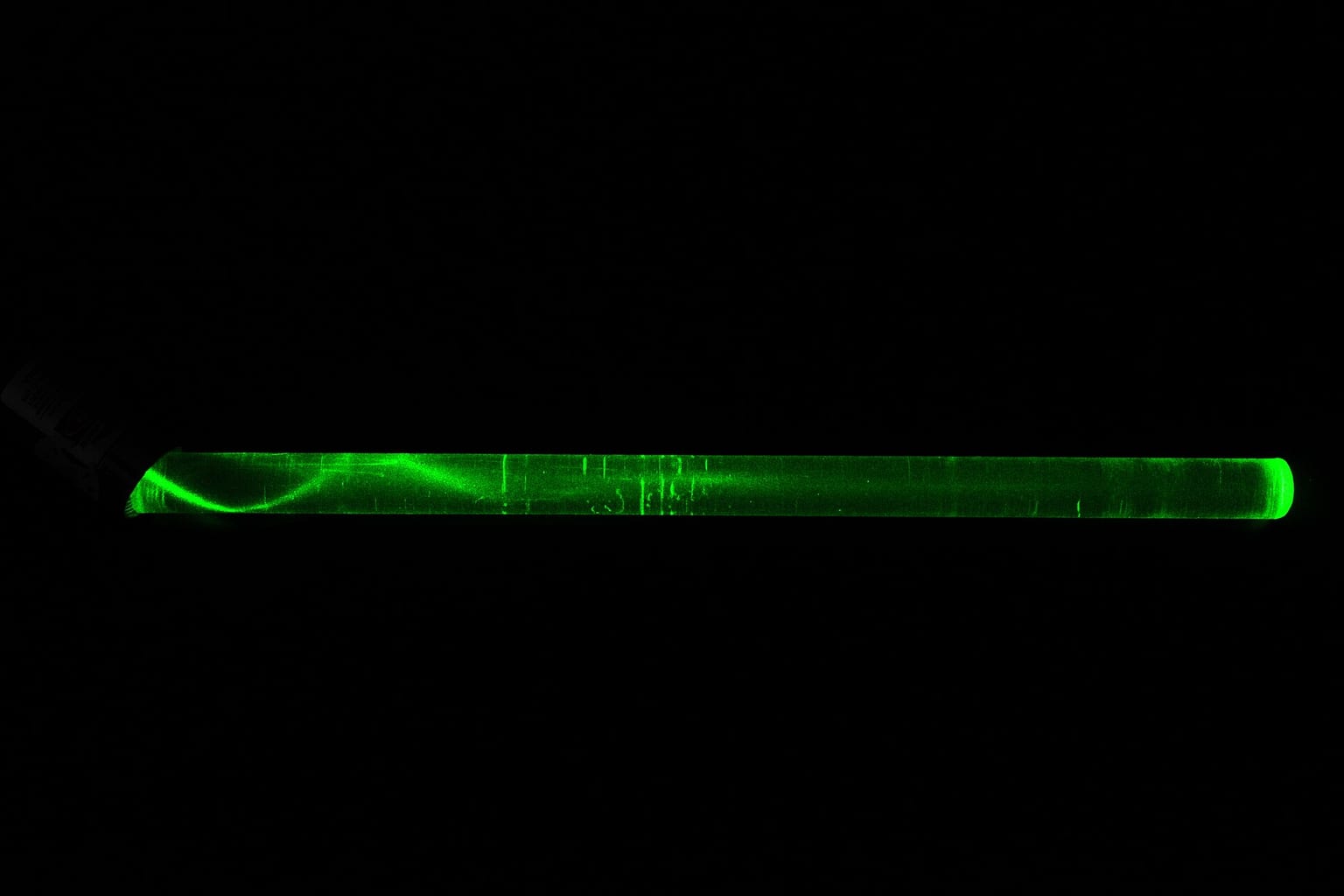
In a lab at the University of the Witwatersrand in Johannesburg, a camera watches the far end of a strand of glass no thicker than a hair. Beside the fiber, but not touching it, researchers move strong magnets. The fiber does not move. The speckle pattern at its end, a random-looking arrangement of bright and dark spots, does. MSc student Mohammed Raiyan Sharif and professor Mitchell Cox at the Wits Optical Communication Lab have shown that a magnetic field placed across a multimode fiber changes the light traveling inside it, an effect that had gone unnoticed in a technology that carries the light signals connecting people to the internet.
The reason it was missed lies in a shortcut. For more than 50 years, engineers have described light in optical fiber with the weak-guidance approximation, which ignores a tiny component of the light: the part that oscillates along the fiber rather than across it. The shortcut is an excellent one when the core and the surrounding glass have very similar refractive indices. Fiber sensors have long used the Faraday effect, first observed by Michael Faraday in a block of glass in 1845, to read magnetic fields. When the field points along the fiber, it twists the polarization of the light, and the twist reveals the strength of the current that produced the field. Such sensors must be wrapped around the conductor. A field pointing across the fiber was not expected to produce any Faraday effect at all.
Sharif and Cox went back to the equations. In step-index fibers, where the refractive index changes in a single sharp step at the edge of the core, the ignored component becomes significant near that edge. A sideways field transfers part of the light's across-fiber oscillation into this along-fiber component, which changes how light reflects off the core's edge. A sideways field also produces the Cotton-Mouton effect, a larger background that grows with the square of the field strength, so that doubling the field quadruples it. The transverse Faraday effect grows in direct proportion to the field, and the team isolated that signal by measuring the change in the speckle. The effect vanished without a strong index step, grew at steeper launch angles, appeared for only one polarization relative to the field, and varied with wavelength as the conventional Faraday effect does.
At 0.24 tesla, roughly the field close to a strong neodymium magnet, light polarized across the field changed the pattern clearly. Phys.org reports the pattern became about 84% similar to the original, while TechCentral gives 78% for the strongest result. The preprint, posted on arXiv, reports a complete null for parallel input and a clear change for perpendicular input. These figures come from the team's own experiments, and the reporting contains no independent replication.
For sensing, the consequence is practical. A transverse sensor could, in principle, sit beside a source of field, such as a fiber laid along an electrical cable in a trench, rather than being wound around the conductor. Cox, who calls the finding "an overlooked, useful interaction in such a familiar technology," points to how often such effects sit "right under our noses." Wits itself cautions that fields near most cables are far weaker than those used in the lab. How sensitive a practical sensor could be remains to be established, and no timeline for a prototype has been announced.
Sources — read the originals(Paris time)
Pages consulted while writing
Read next
Comments
Loading the thread…
Sign in to leave a comment. Sign in