MeerKAT measures hydrogen clumping in the cosmic web for the first time
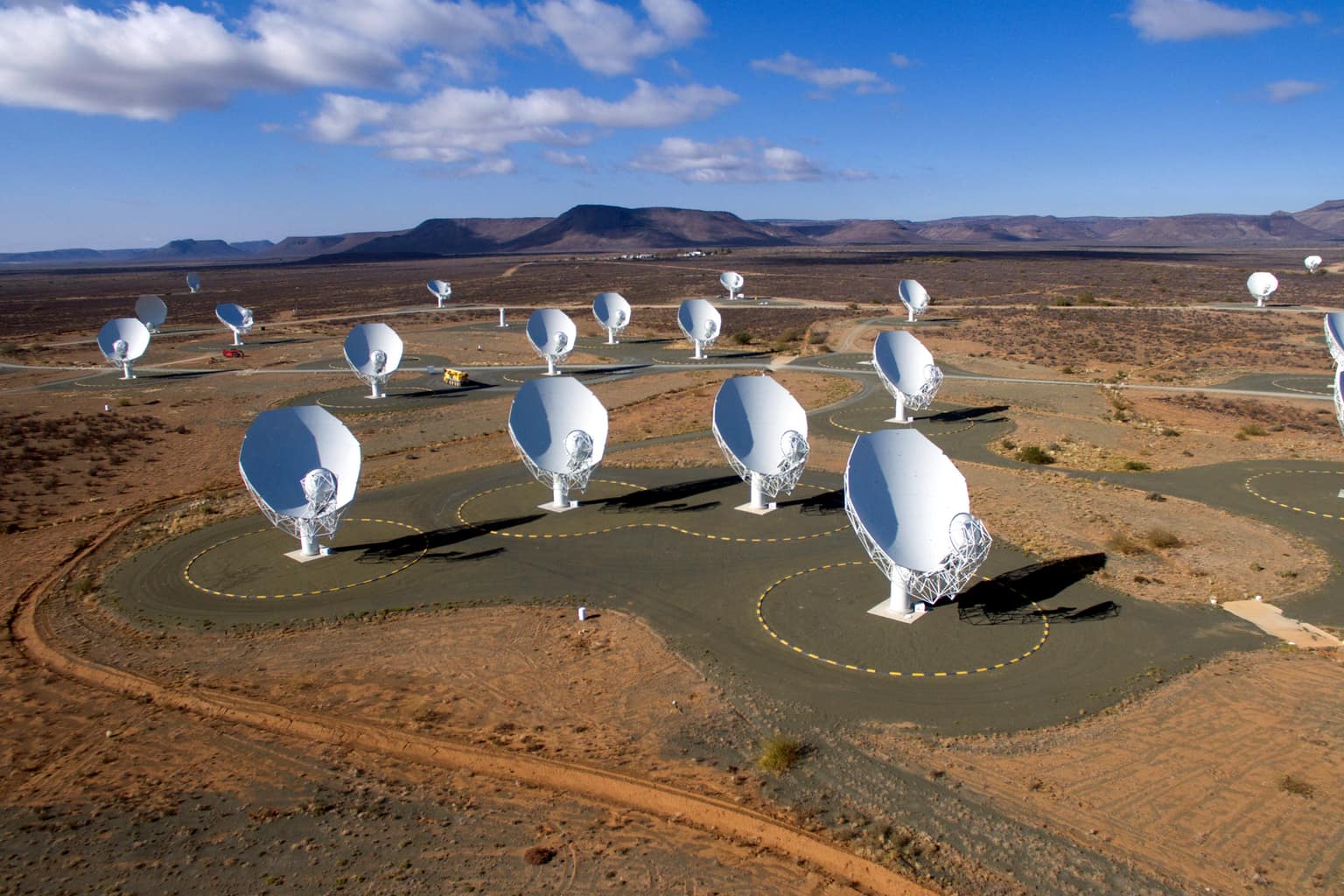
Imagine trying to catch a whispered conversation from the front row of a rock concert. That is roughly the task the MeerKLASS collaboration has just completed. After a decade of work, its researchers have reported the first measurement of the large-scale clustering of cosmic hydrogen, directly showing that neutral hydrogen "clumps" in the distant universe and that this distribution follows the structure of the cosmic web. The study is published in Monthly Notices of the Royal Astronomical Society.
The method is called 21-cm intensity mapping. Rather than picking out individual galaxies, it combines the hydrogen emission of many galaxies within large patches of sky, capturing the collective pattern even when the galaxies themselves cannot be told apart. The technique gives access to a 3D map of the universe. For this detection, the team analyzed MeerKAT observations across approximately 250 square degrees of sky, roughly the area of 1,250 full moons. The signal they picked up originated about 4.5 billion years ago, when the universe was a little older than 9 billion years.
The obstacle was the noise. Astrophysical "foreground" emission is about 10,000 times stronger than the hydrogen signal itself. The team got around it with a mode of observation that MeerKAT had never used before. Instead of combining its 64 dishes into a single interferometer, it operated each dish as an independent telescope, trading sharp angular resolution for very high survey speed. That produced many independent maps, from different dishes and observing times. Real cosmic structure appears in all of them, while instrumental effects that differ from one map to the next are suppressed. By combining these maps, the researchers confirmed a signal more than six times above the statistical noise.
The work involved researchers spread across seven countries and three continents, many of them early-career scientists who spent their whole careers on the project. Dr. Steven Cunnington, of the University of Portsmouth's Institute of Cosmology and Gravitation, led development of the analysis pipeline that made the detection possible. Professor Mário Santos, principal investigator of the MeerKLASS survey at the University of the Western Cape, credits the South African Radio Astronomy Observatory, which built and operates MeerKAT and helped resolve many of the survey's challenges.
What changes is the method more than the single number. According to Santos, the measurement is a milestone in establishing 21-cm intensity mapping as a new tool for cosmology, and cosmologists gain a way to chart the largest structures of the universe that they have pursued for decades. The result rests on one survey covering about 250 square degrees, so it is a first measurement rather than a finished map. It shows the technique works on real data.
Sources — read the originals(Paris time)
Read next
Comments
Loading the thread…
Sign in to leave a comment. Sign in