A Chilean telescope with 63,000 sensors starts mapping the cosmos
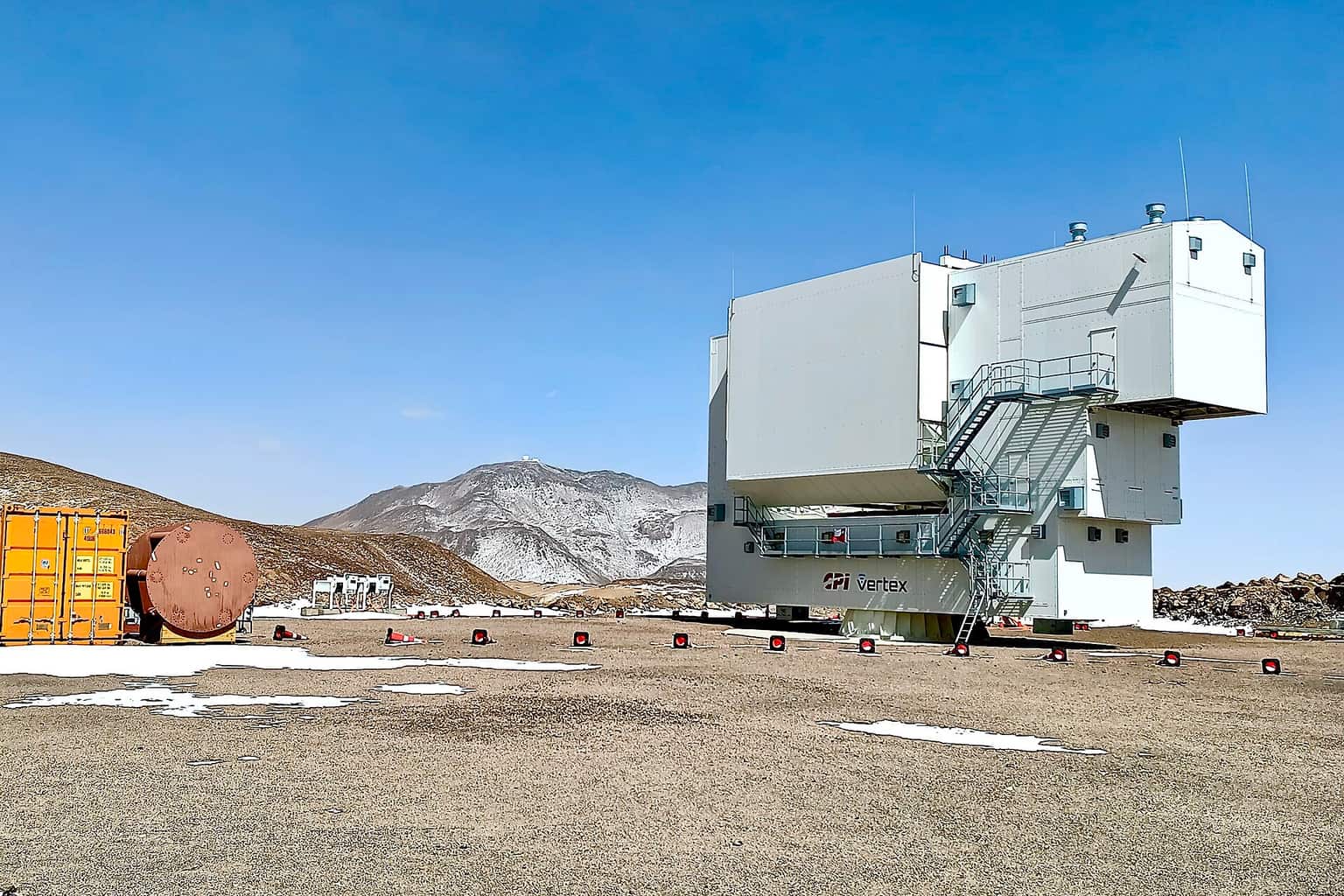
At 5,200 meters in Chile's Atacama Desert, four telescopes are now scanning the sky. The Simons Observatory (SO) is fully online and conducting science operations after two years of calibration, with extra telescopes and a new solar array to secure its power. At the heart of its largest instrument, the 6-meter Large Aperture Telescope (LAT), sits a camera with 63,000 superconducting sensors, detectors that work at extreme cold.
The observatory maps the cosmic microwave background (CMB), the oldest light in the universe, and the millimeter-wave sky in front of it. Those data are meant to reveal what interstellar dust is made of, how magnetic fields shape star-forming regions, and where stellar explosions and other transient events occur. Early data are already competitive with the best CMB maps, including those of the European Space Agency's Planck satellite.
The team deployed the first 31,000 detectors in February 2024 and the last 32,000 earlier this year, making it the largest cryogenic camera for cosmology built to date. The electronics that read out every sensor were designed by a group from Stanford's Kavli Institute for Particle Astrophysics and Cosmology (KIPAC) and SLAC National Accelerator Laboratory, led by Zeesh Ahmed. Doctoral student Toby Satterthwaite made seven trips to the site between 2023 and 2026, starting when the telescope was still an open frame with a wooden board over its aperture.
The LAT has already produced the most comprehensive images of the Milky Way in polarized microwave light. Polarized light reveals the structure of the galaxy's magnetic fields, which matter for understanding star formation. “Polarized light at these wavelengths helps reveal the invisible magnetic fields in the space between the stars,” said Susan Clark, assistant professor of physics. Her graduate student Kaitlyn Karpovich is mapping the emission from the galactic center, which appears in the observatory's first images.
For cosmologists, what changes is the ability to combine measurements. Emmanuel Schaan's group studies the kinematic Sunyaev-Zel'dovich (kSZ) effect, a tiny shift in CMB light as it scatters off moving gas, and plans to cross-check the maps against the Vera C. Rubin Observatory's LSST sky survey. Frank Qu developed the analysis pipeline for CMB lensing, the subtle bending of CMB light by intervening matter, and validated it on data from the Atacama Cosmology Telescope, the observatory's predecessor. “Within SO's first observations, we're already seeing the faint distortions that all the matter in the universe imprints on the oldest light we have,” Qu said. The telescopes are running now, and the analysis is only starting, so the next step is to turn these distortions into a map of the universe's dark matter.
Sources — read the originals(Paris time)
Read next
Comments
Loading the thread…
Sign in to leave a comment. Sign in